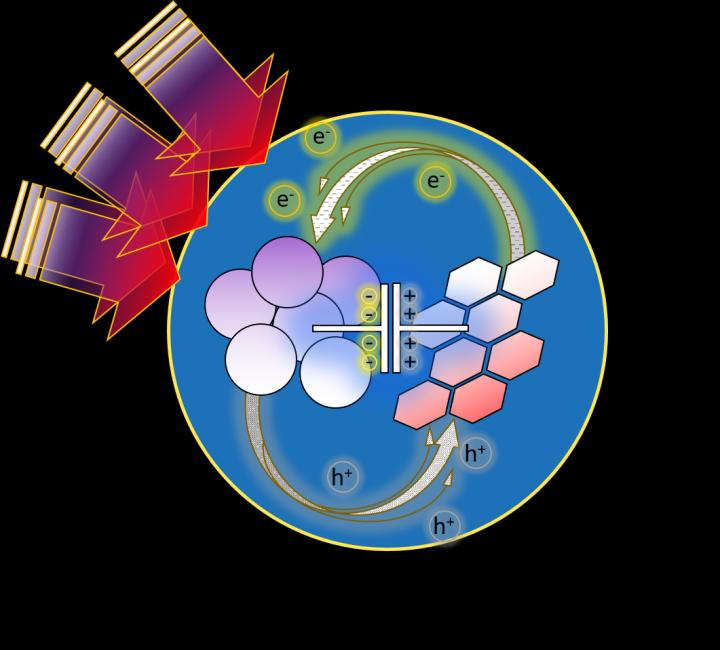
The LIGHT-CAP project has received a 3.18 million euros funding from the European Union. Its main goal is developing innovative approaches for the solar energy harvesting, conversion and storage; it is led by the Istituto Italiano di Tecnologia
Genova (Italy), 25th June, 2021 – New technologies for the European carbon-neutrality program will be developed by the LIGHT-CAP project, a 4-year research initiative whose main objective is to implement a radical change related to the current tools of solar energy conversion and storage technologies. Researchers will apply cutting-edge nanotechnology in order to build systems capable of absorbing sunlight, converting it and concomitantly storing the associated energy (electric charges) in a sustainable way and at low-costs of production. LIGHT-CAP has won funding of 3.18M euros from the European Union and its consortium, coordinated by IIT-Istituto Italiano di Tecnologia (Italian Institute of Technology) includes EU and extra-EU partners with academical and industrial backgrounds that will actively cooperate in order to reach the project’s goals.
The project’s ground-breaking ideas have been presented under the Horizon2020 European call for “Breakthrough zero-emissions energy storage and conversion technologies for carbon-neutrality” in the context of the program “FET Proactive: Emerging Paradigms and Communities”.
Nowadays, environmental sustainability is a central aspect of technological innovation and one of the most influential topics driving future research directions. The European Union is poised to reach the ambitious objective of climate neutrality by 2050. To reach it, it is fundamental to cope with judicious energy management, which should translate into energy production from renewable sources and efficient and effective energy consumption. Solar power is the most promising clean energy source but equally relevant is its storage in order to respond properly to the intermittent nature of sunlight and the fluctuations and diversification of the energy demand.
In this context, the LIGHT-CAP project seeks to change drastically the state-of-the-art of solar energy conversion and related accumulation, which today is still based mostly on expensive silicon solar panels and cumbersome batteries kept separated in two distinct devices. LIGHT-CAP will introduce new nanotechnology-enabled architectures combining the two functionalities in a single versatile device.
Crucial for this innovative proposal is the resorting to eco-friendly and earth-abundant materials, thus not suffering from future possible risks of supply. Specifically, the LIGHT-CAP approach pivots on a combination of materials with dimensions reduced up to the nanoscale (i.e. nanoparticles), based con carbon (such as graphene) together with compounds made of different metals (Indium, Zinc, Tin) with oxygen, usually employed for the electronic components in devices of daily use (like smartphones, displays, LEDs) thanks to their strong electrical conductivity properties. They even offer additionally potential improvement in the storage capacity after light conversion, thanks to multiple and reversible charge transfer processes that they can sustain. These species demonstrated a competitive storage capacity if compared to the current technologies in use for batteries systems and, in addition, they have exhibited long-term stability and cyclability.
The project aims at providing more efficient solar energy harvesting, conversion, storage, and controlled on-demand release for the fabrication of both portable and static technologies, potentially producing a considerable impact in the field of portable and mobile electronics that will drive the paradigm change towards a future sustainable and zero-emission energy landscape in Europe.
The LIGHT-CAP consortium includes: Istituto Italiano di Tecnologia (Italy), Ecole Polytechnique Federale de Lausanne (Switzerland), Technische Universitaet Dresden (Germany), Justus-Liebig-Universitaet Giessen (Germany), Politecnico di Milano (Italy) and Fundacion IMDEA Energia (Spain). The project also benefits of an extra-EU collaboration with a research group at the Okinawa Institute of Science and Technology in Japan, providing key expertise in nanomaterials synthesis and application. Further support comes from the SME Be-Dimensional, active in 2D materials production and implementation in energy devices and from Thales Research and Technology, a big industrial reality active in many different fields.
###
Media Contact
Valeria delle Cave
[email protected]