• HOME
  • NEWS
  • EXPLORE
    • CAREER
      • Companies
      • Jobs
    • EVENTS
    • iGEM
      • News
      • Team
    • PHOTOS
    • VIDEO
    • WIKI
  • BLOG
  • COMMUNITY
    • FACEBOOK
    • INSTAGRAM
    • TWITTER
Tuesday, July 7, 2026
BIOENGINEER.ORG
No Result
View All Result
  • Login
  • HOME
  • NEWS
  • EXPLORE
    • CAREER
      • Companies
      • Jobs
        • Lecturer
        • PhD Studentship
        • Postdoc
        • Research Assistant
    • EVENTS
    • iGEM
      • News
      • Team
    • PHOTOS
    • VIDEO
    • WIKI
  • BLOG
  • COMMUNITY
    • FACEBOOK
    • INSTAGRAM
    • TWITTER
  • HOME
  • NEWS
  • EXPLORE
    • CAREER
      • Companies
      • Jobs
        • Lecturer
        • PhD Studentship
        • Postdoc
        • Research Assistant
    • EVENTS
    • iGEM
      • News
      • Team
    • PHOTOS
    • VIDEO
    • WIKI
  • BLOG
  • COMMUNITY
    • FACEBOOK
    • INSTAGRAM
    • TWITTER
No Result
View All Result
Bioengineer.org
No Result
View All Result
Home NEWS Science News Biology

The importance of light for grassland plant diversity

Bioengineer by Bioengineer
November 3, 2022
in Biology
Reading Time: 2 mins read
0
Experiment
Share on FacebookShare on TwitterShare on LinkedinShare on RedditShare on Telegram

The team of researchers led by Prof. Dr. Anu Eskelinen from the University of Oulu (Finland) used the Global Change Experimental Facility (GCEF) at the UFZ research station in Bad Lauchstädt for their experiments. Scientists from UFZ, iDiv and various universities use the GCEF platform to study the influence of different climate models and land use intensities on plant community structure – specifically food webs and interactions between species.
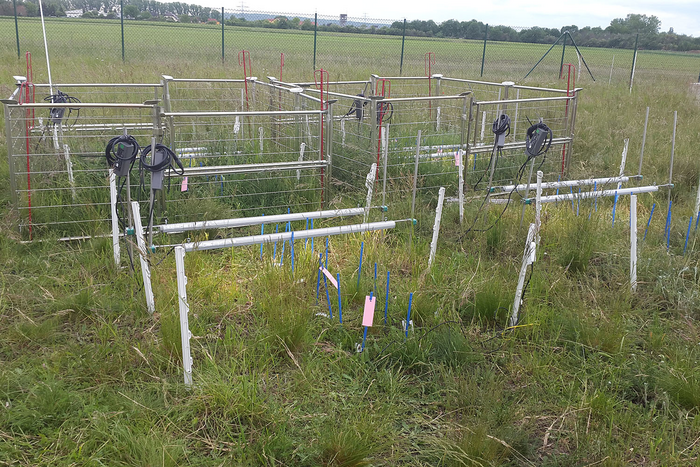
Experiment

Credit: Anu Eskelinen / University of Oulu

The team of researchers led by Prof. Dr. Anu Eskelinen from the University of Oulu (Finland) used the Global Change Experimental Facility (GCEF) at the UFZ research station in Bad Lauchstädt for their experiments. Scientists from UFZ, iDiv and various universities use the GCEF platform to study the influence of different climate models and land use intensities on plant community structure – specifically food webs and interactions between species.

Anu Eskelinen, who spent several years at the UFZ and iDiv as a visiting scientist, used a new experimental approach: the team directly illuminated the low-growing plants in the grassland with LED lamps, thus increasing the amount of light. In addition to this treatment, fertilisers were applied on some plots and grazing by sheep was used on others.

The experiment showed a sharp decline in species richness and biodiversity as a result of artificial fertilisation if the areas were not grazed at the same time. When the researchers added LED lamps, the loss of species richness was mitigated. Later, the researchers excluded sheep from half of the plots, which caused species richness and diversity do decline. At the same time, the total vegetation cover increased without grazing, which, in turn, reduced the light available to plants. Importantly, adding light to the understorey plants mitigated this loss of diversity. “These results suggest that herbivory is a dominant factor controlling competition for light and plant diversity,” says first author Anu Eskelinen.

The research team believes that the results from the field trials should be taken into account for future grassland management and conservation policies. “Our results highlight the importance of conserving native herbivores and using sustainable grazing as a management measure,” Anu Eskelinen further emphasises.

Prof. Dr Stan Harpole, co-author and head of the department of Physiological Diversity at UFZ and iDiv, adds: “This study highlights the value of carefully designed manipulative field experiments, which we need so we can strongly test the causes of diversity loss. We could only advance our understanding and test the theory in more realistic conditions because of the excellent infrastructure of the UFZ’s Global Change Experimental Facility and the support provided at the Bad Lauchstädt Research Station, and the cooperation with iDiv.”


Journal

Nature

DOI

10.1038/s41586-022-05383-9

Method of Research

Experimental study

Subject of Research

Not applicable

Article Title

Light competition drives herbivore and nutrient effects on plant diversity.

Article Publication Date

2-Nov-2022

Share12Tweet8Share2ShareShareShare2

Related Posts

Here are a few rewritten headlines for a science magazine post, each with a slightly different tone: Intriguing & poetic: How do organs sculpt themselves? Sea stars hold the secret Direct & research-focused: Sea stars reveal the hidden rules of organ formation Metaphorical & inviting: Tiny architects beneath the waves: What sea stars teach us about building organs Short & punchy: Star-shaped clues to how our organs take shape Question-led: Could a sea star show us how organs form? Elegant & feature-style: The body’s blueprint, glimpsed in a sea star’s arm

July 6, 2026
Bacteria evolve faster with unconventional gene copies — Biology

Bacteria evolve faster with unconventional gene copies

July 6, 2026

Neighbours rewire soil feedback via root microbiome shifts

July 6, 2026

Evolution-Inspired Biosensors Revolutionize Lipid Tracking in Real Time

July 2, 2026

POPULAR NEWS

  • Detection of EDCs in Breast Milk and Infant Urine Up to Six Months Highlights Early Exposure Risks

    77 shares
    Share 31 Tweet 19
  • New Drug Candidate Developed at McMaster Shows Potential for Treating Brain Cancer

    58 shares
    Share 23 Tweet 15
  • Saying Goodbye to PGY-6: Pediatric Fellowship Realities

    103 shares
    Share 41 Tweet 26
  • KTU Researchers Explore Ultrasound’s Role in Enhancing Blood Flow Beyond Diagnostics

    53 shares
    Share 21 Tweet 13

About

We bring you the latest biotechnology news from best research centers and universities around the world. Check our website.

Follow us

Recent News

Flame retardant BDE-209 targets molecularly linked to ulcerative colitis

Ultra-high frequency particle impacts mimic rockbursts to shatter hard rock

Kidney transplant outcomes in older adults studied by German researchers

Subscribe to Blog via Email

Enter your email address to subscribe to this blog and receive notifications of new posts by email.

Join 83 other subscribers
  • Contact Us

Bioengineer.org © Copyright 2023 All Rights Reserved.

Welcome Back!

Login to your account below

Forgotten Password?

Retrieve your password

Please enter your username or email address to reset your password.

Log In
No Result
View All Result
  • Homepages
    • Home Page 1
    • Home Page 2
  • News
  • National
  • Business
  • Health
  • Lifestyle
  • Science

Bioengineer.org © Copyright 2023 All Rights Reserved.