

• HOME
  • NEWS
  • EXPLORE
    • CAREER
      • Companies
      • Jobs
    • EVENTS
    • iGEM
      • News
      • Team
    • PHOTOS
    • VIDEO
    • WIKI
  • BLOG
  • COMMUNITY
    • FACEBOOK
    • INSTAGRAM
    • TWITTER
Monday, July 6, 2026
BIOENGINEER.ORG
No Result
View All Result
  • Login
  • HOME
  • NEWS
  • EXPLORE
    • CAREER
      • Companies
      • Jobs
        • Lecturer
        • PhD Studentship
        • Postdoc
        • Research Assistant
    • EVENTS
    • iGEM
      • News
      • Team
    • PHOTOS
    • VIDEO
    • WIKI
  • BLOG
  • COMMUNITY
    • FACEBOOK
    • INSTAGRAM
    • TWITTER
  • HOME
  • NEWS
  • EXPLORE
    • CAREER
      • Companies
      • Jobs
        • Lecturer
        • PhD Studentship
        • Postdoc
        • Research Assistant
    • EVENTS
    • iGEM
      • News
      • Team
    • PHOTOS
    • VIDEO
    • WIKI
  • BLOG
  • COMMUNITY
    • FACEBOOK
    • INSTAGRAM
    • TWITTER
No Result
View All Result
Bioengineer.org
No Result
View All Result
Home NEWS Science News Biology

The future of replacement organs is (quite possibly) here: robust human intestinal organoids created in a lab

Bioengineer by Bioengineer
December 5, 2022
in Biology
Reading Time: 3 mins read
0
Growing suspension organoids
Share on FacebookShare on TwitterShare on LinkedinShare on RedditShare on Telegram

Researchers from Tokyo Medical and Dental University (TMDU) find that spheroids grown in suspension mature into human intestinal organoids when transferred to a bioreactor and differentiate into complex intestinal tissue upon transplantation
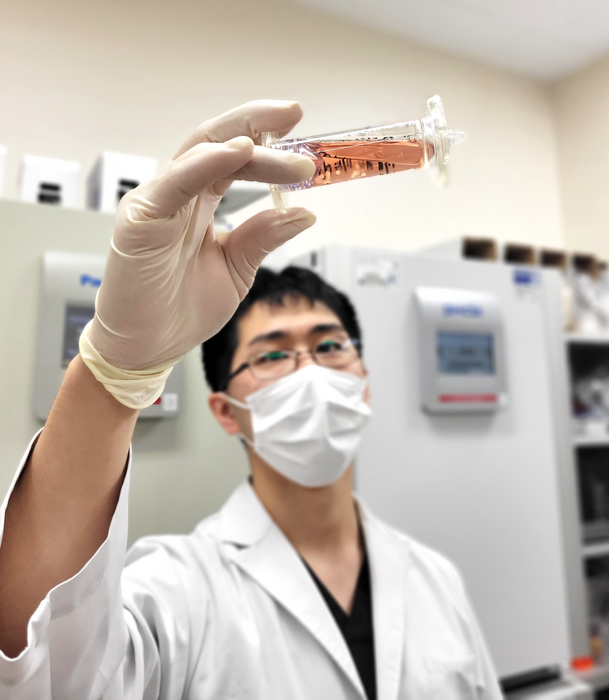
Growing suspension organoids

Credit: Department of Gastroenterology and Hepatology, TMDU

Researchers from Tokyo Medical and Dental University (TMDU) find that spheroids grown in suspension mature into human intestinal organoids when transferred to a bioreactor and differentiate into complex intestinal tissue upon transplantation


Tokyo, Japan – Growing human body parts in the lab is a common trope of horror movies and sci-fi books. But growing miniature organ-like tissues in the lab is already within our reach. Researchers from Japan have developed a new approach that enables intestinal mini-organs to be grown more easily and efficiently in the lab. This holds immense promise for regenerative medicine.


In a study published in November in Cell Reports Methods, researchers from Tokyo Medical and Dental University (TMDU) reveal that applying a few specialized lab techniques yields intestine-like tissues of predictable size and composition.


Organoids are organ-like balls of cells that are grown in the lab from spheroids (even smaller balls) of human cells and mimic the properties of the organ from which the “seed” cell was taken. Organoids are used for studying organ function in a lab setting and are also promising tools in the field of regenerative medicine.


“There are established methods for growing human intestinal organoids (HIOs) from induced pluripotent stem cells (iPSCs),” states Junichi Takahashi, first author of the study. “However, these techniques are challenging to perform. They result in spheroids of varying sizes and are limited by the growth conditions, which can result in deformed and unhealthy spheroids over time.”


To develop a more robust and consistent way to generate HIOs, the researchers explored the use of cell culture plates made with an ultra-low attachment polymer to encourage the cells to detach and grow in suspension. They also tested the effects of growing the resulting spheroids in a bioreactor, a specialized incubator that keeps the growth medium constantly flowing to improve the health of the cells.


“Using our technique, we were able to grow spheroids of a predictable, consistent size that could be modified by modulating the number of cells seeded into the plates,” says Tomohiro Mizutani, corresponding author of the study. “Furthermore, transferring the spheroids to a bioreactor allowed them to grow even larger, into healthy HIOs.”


These organoids were surrounded by mesenchyme, which is a type of tissue found between organs in the human body. Importantly, when the organoids were transplanted into mice, they continued to grow and differentiate, developing a complex tissue architecture reflecting that of mature intestine. “Our findings show that intestinal tissue can be generated from iPSC-derived HIOs by inducing spheroids in suspension and maturing them in a bioreactor,” says Takahashi.


Given that more complex intestinal tissues have been generated using traditional techniques, it is likely that this new approach could be easily adapted to create more complex organoids, such as intestine-like tissue containing blood vessels or nerves. These lab-grown tissues will be invaluable for regenerative medicine applications in the future.


###


The article, “Suspension Culture in a Rotating Bioreactor for Efficient Generation of Human Intestinal Organoids,” was published in Cell Reports Methods at DOI: 10.1016/j.crmeth.2022.100337.


Journal

Cell Reports Methods

DOI

10.1016/j.crmeth.2022.100337

Article Title

Suspension culture in a rotating bioreactor for efficient generation of human intestinal organoids

Share13Tweet8Share2ShareShareShare2

Related Posts

Here are a few rewritten headlines for a science magazine post, each with a slightly different tone: Intriguing & poetic: How do organs sculpt themselves? Sea stars hold the secret Direct & research-focused: Sea stars reveal the hidden rules of organ formation Metaphorical & inviting: Tiny architects beneath the waves: What sea stars teach us about building organs Short & punchy: Star-shaped clues to how our organs take shape Question-led: Could a sea star show us how organs form? Elegant & feature-style: The body’s blueprint, glimpsed in a sea star’s arm

July 6, 2026
Bacteria evolve faster with unconventional gene copies — Biology

Bacteria evolve faster with unconventional gene copies

July 6, 2026

Neighbours rewire soil feedback via root microbiome shifts

July 6, 2026

Evolution-Inspired Biosensors Revolutionize Lipid Tracking in Real Time

July 2, 2026

POPULAR NEWS

  • Detection of EDCs in Breast Milk and Infant Urine Up to Six Months Highlights Early Exposure Risks

    77 shares
    Share 31 Tweet 19
  • New Drug Candidate Developed at McMaster Shows Potential for Treating Brain Cancer

    58 shares
    Share 23 Tweet 15
  • Saying Goodbye to PGY-6: Pediatric Fellowship Realities

    103 shares
    Share 41 Tweet 26
  • KTU Researchers Explore Ultrasound’s Role in Enhancing Blood Flow Beyond Diagnostics

    53 shares
    Share 21 Tweet 13

About

We bring you the latest biotechnology news from best research centers and universities around the world. Check our website.

Follow us

Recent News

Flame retardant BDE-209 targets molecularly linked to ulcerative colitis

Ultra-high frequency particle impacts mimic rockbursts to shatter hard rock

Kidney transplant outcomes in older adults studied by German researchers

Subscribe to Blog via Email

Enter your email address to subscribe to this blog and receive notifications of new posts by email.

Join 83 other subscribers
  • Contact Us

Bioengineer.org © Copyright 2023 All Rights Reserved.

Welcome Back!

Login to your account below

Forgotten Password?

Retrieve your password

Please enter your username or email address to reset your password.

Log In
No Result
View All Result
  • Homepages
    • Home Page 1
    • Home Page 2
  • News
  • National
  • Business
  • Health
  • Lifestyle
  • Science

Bioengineer.org © Copyright 2023 All Rights Reserved.
