• HOME
  • NEWS
  • EXPLORE
    • CAREER
      • Companies
      • Jobs
    • EVENTS
    • iGEM
      • News
      • Team
    • PHOTOS
    • VIDEO
    • WIKI
  • BLOG
  • COMMUNITY
    • FACEBOOK
    • INSTAGRAM
    • TWITTER
Saturday, July 18, 2026
BIOENGINEER.ORG
No Result
View All Result
  • Login
  • HOME
  • NEWS
  • EXPLORE
    • CAREER
      • Companies
      • Jobs
        • Lecturer
        • PhD Studentship
        • Postdoc
        • Research Assistant
    • EVENTS
    • iGEM
      • News
      • Team
    • PHOTOS
    • VIDEO
    • WIKI
  • BLOG
  • COMMUNITY
    • FACEBOOK
    • INSTAGRAM
    • TWITTER
  • HOME
  • NEWS
  • EXPLORE
    • CAREER
      • Companies
      • Jobs
        • Lecturer
        • PhD Studentship
        • Postdoc
        • Research Assistant
    • EVENTS
    • iGEM
      • News
      • Team
    • PHOTOS
    • VIDEO
    • WIKI
  • BLOG
  • COMMUNITY
    • FACEBOOK
    • INSTAGRAM
    • TWITTER
No Result
View All Result
Bioengineer.org
No Result
View All Result
Home NEWS Science News Biology

The future of biofuels in the dark

Bioengineer by Bioengineer
September 15, 2020
in Biology
Reading Time: 2 mins read
0
IMAGE
Share on FacebookShare on TwitterShare on LinkedinShare on RedditShare on Telegram

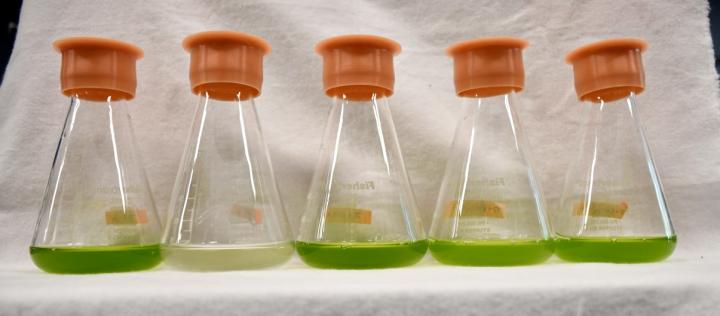
Fellowship funds experiments in growing algae without sunlight
IMAGE

Credit: Elizabeth Hann/UCR

Algae could compete with petroleum as the fuel of the future if only the process of growing it was more efficient. Thanks to a fellowship from the Link Foundation, it soon could be.

Elizabeth Hann, a doctoral student in plant biology at UC Riverside, is using the two-year, $60,000 fellowship to test whether she can grow algae for biofuels completely in the dark using solar-generated electricity.

The need for energy is projected to increase, and algae could help meet that demand. It can be converted into lower-emission fuel without competing with food or fresh water supplies, unlike other biofuel sources such as corn or sugar cane. Algal biofuels can also be used directly in existing engines. And unlike petroleum, algae is a renewable resource.

Many scientists are also working to develop more cost-effective ways of growing algae. “What makes this different from other algae biofuel projects is that we’re specifically looking at growing algae without the limitations of photosynthesis,” Hann said. “We’re growing algae in the dark.”

Though algae lack roots, stems, and leaves, like land plants they use photosynthesis, which is the process of using sunlight to convert carbon dioxide and water into food for itself. This process converts sunlight into usable energy at roughly 2% efficiency, whereas solar panels can do it at 25% efficiency or higher, Hann explained.

In other words, with photosynthesis, most of the energy in sunlight gets converted into heat and doesn’t contribute to growth of the algae. With solar panels, much more energy is captured but it is not in a form that algae can use directly. This is where Hann’s research comes in.

Currently, algae for biofuels is typically farmed in ponds that use the sun to cause growth.

“Our work takes away the need for the pond and access to sunlight,” Hann said. “We can potentially grow the algae in a confined space, just using electricity from solar panels.”

Hann is working with UC Riverside Chemical & Environmental Engineering professor Robert Jinkerson to grow the algae on campus, and with collaborators at the University of Delaware.

The Link Foundation funds projects like these to foster innovation in energy as well as aeronautics and ocean engineering. The foundation was created in honor of Edwin A. Link, who created autonomous underwater vehicles.

Though the initial setup of solar panels may be more expensive than just setting up ponds, this startup cost may eventually pay for itself due to the boost in productivity, according to Hann.

“We will likely be able to produce more algae, and thus more biofuel per square meter, using our process versus biological photosynthesis,” she said.

###

Media Contact
Jules Bernstein
[email protected]

Original Source

https://news.ucr.edu/articles/2020/09/15/fellowship-funds-experiments-growing-algae-without-sunlight

Tags: BiochemistryBiologyBiotechnologyChemistry/Physics/Materials SciencesEnergy/Fuel (non-petroleum)Industrial Engineering/ChemistryMicrobiologyPollution/Remediation
Share12Tweet8Share2ShareShareShare2

Related Posts

Asteroid impact may have reshaped tuna evolution alongside dinosaur extinction

Asteroid impact may have reshaped tuna evolution alongside dinosaur extinction

July 18, 2026
Wild snapdragons subtly change color to attract bees

Wild snapdragons subtly change color to attract bees

July 17, 2026

Root developmental zonation persists despite changes in cell wall pH

July 17, 2026

Genes rapidly reactivate expression following thermal stress exposure

July 17, 2026
Please login to join discussion

POPULAR NEWS

  • A painless adhesive

    49 shares
    Share 20 Tweet 12
  • Groundbreaking Discovery: New Shark Species Identified for the First Time

    34 shares
    Share 14 Tweet 9
  • 研究人员开发认知工具包,实现阿尔茨海默症早期检测

    50 shares
    Share 20 Tweet 13
  • A varied menu

    51 shares
    Share 22 Tweet 12

About

We bring you the latest biotechnology news from best research centers and universities around the world. Check our website.

Follow us

Recent News

AI Identifies Environmental Chemicals with Highest Potential Health Risks

Texas Tech Veterinary Students Publish Research in International Journals

Biochar from rice straw may cut heavy metal contamination risks in rice

Subscribe to Blog via Email

Enter your email address to subscribe to this blog and receive notifications of new posts by email.

Join 85 other subscribers
  • Contact Us

Bioengineer.org © Copyright 2023 All Rights Reserved.

Welcome Back!

Login to your account below

Forgotten Password?

Retrieve your password

Please enter your username or email address to reset your password.

Log In
No Result
View All Result
  • Homepages
    • Home Page 1
    • Home Page 2
  • News
  • National
  • Business
  • Health
  • Lifestyle
  • Science

Bioengineer.org © Copyright 2023 All Rights Reserved.