• HOME
  • NEWS
  • EXPLORE
    • CAREER
      • Companies
      • Jobs
    • EVENTS
    • iGEM
      • News
      • Team
    • PHOTOS
    • VIDEO
    • WIKI
  • BLOG
  • COMMUNITY
    • FACEBOOK
    • INSTAGRAM
    • TWITTER
Saturday, September 26, 2026
BIOENGINEER.ORG
No Result
View All Result
  • Login
  • HOME
  • NEWS
  • EXPLORE
    • CAREER
      • Companies
      • Jobs
        • Lecturer
        • PhD Studentship
        • Postdoc
        • Research Assistant
    • EVENTS
    • iGEM
      • News
      • Team
    • PHOTOS
    • VIDEO
    • WIKI
  • BLOG
  • COMMUNITY
    • FACEBOOK
    • INSTAGRAM
    • TWITTER
  • HOME
  • NEWS
  • EXPLORE
    • CAREER
      • Companies
      • Jobs
        • Lecturer
        • PhD Studentship
        • Postdoc
        • Research Assistant
    • EVENTS
    • iGEM
      • News
      • Team
    • PHOTOS
    • VIDEO
    • WIKI
  • BLOG
  • COMMUNITY
    • FACEBOOK
    • INSTAGRAM
    • TWITTER
No Result
View All Result
Bioengineer.org
No Result
View All Result
Home NEWS Science News Chemistry

The discovery of new compounds for acting on the circadian clock

Bioengineer by Bioengineer
April 1, 2020
in Chemistry
Reading Time: 2 mins read
0
IMAGE
Share on FacebookShare on TwitterShare on LinkedinShare on RedditShare on Telegram

New small molecules promote the differentiation of brown adipocytes
IMAGE

Credit: Issey Takahashi | ITBM, Nagoya University

The circadian clock controls a variety of biological phenomena that occur during the course of the day, such as sleeping and waking. Perturbation of the circadian clock has been associated with many diseases such as sleep disorders, metabolic syndrome, and cancer. The development of small-molecule compounds to regulate specific components of the circadian clock facilitates the elucidation of the molecular basis of clock function, and provides a platform for the therapeutic treatment of clock-related diseases.

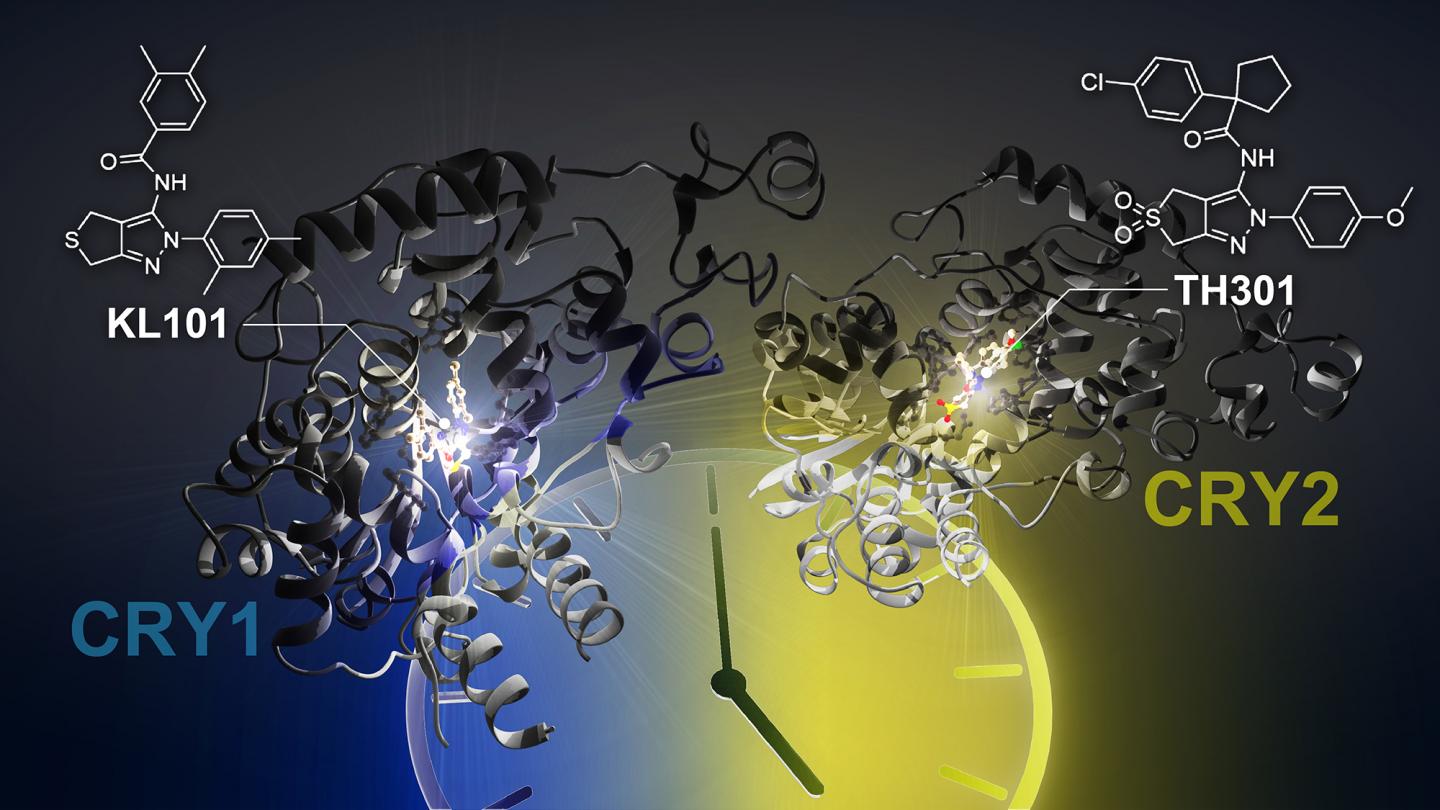
In this study, the research team discovered the small molecules, KL101 and TH301, that lengthen the period of the circadian clock. They found that KL101 and TH301 are the first compounds that selectively target clock components CRY1 and CRY2, respectively. By utilizing X-ray crystallography to determine the structures, they revealed how KL101 and TH301 bind to CRY1 and CRY2.

However, additional experiments were required to determine the mechanism of CRY1 and CRY2 selectivity. It was found that the disordered tail regions of CRY proteins impart compound selectivity. Additionally, in collaboration with Project Associate Professor Megumi Hatori and Postdoctoral Fellow You Lee Son of the Keio University School of Medicine, they found that CRY1 and CRY2 are required for the differentiation of brown adipocytes, and both KL101 and TH301 are expected to provide a promising foundation for the therapeutic treatment of obesity.

###

Media Contact
Dr. Tsuyoshi Hirota
[email protected]

Original Source

https://www.nature.com/articles/s41589-020-0505-1

Related Journal Article

http://dx.doi.org/10.1038/s41589-020-0505-1

Tags: BiochemistryBiologyCell BiologyCircadian RhythmDiet/Body WeightGeneticsMolecular Biology
Share12Tweet8Share2ShareShareShare2

Related Posts

Pulsed Nickel Coating on Titanium Delivers a Durable, pH-Universal Hydrogen Catalyst

Pulsed Nickel Coating on Titanium Delivers a Durable, pH-Universal Hydrogen Catalyst

September 26, 2026
Cow Dung Yields Fulvic Acid That Kills E. coli in Early Lab Tests

Cow Dung Yields Fulvic Acid That Kills E. coli in Early Lab Tests

September 26, 2026

Century-Old Solvent Dichloromethane Emerges as Surprising Coupling Reagent for Amide Synthesis

September 26, 2026

Where the Vacancy Sits Decides Everything: Iron-Doped Ceria Cracks the Nitrogen Oxide Puzzle

September 26, 2026
Please login to join discussion

POPULAR NEWS

  • Salt Marsh Microbes Hold Steady Through Day-Night Swings, Venice Lagoon Study Finds

    29 shares
    Share 12 Tweet 7
  • New Protocol Reveals Millions of Microplastic Clues Hidden in Greenhouse Soils

    29 shares
    Share 12 Tweet 7
  • Lanthanum Nanorods Deliver New Drug Candidate That Kills Parasitic Worms

    29 shares
    Share 12 Tweet 7
  • Tiny Blood RNAs Emerge as Early Warning Signals of Sepsis in Newborns

    29 shares
    Share 12 Tweet 7

About

We bring you the latest biotechnology news from best research centers and universities around the world. Check our website.

Follow us

Recent News

Salt Marsh Microbes Hold Steady Through Day-Night Swings, Venice Lagoon Study Finds

New Protocol Reveals Millions of Microplastic Clues Hidden in Greenhouse Soils

Lanthanum Nanorods Deliver New Drug Candidate That Kills Parasitic Worms

Subscribe to Blog via Email

Enter your email address to subscribe to this blog and receive notifications of new posts by email.

Join 85 other subscribers
  • Contact Us

Bioengineer.org © Copyright 2023 All Rights Reserved.

Welcome Back!

Login to your account below

Forgotten Password?

Retrieve your password

Please enter your username or email address to reset your password.

Log In
No Result
View All Result
  • Homepages
    • Home Page 1
    • Home Page 2
  • News
  • National
  • Business
  • Health
  • Lifestyle
  • Science

Bioengineer.org © Copyright 2023 All Rights Reserved.