• HOME
  • NEWS
  • EXPLORE
    • CAREER
      • Companies
      • Jobs
    • EVENTS
    • iGEM
      • News
      • Team
    • PHOTOS
    • VIDEO
    • WIKI
  • BLOG
  • COMMUNITY
    • FACEBOOK
    • INSTAGRAM
    • TWITTER
Wednesday, July 1, 2026
BIOENGINEER.ORG
No Result
View All Result
  • Login
  • HOME
  • NEWS
  • EXPLORE
    • CAREER
      • Companies
      • Jobs
        • Lecturer
        • PhD Studentship
        • Postdoc
        • Research Assistant
    • EVENTS
    • iGEM
      • News
      • Team
    • PHOTOS
    • VIDEO
    • WIKI
  • BLOG
  • COMMUNITY
    • FACEBOOK
    • INSTAGRAM
    • TWITTER
  • HOME
  • NEWS
  • EXPLORE
    • CAREER
      • Companies
      • Jobs
        • Lecturer
        • PhD Studentship
        • Postdoc
        • Research Assistant
    • EVENTS
    • iGEM
      • News
      • Team
    • PHOTOS
    • VIDEO
    • WIKI
  • BLOG
  • COMMUNITY
    • FACEBOOK
    • INSTAGRAM
    • TWITTER
No Result
View All Result
Bioengineer.org
No Result
View All Result
Home NEWS Science News

The catalyst that removes CO2 and produces hydrocarbons

Bioengineer by Bioengineer
February 14, 2020
in Science News
Reading Time: 3 mins read
0
IMAGE
Share on FacebookShare on TwitterShare on LinkedinShare on RedditShare on Telegram

IMAGE

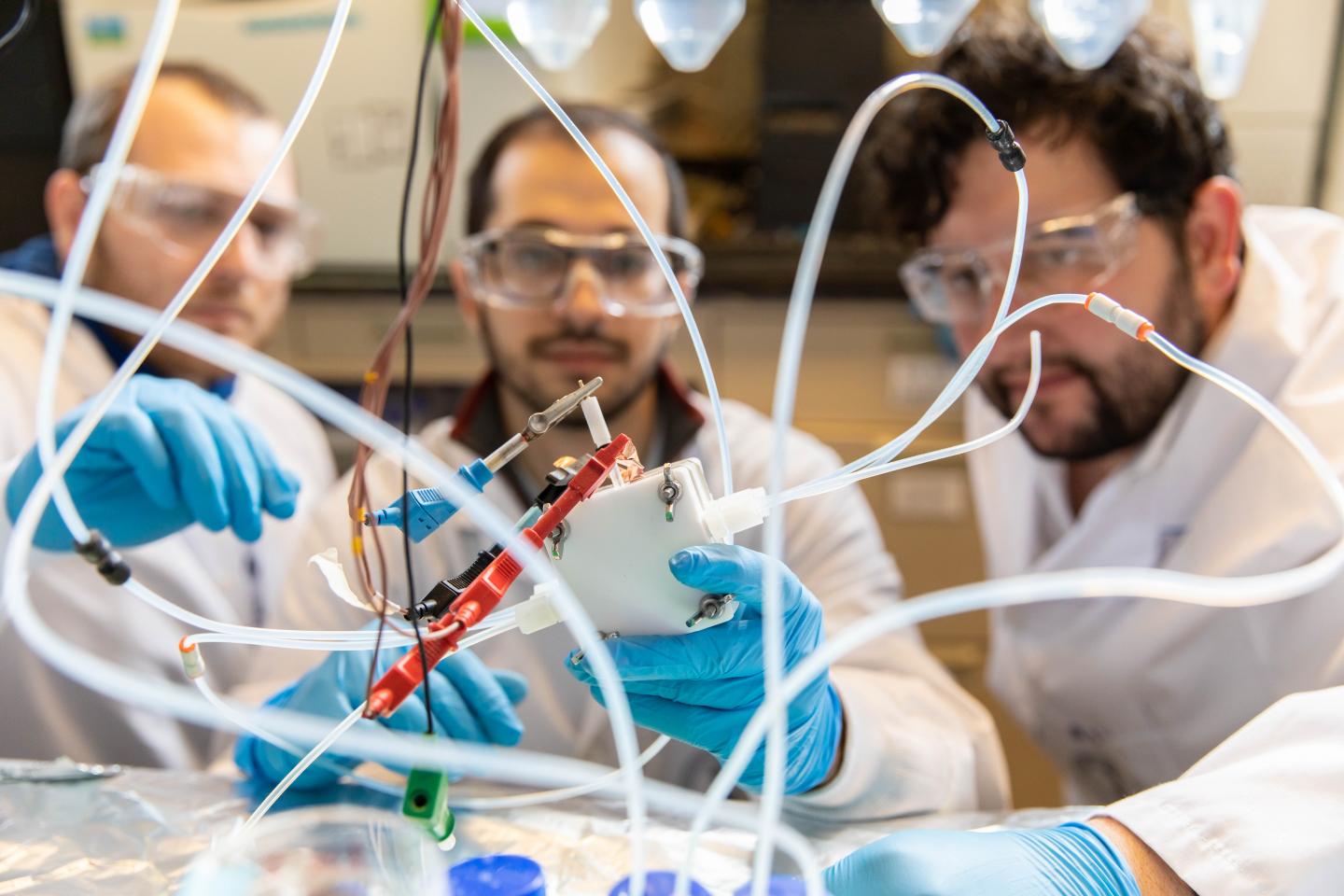
Credit: Daria Perevezentsev / U of T Engineering

Water is split into hydrogen and oxygen by electrolysis, but if CO2 is also added to the mixture, compounds can be generated to make textiles, diapers and even spirits. American scientists, led by a Spaniard, have developed a catalyst that accelerates this reaction, while also removing a greenhouse gas.

A team of researchers from Canada and the U.S. has developed a catalyst that quickly and efficiently converts carbon dioxide into simple chemicals. In this way, they transform the most important greenhouse gas into useful products for industry.

“The technology of water electrolysers is well known: they transform water and electricity into hydrogen and oxygen, but in our case, we add CO2 to the cocktail and, instead of producing hydrogen, we can generate various hydrocarbons, such as ethylene, which is the most widely used organic compound worldwide,” researcher F. Pelayo García de Arquer, of the University of Toronto (Canada), has told SINC.

“Thus,” he explains, “we can obtain raw materials for the manufacture of products such as construction materials, textiles, paints, electronic device components, diapers… or even spirits.”

The key to the new device is a polymer coating that facilitates the transport of CO2 through the surface of the metal or electrode of the catalyst. Carbon dioxide, generally speaking, has difficulty penetrating aqueous solutions and reaching the entire surface of this material; so when the flow of electrons (electric current) is increased to carry out the reaction, there is not enough CO2 to be transformed.

But the authors, who have published their study in Science magazine, show that this limitation can be overcome: “We have discovered that a certain configuration of ionomers (polymers that conduct ions and water to the catalyst) allows us to considerably increase the ease with which CO2 is distributed along the catalytic surface, thus allowing us to achieve higher productivity,” García de Arquer points out.

This ionomer coating contains hydrophobic (water-repellent) and hydrophilic (water-attracting) parts and is grouped together to form an ultra-thin layer of about 10 nanometres that helps to maintain the reaction where, from the CO2 gas and the hydrogen in the water (H+ protons), the hydrocarbon is built.

“About two years ago, CO2 electrolysis systems were limited to electrical outputs or currents of tens of milliamps per square centimetre, meaning that only a few molecules of this gas can be transformed into something useful,” says the researcher, “but our discovery allows them to operate at currents a hundred times higher, more than one ampere per square centimetre. In this way, many more CO2 molecules can be transformed, reaching activities that were unthinkable a few years ago.”

Another benefit that García de Arquer highlights is that the source of electricity needed for the process “can be perfectly renewable, such as solar, wind or hydraulic energy, so it is a way of building likewise renewable hydrocarbons.”

The researchers are now working on further increasing the efficiency of the system and its stability, which, although now at about tens of hours, is still far from the thousands of operating hours of the water electrolysers.

###

References:

F. Pelayo García de Arquer et al. “CO2 electrolysis to multicarbon products at activities greater than 1 A cm-2.” Science, February 2020.

Media Contact
SINC
[email protected]
34-914-251-820

Original Source

https://www.agenciasinc.es/en/News/The-catalyst-that-removes-CO2-and-produces-hydrocarbons

Related Journal Article

http://dx.doi.org/10.1126/science.aay4217

Tags: BiochemistryChemistry/Physics/Materials SciencesClimate ChangeElectrical Engineering/ElectronicsIndustrial Engineering/Chemistry
Share12Tweet8Share2ShareShareShare2

Related Posts

Social Marginalization Limits Access to Ontario Home Care

July 1, 2026
Revolutionary Soft Robotic Heart Paves the Way for Advanced Disease Research and Medical Device Testing — Technology and Engineering

Revolutionary Soft Robotic Heart Paves the Way for Advanced Disease Research and Medical Device Testing

July 1, 2026

Gut Microbiome: The Secret Architect Shaping Liver Cancer Immunotherapy Outcomes

July 1, 2026

Non-Toxic Lyme Disease Protection May Soon Be a Common Purchase

July 1, 2026
Please login to join discussion

POPULAR NEWS

  • Detection of EDCs in Breast Milk and Infant Urine Up to Six Months Highlights Early Exposure Risks

    77 shares
    Share 31 Tweet 19
  • Saying Goodbye to PGY-6: Pediatric Fellowship Realities

    103 shares
    Share 41 Tweet 26
  • New Drug Candidate Developed at McMaster Shows Potential for Treating Brain Cancer

    58 shares
    Share 23 Tweet 15
  • KTU Researchers Explore Ultrasound’s Role in Enhancing Blood Flow Beyond Diagnostics

    53 shares
    Share 21 Tweet 13

About

We bring you the latest biotechnology news from best research centers and universities around the world. Check our website.

Follow us

Recent News

Social Marginalization Limits Access to Ontario Home Care

Revolutionary Soft Robotic Heart Paves the Way for Advanced Disease Research and Medical Device Testing

Gut Microbiome: The Secret Architect Shaping Liver Cancer Immunotherapy Outcomes

Subscribe to Blog via Email

Enter your email address to subscribe to this blog and receive notifications of new posts by email.

Join 82 other subscribers
  • Contact Us

Bioengineer.org © Copyright 2023 All Rights Reserved.

Welcome Back!

Login to your account below

Forgotten Password?

Retrieve your password

Please enter your username or email address to reset your password.

Log In
No Result
View All Result
  • Homepages
    • Home Page 1
    • Home Page 2
  • News
  • National
  • Business
  • Health
  • Lifestyle
  • Science

Bioengineer.org © Copyright 2023 All Rights Reserved.