A knitted, three-dimensional textile cover developed at North Carolina State University has more than tripled strawberry yields in tunnel field trials, offering growers a physical barrier against insects without depriving plants of the light, water and airflow they need to fruit. The fabric, known as Plant Armor, raised harvestable fruit counts by as much as 3.56 times compared with uncovered plants across experiments spanning the fall-to-spring growing cycle, and it did so without measurable harm to vegetative biomass, relative humidity or light access. The findings, published Sept. 24, 2026 in the journal Agriculture, suggest that a carefully engineered cloth could become a non-chemical tool for protecting one of the most economically and culturally beloved fruit crops in the world.
The technology emerged from an unexpected direction. Plant Armor began as an effort to make military uniforms resistant to mosquito bites and to improve comfort for soldiers wearing heavy body armor, according to co-author R. Michael Roe, William Neal Reynolds Distinguished Professor at NC State. The team’s original goal was a cloth that could sit against a soldier’s chest and make protective gear more wearable. Through iterative design and testing, that same class of knitted spacer fabrics proved remarkably effective at excluding insects from crops, a pivot that Roe described as impossible to predict at the outset. The version examined in the new study, Plant Armor Gen 2, is patented by NC State and licensed for commercial development by the university.
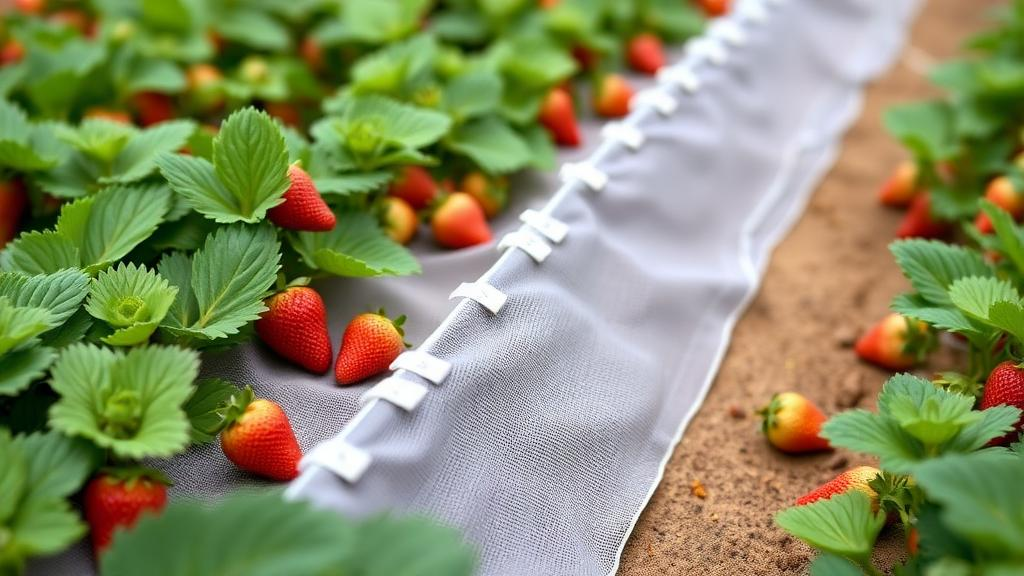
What distinguishes Plant Armor from conventional row covers is its three-dimensional architecture. Rather than a flat, single-layer textile, the fabric is a knitted spacer construction with multiple layers separated by an internal gap, creating a porous but tortuous pathway that insects cannot navigate. Laboratory bioassays demonstrated absolute exclusion of aphids, small sap-sucking pests that are among the most damaging and difficult-to-control insects in strawberry production. At the same time, the open, porous structure permits sunlight, rain and air to pass through to the plants beneath, meaning the cover functions less like a greenhouse wall and more like a selective filter that admits what crops need and blocks what harms them.
The yield results were striking. In tunnel field studies, covered strawberry plants produced 3.56 times more harvestable fruits than uncovered controls, with both the number and the total weight of fruit significantly higher. Equally important was what the researchers did not find: no differences in vegetative plant biomass between covered and uncovered plots, and no evidence of the shade-avoidance response the team had feared. Gabriel Olawuyi, a graduate research assistant at NC State and lead author of the paper, explained that the team expected the seemingly opaque fabric to reduce light availability and trigger a physiological shift in which plants divert energy from fruiting toward stem and leaf growth. Instead, measurements showed the fabric did not impede light access at all, and fruit production increased substantially.
Light is only part of the story. The cover also produced a consistent warming effect across the three seasons over which strawberry plants develop, from fall establishment through spring harvest. Olawuyi noted that plants require a certain amount of accumulated heat, calculated as growing degree-days, to progress through each developmental stage, including flowering and fruiting. By trapping warmth while remaining porous to air and water, the fabric appears to have delivered the thermal accumulation plants need at each phenological stage more optimally than the open field environment, allowing covered bushes to reach the fruiting stage earlier than their uncovered counterparts and to produce far more fruit once they arrived.
The microclimate effects were otherwise restrained. Despite the consistent temperature increase under the cover, relative humidity did not differ significantly between covered and uncovered plots, an important finding because elevated humidity under protective covers can promote fungal diseases and fruit rot in strawberries. Preliminary measurements of rhizosphere bacterial colony-forming units, an indicator of soil microbial communities around the roots, also showed no significant differences between covered and uncovered plots, suggesting the fabric did not disrupt the below-ground biology on which strawberry plants depend. Together, these results indicate that the cover modifies the above-canopy environment in targeted ways rather than wholesale.
Beyond yield, the insect-exclusion function carries implications for pesticide use. Strawberries are notoriously vulnerable to a range of arthropod pests, and conventional management relies heavily on chemical insecticides that raise concerns about residues, pollinator health, resistance development and regulatory pressure. By physically preventing insects from reaching plants, Plant Armor could reduce the need for traditional pesticides in agriculture, Olawuyi said. A non-chemical barrier that also boosts production, rather than merely protecting it, would be an unusual combination in crop protection, where physical exclusion methods such as netting and row covers typically involve trade-offs in light, ventilation or labor.
The study builds on the research group’s earlier work with the same class of materials. In previous experiments, the first 3-D spacer fabric constructed as a crop cover for tunnel field application increased cabbage vegetative growth 2.93-fold and proved resistant to insect penetration. What remained untested was whether such a cover could enhance fruit production specifically, since fruiting crops respond differently to modified light and temperature environments than leafy vegetables. Strawberries presented a demanding test case: they grow across three seasons, their flowers and fruit are traditionally protected from freezing with single-layer textiles, and their yield depends on a delicate balance of light, heat and pollination conditions.
The research was a collaborative effort spanning three NC State colleges: the College of Natural Resources, the Wilson College of Textiles and the College of Agriculture and Life Sciences. In addition to Olawuyi and Roe, the author team included James Clothier, Matthew Bertone, Grayson Cave, Reuben Garshong, Andre West, Loganathan Ponnusamy and Clyde Sorenson. Funding came from the North Carolina Agricultural Foundation and from the Research Capacity Fund (HATCH) administered by the U.S. Department of Agriculture’s National Institute of Food and Agriculture. The authors reported no known competing financial interests, though the patented Gen 2 fabric is licensed by the university for commercial development, with West and Roe among the named inventors.
The researchers caution that on-farm testing is now needed to determine how well the textile performs across different crop species, geographic locations and commercial production systems. Tunnel trials, while rigorous, do not capture the full variability of open-field agriculture, and strawberries grown in different climates, soils and management regimes may respond differently to the cover’s warming and exclusion effects. Still, the combination of a 3.56-fold yield increase, absolute aphid exclusion in bioassays, unchanged humidity and soil biology, and a fabric light enough to drape over plants positions Plant Armor as a rare crop-protection technology that appears to add productivity while subtracting chemical inputs. If on-farm results hold, a cloth originally conceived for soldiers’ body armor could find its largest audience in the strawberry fields of North Carolina and beyond.
Subject of Research: A knitted 3-D spacer fabric crop cover that increases strawberry fruit production and prevents insect feeding
Article Title: How a new textile fabric could triple production in strawberry plants
Article References: How a new textile fabric could triple production in strawberry plants. (n.d.). Original publication
Image Credits: AI Generated
DOI: Not provided
Keywords: Plant Armor, strawberries, textile crop cover, 3-D spacer fabric, insect exclusion, aphids, crop yield, growing degree-days, pesticide reduction, North Carolina State University, agriculture, protected cultivation
News Source: Alan Morgan. (October 11, 2026). Textile Cover Boosts Strawberry Yields More Than Threefold in Field Tests. Scienmag.