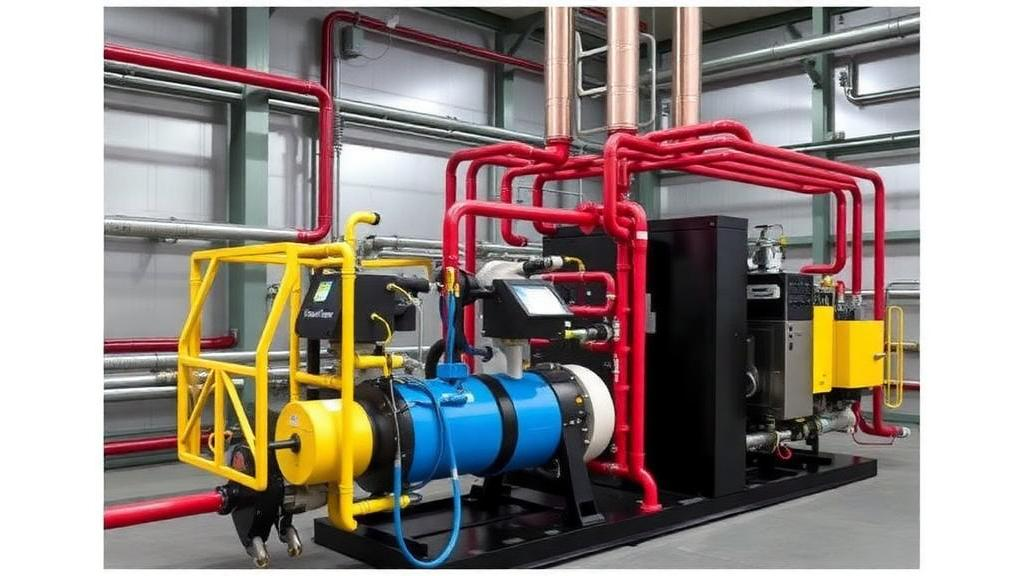
Inside every modern refinery, one towering piece of equipment quietly performs some of the most consequential chemistry in the energy economy. The fluid catalytic cracking unit, and its heavier-duty cousin the residue fluid catalytic cracking (RFCC) unit, converts low-value heavy hydrocarbons into the gasoline, liquefied petroleum gas, and light olefins on which transportation and petrochemical industries depend. Now, a team at the Shazand Oil Refining Company in Arak, Iran, has taken an unusually direct approach to a question that refineries worldwide are asking: can a whole crude oil, rather than carefully pre-treated feedstock, be pushed straight through an industrial RFCC reactor, and what happens to the product slate when operating severity is cranked up? Their answer, published in Results in Engineering, combines laboratory cracking experiments on an industrially aged catalyst with a full process simulation of a commercial UOP-licensed unit, and the results offer a rare quantitative window into severity-dependent product redistribution under genuinely industrial conditions.
The feed in question was no easy target. The Iranian medium crude oil used in the study has an API gravity of 28.8 degrees, moderate sulfur content of 2.05 weight percent, and a Conradson carbon residue of 4.9 weight percent, all signals of a heavy, aromatic, coke-prone material. It also carries appreciable loads of nickel and vanadium, metals that poison cracking catalysts and promote unwanted dehydrogenation. Roughly half of the crude boils above 343 degrees Celsius, while about 27 percent already exists as naphtha-range material before any cracking occurs. That native naphtha matters enormously for interpreting results, because any measured gasoline yield includes molecules that were never created by the catalyst at all. The researchers therefore evaluated their product streams on both apparent and net bases, subtracting the feed’s pre-existing light fractions to isolate what cracking chemistry actually contributed.
Equally important was the catalyst itself. Rather than fresh laboratory catalyst, the team used equilibrium catalyst, or E-Cat, drawn directly from the refinery’s operating RFCC unit. This material had already accumulated roughly 2,162 parts per million by weight of nickel and 6,245 ppm of vanadium, along with iron contamination, from months of industrial service. Its zeolite content stood at 37 weight percent with a total surface area near 107 square meters per gram. Ammonia temperature-programmed desorption revealed two distinct acidity domains: a modest population of weak acid sites and a much larger population of strong acid sites, the latter dominating the cracking chemistry. Using such a metal-laden, industrially aged catalyst makes the findings far more representative of what a commercial unit actually experiences than studies performed on pristine model catalysts.
The experiments were conducted in an Advanced Cracking Evaluation unit, a fixed fluidized-bed micro-reactor that follows the ASTM D7964 standard and is widely used to benchmark FCC catalyst performance. The researchers deliberately varied reactor temperature and catalyst-to-oil ratio simultaneously, moving through four severity levels from 500 degrees Celsius with a ratio of 4.5 up to 560 degrees Celsius with a ratio of 7.5. This coupled approach mirrors commercial practice, where temperature and catalyst circulation are physically linked through the regenerator’s heat balance: pushing more hot catalyst into the riser raises the reactor temperature. The trade-off is that the study cannot disentangle the individual effects of temperature and catalyst loading, a limitation the authors acknowledge explicitly throughout their analysis.
The headline finding is a dramatic reshuffling of the product slate as severity rises. Total conversion of the heavy fraction climbed monotonically from 61.13 weight percent at the mildest condition to 82.00 weight percent at the most severe. Propylene yield nearly tripled, from 4.60 to 11.30 weight percent, and butenes doubled from 5.80 to 11.69 weight percent. But the gains came at a price: dry gas, the low-value C1-C2 fraction, quadrupled from 2.20 to 8.70 weight percent, and coke formation rose from 3.85 to 4.45 weight percent. Gasoline told the most interesting story, rising to a maximum of 51.00 weight percent at intermediate severity before collapsing to 40.68 weight percent at the harshest condition. Light cycle oil fell steadily from 24.11 to 9.13 weight percent, while slurry barely moved, suggesting the heaviest, most refractory molecules resisted conversion regardless of severity.
That bell-shaped gasoline curve is the classic fingerprint of secondary cracking. At moderate severity, heavy molecules break down into gasoline-range intermediates faster than those intermediates are destroyed. Push harder, and the gasoline itself becomes feedstock, re-cracking into propylene, butenes, and dry gas. The authors interpret the rising light-gas yields as evidence of enhanced secondary cracking and a growing contribution from thermally induced free-radical reactions at high temperature, but they are careful not to overclaim: because temperature and catalyst-to-oil ratio moved together, the relative contributions of catalytic and thermal pathways cannot be independently quantified. The metal-contaminated E-Cat adds further ambiguity, since nickel and vanadium promote dehydrogenation reactions that generate hydrogen and light gases through entirely non-acid-catalyzed routes.
To bridge the laboratory and the plant, the team built an Aspen HYSYS model of the actual Shazand RFCC reactor, complete with its 69.8-meter riser, 2.25-meter diameter, twelve internal cyclones, and realistic feed blend of treated atmospheric residue, vacuum gas oils, and a small crude oil slipstream. Benchmarked against real operating data at 532 degrees Celsius, the simulation reproduced commercial yields impressively well: gasoline within 0.5 percent, conversion within 1.6 percent, and coke within 2.4 percent, though dry gas and slurry deviated by nearly 10 percent. Against the ACE experiments, the model captured overall conversion trends with an average deviation of just 1.42 percent but struggled with individual gas components, overestimating butanes and underestimating dry gas by large margins. The authors are candid that the ACE data served to calibrate the model’s yield correlations, so the ACE-HYSYS comparison is a consistency check, not an independent validation; only the benchmark against commercial data tests the model’s predictive power.
A screening-level energy analysis added an engineering dimension. Summing the heating values of gasoline and C3-C4 products, the researchers found that valuable-product energy rose from about 28.55 to 32.55 megajoules per kilogram of feed across the severity range, corresponding to roughly 68 to 77.5 percent of the feed’s chemical energy captured in those selected fractions. Coke combustion heat, which supplies the energy for the endothermic cracking reactions, increased about 16 percent at the highest severity. But the authors warn against reading this as proof that severe operation is more efficient: the calculation excludes feed vaporization, catalyst circulation duties, steam, and flue-gas heat, and the highest-severity case simultaneously produces far more low-value dry gas. Product quality shifts, not simple improvement, is the honest description.
Perhaps the most forward-looking result concerns feed strategy. When the team held conditions fixed at 520 degrees Celsius and a catalyst-to-oil ratio of 5.5 and progressively substituted whole crude for treated atmospheric residue, up to a 50-50 blend, conversion and yields of gasoline, propylene, and butenes all rose while light cycle oil fell. This supports the technical feasibility of co-processing whole crude directly in an existing RFCC unit, a concept aligned with the broader crude-to-chemicals movement that seeks to bypass expensive hydrotreating and hydrogen consumption. The comparison with Arabian light crudes reinforced the point: the heavier Iranian crude produced more LCO and coke but still delivered competitive olefin yields at high severity, with gasoline and propylene trading off in much the same way as for lighter feeds.
The caveats matter as much as the conclusions. Replicate measurements were unavailable, so no statistical confidence intervals accompany the yields. The crude-oil and atmospheric-residue comparisons used different operating conditions, so feed effects and severity effects remain entangled. Long-term catalyst deactivation, metals deposition, regenerator heat balance, and emissions were outside the scope of the study. Yet as a demonstration that an industrially aged catalyst and a benchmarked plant model can be combined into a coherent severity-dependent dataset for whole-crude cracking, the work fills a genuine gap. For refiners weighing fuel-oriented against olefin-oriented operating modes, the message is concrete: the operating window between roughly 520 and 540 degrees Celsius marks the pivot where gasoline maximization gives way to olefin production, and choosing where to sit on that curve is now a matter of measured engineering rather than intuition.
Subject of Research: Whole-crude oil processing in an industrial residue fluid catalytic cracking reactor assessed by ACE experiments and process simulation
Article Title: Industrial-scale assessment of whole-crude oil processing in RFCC reactor: Experimental and simulation study
Article References: Hosseini, S. M., & Afshar Ebrahimi, A. (2026). Industrial-scale assessment of whole-crude oil processing in RFCC reactor: Experimental and simulation study. Results in Engineering, 32, Article 113409. https://doi.org/10.1016/j.rineng.2026.113409
Image Credits: AI Generated
DOI: 10.1016/j.rineng.2026.113409
Keywords: RFCC, fluid catalytic cracking, whole crude oil, propylene, reaction severity, equilibrium catalyst, Aspen HYSYS, ACE unit, coke formation, light olefins, gasoline yield, crude-to-chemicals
News Source: Bethany Barker. (October 11, 2026). Crude Oil Straight to the Reactor: Industrial Test Shows Whole Crude Can Feed an RFCC Unit. Scienmag.