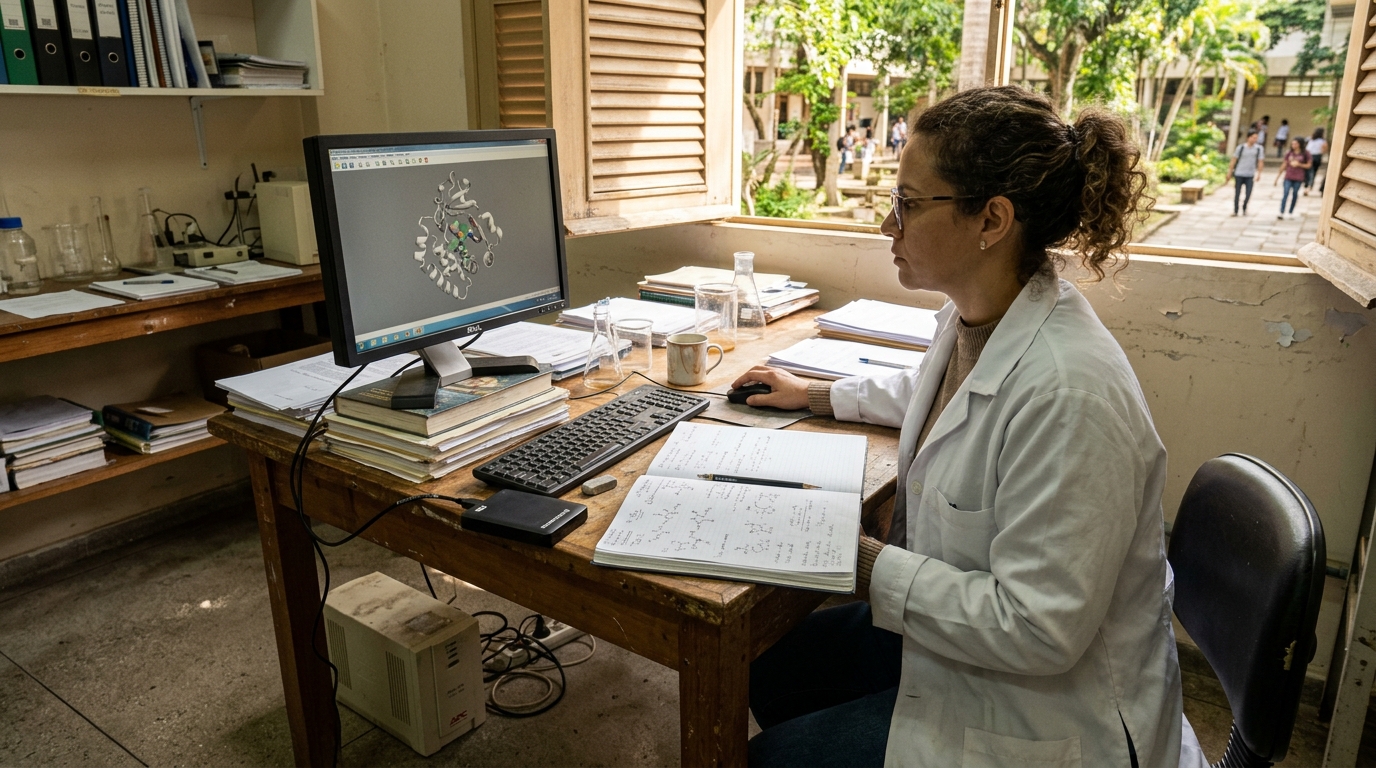
Computational drug discovery is no longer the exclusive province of wealthy laboratories with expensive software licenses and high-performance computing clusters. A team of researchers from Cameroon and Germany argues that meaningful participation in the field depends less on costly hardware than on strategic planning, investment in people, and the effective use of open scientific resources. Writing in Frontiers in Drug Discovery, the authors, based at the University of Buea Centre for Drug Discovery and Martin Luther University Halle-Wittenberg, distill their experience into ten practical principles for building a sustainable computational drug discovery program in low- and middle-income countries, while cautioning that the guidelines are drawn from African research settings and may not capture the full diversity of challenges elsewhere.
The Perspective, published in November 2026, arrives at a moment when artificial intelligence, machine learning, molecular docking, molecular dynamics, and cheminformatics are reshaping how therapeutic candidates are identified, prioritized, and optimized. The authors note that the growing ecosystem of open-source software, public chemical and biological databases, cloud and high-performance computing, and increasingly accessible AI technologies has created an opportunity for institutions in resource-limited settings to participate more actively in global drug discovery. Yet translating these technological opportunities into durable research capacity remains difficult, particularly where funding, infrastructure, skilled personnel, multidisciplinary integration, and access to appropriate technologies are constrained.
The first principle is scientific focus. New laboratories often attempt to address multiple research areas simultaneously, resulting in fragmented efforts and limited impact, the authors write. Instead, they recommend identifying a niche that aligns with local expertise, institutional priorities, regional health needs, or unique resources such as biodiversity. Examples include natural product drug discovery, neglected tropical diseases, antimicrobial resistance, AI-assisted virtual screening, and structure-based drug design. A focused niche facilitates specialized expertise, coherent research programs, stronger scientific visibility, strategic training, targeted funding applications, and productive collaborations. As expertise grows, laboratories can gradually expand into complementary areas without losing scientific identity, and defining measurable long-term objectives such as computational pipelines, curated databases, or disease-specific discovery platforms provides direction.
The authors illustrate this approach with their own antiviral research program. Their laboratory has established research questions around antivirals, for which biological assays were developed in collaboration with partners, including SARS-CoV-2 spike/human ACE2 inhibition and HIV latency reversal. These targets have been investigated with plant extracts and several classes of small molecules, including natural products, pseudo-natural products, and synthetic derivatives, most of the work anchored around the African Natural Products Database. In one case study, the team designed and synthesized more than 200 compounds in two chemical series, spirooxindoles and isatin derivatives, intended to block the interaction between the SARS-CoV-2 spike protein and the human ACE2 receptor, potentially interfering with viral attachment and transmission.
The compounds were designed using structural information on the SARS-CoV-2 spike receptor-binding domain in complex with human ACE2, with particular emphasis on the angiotensin II binding site of ACE2. Molecular docking was used to predict binding modes and relative affinities, complemented by molecular dynamics simulations and binding free-energy calculations to assess the stability of ligand-protein interactions. The modelling results suggested that compounds occupying the angiotensin II binding site could induce local conformational or steric changes that alter the interaction surface between ACE2 and the viral receptor-binding domain, potentially reducing molecular recognition and interfering with the initial attachment step required for viral entry. Among the compounds evaluated, one of the most promising inhibitors, 5-chloro-3-(2-(2,4-dinitrophenyl)hydrazono)indolin-2-one, exhibited an IC50 value of approximately 260 nM and a selectivity index of 7.9 when compared with an unrelated PD-1/PD-L1 ligand-receptor binding pair.
Comparative biological evaluation against SARS-CoV-2 variants showed that the compound was less active than the therapeutic monoclonal antibody REGN10933, known as casirivimab, against the wild-type, Beta, Delta, and Lambda variants, but displayed greater activity against the Omicron variant. The tested variants displayed broadly comparable IC50 values, suggesting that this chemotype may provide a useful starting point for developing analogues with improved potency and broader activity against emerging variants. The authors stress that further structure-activity relationship studies, followed by in vitro cellular infection and viral replication assays, are warranted to determine whether optimized analogues can effectively inhibit SARS-CoV-2 entry and replication. They also point to AI-driven expansion of chemical space around manually curated datasets of natural products and synthetic drugs as a way of finding new scaffolds for targeting SARS-CoV-2 vital proteins, and cite Brazilian biodiversity-driven efforts that produced the NuBBE database, now expanded to cover Latin America.
The second principle is to invest in people before infrastructure. The greatest asset of a computational drug discovery program is not its hardware but its people, the authors argue, noting that well-trained researchers can produce internationally competitive science with modest computational resources, whereas expensive infrastructure cannot compensate for limited expertise. Early investments should prioritize recruiting motivated students, providing multidisciplinary training, and fostering mentorship. Training should emphasize fundamental concepts in computational chemistry, biology, programming, data science, and scientific communication rather than mastery of specific software packages, using cost-effective mechanisms such as journal clubs, coding sessions, peer mentoring, online courses, and international exchanges. Investment in people must nonetheless be accompanied by progressive development of fit-for-purpose infrastructure, including reliable computers, local servers or access to high-performance computing, stable internet connectivity, secure data storage, and cloud-computing resources, expanded incrementally as expertise, outputs, and funding grow.
The remaining principles address the research ecosystem itself. Laboratories should build on robust community-supported open-source tools such as RDKit for cheminformatics, AutoDock Vina for molecular docking, GROMACS or OpenMM for molecular dynamics, and KNIME or Python for workflow automation, alongside public resources including PubChem, ChEMBL, UniProt, and the Protein Data Bank, which provide high-quality data without subscription costs. High-quality data and reproducible workflows come next: applying the FAIR principles, maintaining version-controlled code repositories, documenting computational protocols, benchmarking new methods on well-characterized datasets, and clearly reporting software versions and parameters. Equitable and strategic collaborations should be based on complementary expertise, shared scientific goals, and mutual benefit rather than solely on access to funding or infrastructure, and computational predictions should be explicitly linked to experimental validation through planned partnerships with laboratories capable of biochemical, cellular, pharmacological, and ADME/Tox assays, creating a continuous computational-experimental feedback loop.
Artificial intelligence, the authors caution, should complement rather than replace scientific reasoning and experimental validation. Models must be trained on high-quality, representative datasets and evaluated with transparent performance metrics, and researchers must understand model assumptions, limitations, and potential biases before interpreting predictions. Responsible AI requires attention to data quality, applicability domain, uncertainty, and rigorous external validation, particularly with small or heterogeneous datasets, and safeguards against data leakage are essential so that apparently strong predictive performance reflects genuine generalization rather than memorization or methodological artefacts. In resource-limited settings, limited datasets and computational resources can amplify model bias, overfitting, and uncertainty, making careful interpretation and independent experimental validation indispensable. The authors also warn that AI-derived small molecules from virtual screens and generative modeling must be accompanied by concrete proof of synthetic tractability, otherwise they remain in publications and never become real molecules to be tested, and that using AI to interpret LC-MS/MS profiles of biological extracts must be approached with caution because such methods often give misleading results.
The authors cite a recent review reporting that Phase I and Phase II trial outcome data across AI-native biopharma showed AI demonstrably outperforming historical industry norms in Phase I, with success rates of 80 to 90 percent compared with historical rates of roughly 52 percent, while still insisting AI be used responsibly in early lead discovery. The remaining principles call for embracing open science by sharing datasets, source code, workflows, and protocols through repositories such as GitHub, Zenodo, and Figshare; diversifying funding across institutional support, national and international grants, philanthropic funding, industry partnerships, and collaborative projects; building a strong research culture through mentorship, teamwork, integrity, and continuous learning; and planning for long-term sustainability through succession planning, equipment maintenance, curriculum development, and embedding computational drug discovery into university teaching. The authors’ own experience at the University of Buea illustrates the practical challenges: unreliable electricity and internet connectivity, addressed through resource-conscious workflows, distributed computing, external high-performance computing access, and a solar-powered backup system; limited access to commercial software, addressed by adopting open-source tools; and problematic data quality for African natural products, addressed by systematically curating the African Natural Products Database. Success, they conclude, should be measured not only by publications and grants but also by the number of trained scientists, strengthened partnerships, open resources developed, and contributions to regional research capacity.
Subject of Research: Practical principles for establishing computational drug discovery programs in resource-limited settings
Article Title: Perspectives for building a computational drug discovery program in resource-limited settings
Article References: Betow, J. Y., Nebangwa, D. N., Tjegbe, M. J. M., Tanyi, S. A., & Ntie-Kang, F. (2026). Perspectives for building a computational drug discovery program in resource-limited settings. Frontiers in Drug Discovery, 6, Article 1973504. https://doi.org/10.3389/fddsv.2026.1973504
Image Credits: AI Generated
DOI: 10.3389/fddsv.2026.1973504
Keywords: computational drug discovery, low- and middle-income countries, artificial intelligence, open-source software, SARS-CoV-2, molecular docking, natural products, capacity building, open science, reproducibility, University of Buea, Frontiers in Drug Discovery
News Source: Louis Brooks. (November 6, 2026). Ten guiding principles for computational drug discovery in resource-limited settings. Scienmag.