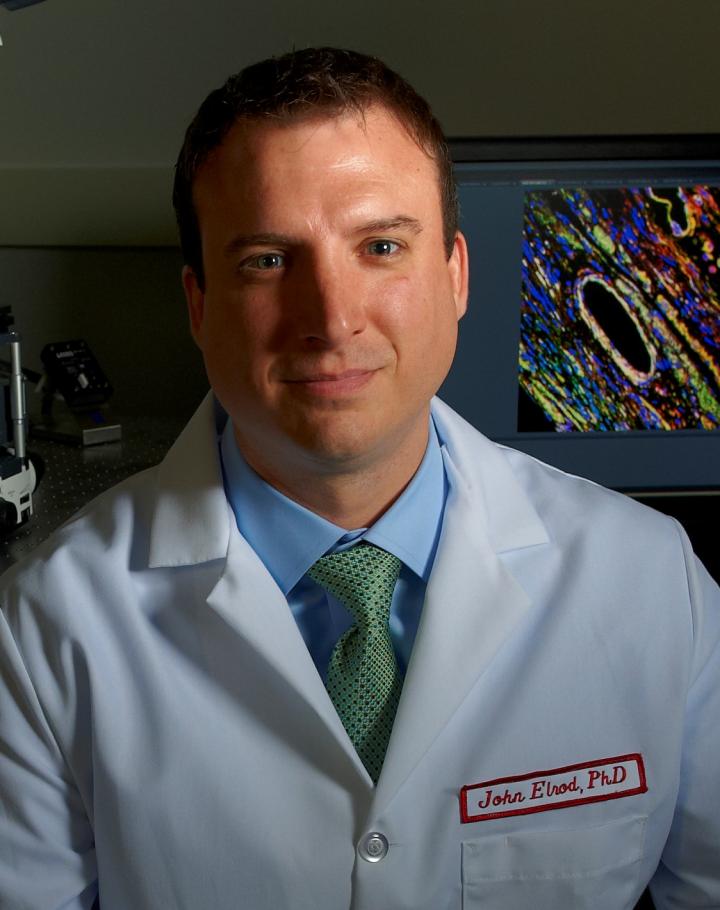
Credit: Lewis Katz School of Medicine at Temple University
(Philadelphia, PA) – Finding ways to optimize energy use is critical to keeping up productivity. This idea applies to the human body overall, as well as to each individual cell that makes up the body. Cells, in fact, go to great lengths to maintain energy levels, frequently increasing the activity of certain proteins and support pathways to compensate for drops in energy production that are brought about by stress or disease.
One way in which cells compensate for flagging energy production and metabolic dysfunction is mitochondrial calcium transport remodeling – a process marked by seemingly harmless changes in the amount of calcium present within mitochondria, the energy-generating batteries of cells. But while beneficial at first, this response may become maladaptive over time, with altered calcium levels inflicting severe damage to mitochondria. In the nervous system, this ultimately impacts cellular activities necessary for memory and learning.
A team of scientists led by John W. Elrod, PhD, Associate Professor in the Center for Translational Medicine at the Lewis Katz School of Medicine at Temple University, has hypothesized that altered mitochondrial calcium transport contributes to Alzheimer’s disease development and progression. But whether and how this happens remains unclear.
Now, thanks to a new three-year, $2.27 million grant from the National Institutes of Health’s National Institute of Neurological Disorders and Stroke, Dr. Elrod and colleagues are poised to gain novel insight into biological mechanisms that may be driving or worsening neurodegeneration. The researchers will investigate potential mechanisms using mouse models of Alzheimer’s disease and a systems biology approach. The work could help identify new drug targets and therapeutic opportunities for Alzheimer’s disease.
“We recently reported that altered mitochondrial calcium transport impacts the progression of neurodegenerative diseases, particularly Alzheimer’s disease,” said Dr. Elrod, who is senior investigator on the new grant. “But very little is known about the mechanisms involved.”
Dr. Elrod and colleagues think that an initial energetic or metabolic stress likely causes cells to change their behavior.
“We suspect that in Alzheimer’s disease, stressed brain cells (neurons) have an energy deficit, which causes the cells to take up more calcium in order to augment energy production. But ultimately the high mitochondrial calcium levels cause maladaptive remodeling and disease.”
Dr. Elrod and colleagues demonstrated that neuronal expression of a calcium transporter known as NCLX is lost in Alzheimer’s disease and that re-expression of NCLX protects against disease development. In particular, by moving calcium out of mitochondria, NCLX prevented the formation of harmful protein aggregates and re-established mitochondrial calcium homeostasis in neurons, effectively rescuing animals from cognitive decline.
Dr. Elrod’s laboratory further discovered that in neurons, loss of expression of a protein known as MICU1 correlates with Alzheimer’s disease progression. MICU1 is a key regulator of mitochondrial calcium uptake. Its loss predisposes the energy-producing organelles to calcium overload.
“Now we want to know if mitochondrial calcium uptake contributes specifically to the development and progression of Alzheimer’s disease,” Dr. Elrod said. “We also want to find out what energy or metabolic deficits are occurring in cells as Alzheimer’s disease develops. Using new genetic tools, we hope to identify metabolic changes in neurons during the course of disease. Defining what cellular stresses are occurring and which metabolic pathways are affected can help us better understand what triggers mitochondrial dysfunction in the first place.”
**Research reported in this publication was supported by grants from the National Institutes of Health (NS121379, HL136954, HL123966, HL123966, HL142271). The content is solely the responsibility of the authors and does not necessarily represent the official views of the National Institutes of Health.
###
Media Contact
Jennifer Reardon
[email protected]