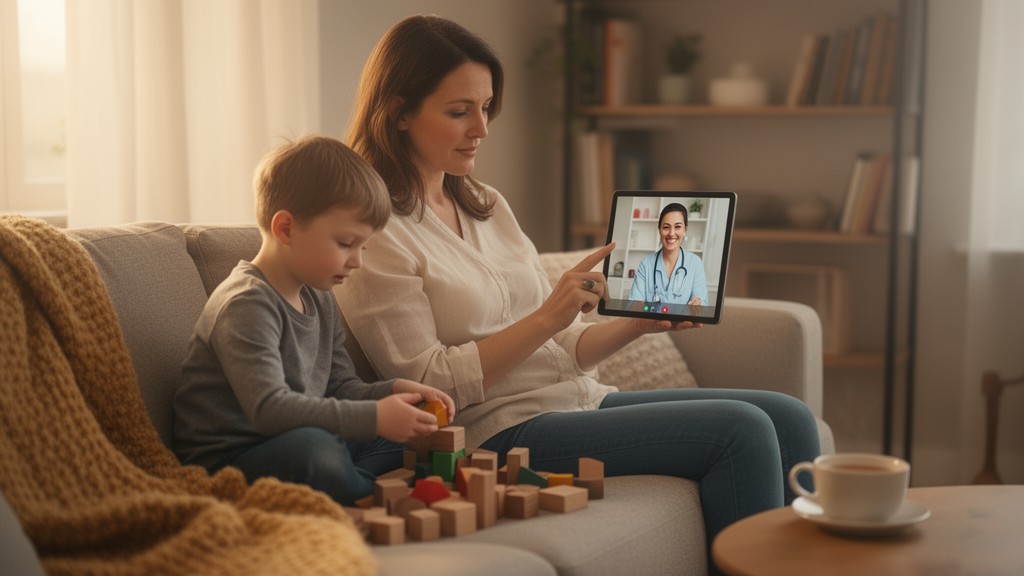
A cluster-randomized controlled trial conducted in Shiraz, Iran, reports that a telehealth education program delivered to mothers of children with autism spectrum disorder produced measurable improvements in general health, sleep quality, and resilience. The study, published in BMC Primary Care, enrolled 80 mothers recruited from two comprehensive pediatric rehabilitation centers and followed them for two months after an eleven-week virtual intervention.
The trial used a single-blind, two-arm, cluster-randomized design. Rather than randomizing individual participants, the two centers were allocated by lottery, with one center assigned to the telehealth intervention and the other to a waitlist control group. All eligible mothers at each center were invited to take part, and participants were assigned to the group corresponding to their center, yielding 40 mothers per arm.
The intervention consisted of eleven weekly interactive virtual group sessions, each lasting 65 minutes. Outcomes were assessed with three validated instruments: the General Health Questionnaire (GHQ-28) for psychological distress, the Pittsburgh Sleep Quality Index (PSQI) for sleep disturbance, and the Connor–Davidson Resilience Scale (CD-RISC) for resilience. Each mother completed these measures at three time points: baseline, immediately after the program, and at a two-month follow-up.
Analysis relied on two-way mixed-design repeated measures analysis of variance, which evaluates whether the two groups changed differently over time. At baseline, demographic characteristics and clinical scores were statistically equivalent between the groups, meaning any later divergence could be attributed to the intervention rather than pre-existing differences.
The results showed statistically significant Group × Time interaction effects across all three primary outcomes. For general health, the interaction yielded F(1.526, 119.031) = 8.435, p = .001, with a partial eta-squared of 0.098. Sleep quality showed the largest effect, F(1.768, 137.906) = 17.736, p < .001, ηp² = 0.185, and resilience showed F(1.442, 112.453) = 14.360, p < .001, ηp² = 0.155. In practical terms, the trajectory of change over the study period differed substantially between mothers who received the telehealth program and those who did not.
Post-hoc pairwise comparisons within the intervention group indicated sustained improvements. Psychological distress scores on the GHQ-28 fell from 34.62 ± 9.44 at baseline to 32.42 ± 7.17, a difference that reached p < .001. Resilience scores on the CD-RISC rose from 64.08 ± 10.90 to 71.43 ± 8.16, also p < .001. Sleep disturbance on the PSQI improved progressively over time, from 12.27 ± 2.83 to 11.15 ± 2.56, p < .001. By contrast, control group scores remained stable across all measurement waves, with no statistically significant change.
The authors conclude that telehealth education could serve as a cost-effective and accessible method within primary healthcare for supporting mothers of children with autism.
Several limitations frame these findings. The follow-up period extended only two months beyond the intervention, leaving longer-term durability of the effects an open question.
The study team registered the trial with the Iranian Registry of Clinical Trials (IRCT20160404027216N12) on 19 February 2024. The authors note that further research is necessary to explore the impact of telehealth on the health of both parents and children with autism, since this trial measured maternal outcomes only. As an open-access publication shared early for faster access, the article remains citable through its permanent DOI while awaiting the final version of record.
For clinicians and policymakers in primary care, the trial adds controlled evidence that a structured, relatively low-resource format—weekly interactive video sessions totaling roughly twelve hours—was associated with clinically tracked gains in three distinct dimensions of caregiver well-being. Whether similar results generalize to other health systems, caregiver populations, and delivery formats will depend on replication in larger, multi-site trials with extended follow-up.
Subject of Research: A cluster-randomized controlled trial of telehealth education for mothers of children with autism
Article Title: Examining the impact of telehealth education on the general health, sleep quality, and resilience of mothers with children diagnosed with autism: a cluster-randomized controlled trial
Article References: Mosavi, B. B. L., Vizeshfar, F., & Javanmardifard, S. (2026). Examining the impact of telehealth education on the general health, sleep quality, and resilience of mothers with children diagnosed with autism: a cluster-randomized controlled trial. BMC Primary Care. https://doi.org/10.1186/s12875-026-03609-7
Image Credits: AI Generated
DOI: 10.1186/s12875-026-03609-7
Keywords: telehealth, autism spectrum disorder, caregivers, mothers, sleep quality, resilience, general health, cluster-randomized trial, primary care, Iran, mental health, remote education
News Source: Courtney Benton. (October 30, 2026). Telehealth Education Improves Health, Sleep and Resilience in Mothers of Autistic Children. Scienmag.