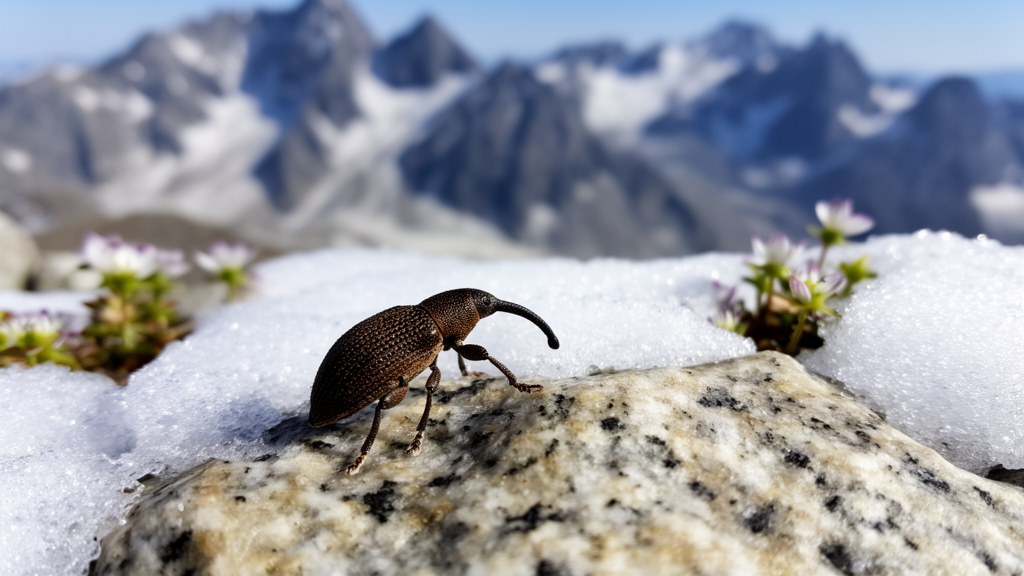
A taxonomic and mitochondrial sequence study describes a new species of alpine weevil, Dichotrachelus sonjae sp. nov., from the Pizzo Nona area of Valle Vigezzo in Piemonte, northwestern Italy. The researchers distinguished the species from its closest morphological relative, D. lepontinus, and mitochondrial Cox1 data supported their assessment that the two species are sister taxa. Dichotrachelus weevils are cold-tolerant insects associated with cold, humid, rocky habitats at alpine elevations.
They develop and feed on mosses and Saxifraga species. The genus comprises about 60 species in Europe and North Africa, all of which are wingless and consequently have limited mobility. Many occupy small distribution areas and are endemic.
With the description of D. sonjae, 34 taxa have been recorded from Italy. Their morphological assessment included external anatomy, male genitalia and female reproductive structures. For the genetic analysis, they used 658 nucleotides of mitochondrial Cox1 and constructed a Jukes-Cantor-corrected neighbor-joining tree in MEGA.
The holotype is a male collected below Pizzo Nona at 1,950 metres above sea level on 31 October 2024. Paratypes came from nearby locations at approximately 1,910 and 2,000 metres. Adults measure 3.3–4.2 millimetres long: males measure 3.3–4.0 millimetres and females 4.0–4.2 millimetres.
The body is black to dark brown, with reddish-brown antennae and legs, dark and light brown scales on the pronotum and elytra, paired lobal tibial spurs, and a strongly sclerotized base to the penis. D. sonjae is morphologically most similar to D. lepontinus, which was described from Cimalmotto in Ticino, Switzerland. The principal male distinction is the new species’ long, dagger-like penile tip.
Females can be separated by the spermatheca and eighth sternite: an edged projection at the base of the D. lepontinus spermatheca is absent in D. sonjae. The new species also has more elongate-oval male elytra with reduced shoulders, stronger femora and thicker erect scales. The two species share duplex lobal spurs on the tibiae and a heavily sclerotized basal region of the penis with a clearly delineated ostium.
Among alpine members of the genus, similar basal sclerotization also occurs in D. rudeni and D. imhoffi. D. meregallii shares the duplex tibial spurs, but its apparently single enlarged posterior tibial spur consists of two separate elements. The authors suggest that elongated tibiae and prominent spurs may be associated with extreme rocky habitats and possibly with sexual selection; male spurs were more pronounced than female spurs in the three species considered.
Cox1 sequence distances were 5.9–6.5% between D. sonjae and D. lepontinus, while every other species examined differed by at least 11%. At the type locality, adults and larvae were found in dense moss cushions on granite stones in a scree slope below the north face of Pizzo Nona. The site was described as exceptionally cold because a cavity in the north face deprives it of direct sunlight for much of the year.
The collections included late-stage larvae and first-stage larvae less than one millimetre long. The associated fauna included the alpine carabid Nebria casalei, which the authors consider to belong to Nebria cordicollis sensu stricto, while D. rudeni occurred nearby. The authors considered the population potentially relictual because of its restricted, cold habitat and separation from D. lepontinus populations around Monte Gridone and Cima Laurasca.
They also proposed that isolated D. meregallii populations may reflect survival in glacial refuges, while acknowledging that current distributions do not fully explain the species’ marked disjunction. The authors called for further research on the biogeography and phylogeny of high-alpine beetles.
Subject of Research: Taxonomic and mitochondrial characterization of a new alpine weevil species in Piemonte, Italy
Article Title: A new Dichotrachelus Stierlin from Val Grande (Piemonte, Italy) ( Coleoptera , Curculionidae ) with comments on biogeography and evolution of high alpine species of the genus
Article References: Szallies, A., & Germann, C. (2025). A new Dichotrachelus Stierlin from Val Grande (Piemonte, Italy) (Coleoptera, Curculionidae) with comments on biogeography and evolution of high alpine species of the genus. Alpine Entomology, 9, 29-36. https://doi.org/10.3897/alpento.9.153998
Image Credits: AI Generated
Keywords: Dichotrachelus sonjae, taxonomy, alpine weevil, Curculionidae, mitochondrial Cox1, species description, biogeography, phylogeny, Piemonte, Valle Vigezzo, Dichotrachelus, Stierlin
News Source: Gavin Prescott. (October 20, 2026). Taxonomic and mitochondrial study identifies new alpine weevil in Piemonte. Scienmag.