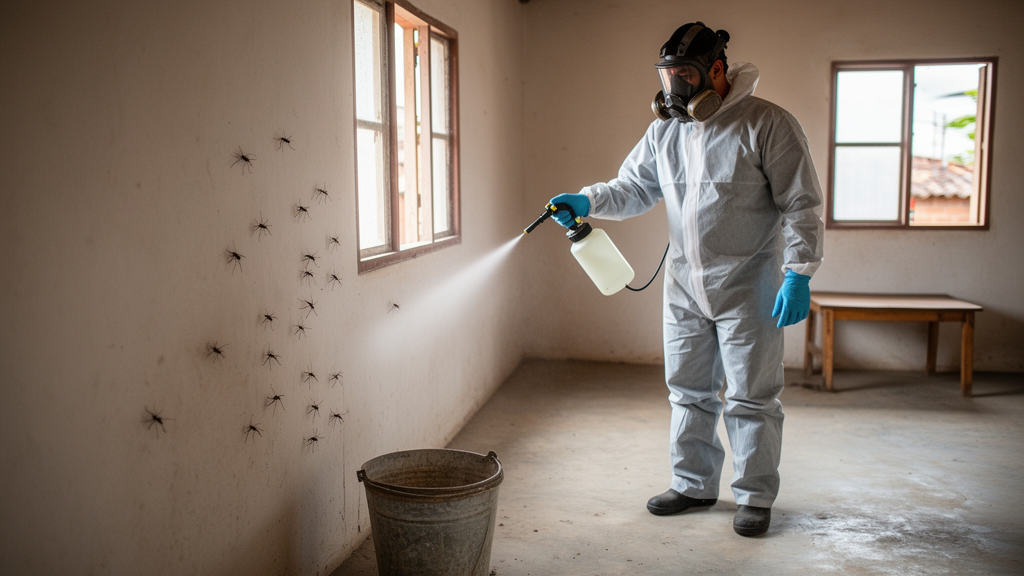
A cluster-randomized trial in Iquitos, Peru, found that targeted indoor residual spraying sharply reduced the density of Aedes aegypti, the primary vector of dengue and other Aedes-borne viruses. Fifteen days after treatment, sprayed houses had 96% fewer mosquitoes than comparison houses, while the estimated direct effect remained significant at 255 days, with a 40% reduction. The intervention also produced measurable indirect effects in untreated houses within the same intervention clusters, with efficacy estimated at 69% after 15 days and 7% after 255 days.
Researchers randomly assigned 30 urban clusters to either targeted indoor residual spraying, or TIRS, or to standard vector-control activities conducted by Peru’s Ministry of Health. TIRS used pirimiphos-methyl and focused on locations where A. aegypti were known to rest inside homes. The intervention covered 15 clusters containing 898 structures, and the comparison group included 15 clusters with 1,018 structures. By examining both sprayed houses and untreated houses in intervention clusters, the investigators could estimate direct effects in treated structures and indirect community-wide effects associated with the intervention.
The team assessed indoor mosquito density using Prokopack aspiration during the 45 days before spraying and at four subsequent time points extending to 255 days after the intervention. Generalized linear mixed models with a negative-binomial link estimated incidence rate ratios, and efficacy was calculated as one minus the incidence rate ratio. These measurements concern mosquito abundance, not human infections. The trial therefore provides entomological evidence about the effectiveness of TIRS but does not establish whether the intervention reduced dengue incidence, other viral infections or disease severity.
The largest direct effect appeared 15 days after spraying, when A. aegypti captures in treated houses were 96% lower than in the comparison group. The estimated reduction then weakened but remained significant at 255 days, when direct efficacy was 40%. In untreated houses located within TIRS clusters, estimated indirect efficacy reached 69% at 15 days. Although this estimate declined substantially over time, it remained statistically significant after eight months, reaching 7% at 255 days. Thus, the results indicate that TIRS was associated with reductions both in sprayed structures and in nearby untreated homes, with a much stronger and more persistent direct effect than indirect effect.
Household-level TIRS coverage was only 57%, yet statistically significant direct and indirect impacts were observed during the early post-intervention surveys, and indirect effects were still evident after eight months. The findings show that partial household coverage can coincide with meaningful reductions in indoor mosquito density. The trial’s scope also constrains interpretation: it was conducted in an urban setting in Iquitos, used one insecticide-based intervention and measured entomological outcomes rather than clinical disease. Within those limits, the results support the entomological value of TIRS in dengue-endemic urban settings and in tropical or subtropical military locations where the method is deployed, without demonstrating a corresponding reduction in human viral transmission.
Subject of Research: Entomological efficacy of targeted indoor residual spraying against Aedes aegypti in Iquitos, Peru
Article Title: Direct and indirect entomological efficacy of Targeted Indoor Residual Spraying against Aedes aegypti in Iquitos, Peru
Article References: Astete, H., Vasquez, G. M., López-Sifuentes, V. M., Zambrano, B., Reyna, B., Moore, R. C., Morrison, A. C., Vazquez-Prokopec, G. M., & Larson, R. T. (2026). Direct and indirect entomological efficacy of Targeted Indoor Residual Spraying against Aedes aegypti in Iquitos, Peru. PLOS Neglected Tropical Diseases, 20(10), e0014390. https://doi.org/10.1371/journal.pntd.0014390
Image Credits: AI Generated
DOI: 10.1371/journal.pntd.0014390
Keywords: Aedes aegypti, dengue, mosquito control, indoor residual spraying, pirimiphos-methyl, cluster-randomized trial, Peru, vector control, entomological efficacy, Direct, indirect, entomological
News Source: Ophelia Keating. (October 21, 2026). Targeted spraying reduced indoor Aedes mosquitoes in Peruvian trial. Scienmag.