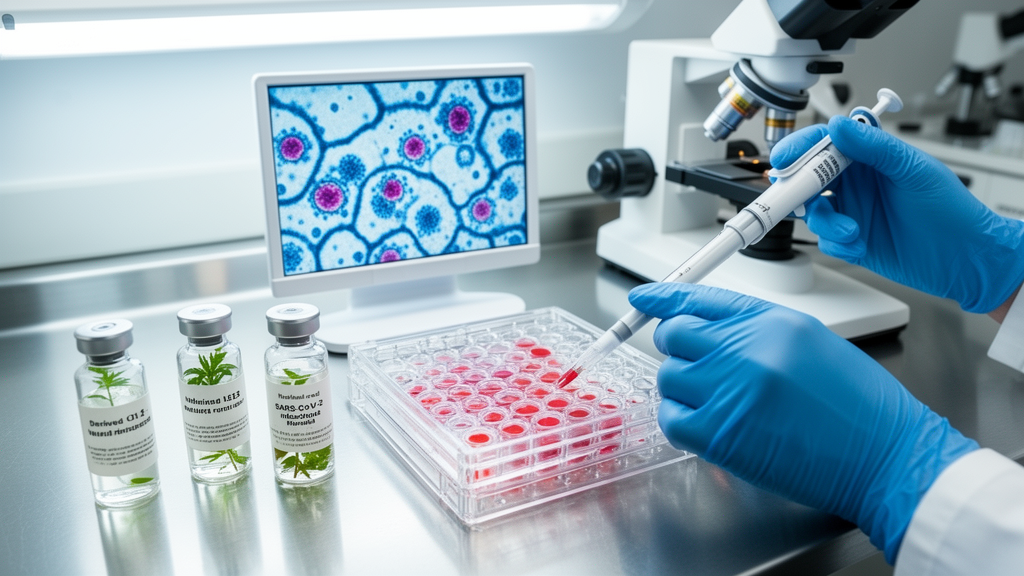
Three compounds from the pan-African Natural Products Library—oleanolic acid, poinsettifolin B, and rhuschalcone III—disrupted interactions between the SARS-CoV-2 spike receptor-binding domain and the human ACE2 receptor in laboratory screening. The study identified the molecules as potential antiviral leads for COVID-19, but the findings remain preclinical: the compounds were tested in biochemical and cell-based systems, not in people. Oleanolic acid and rhuschalcone III also reduced SARS-CoV-2 replication in Vero cells at low micromolar concentrations without detectable cytotoxicity under the reported conditions, whereas poinsettifolin B did not show the same antiviral activity in that assay.
Researchers screened physical, pure compounds obtained from African medicinal plants in the pan-African Natural Products Library, abbreviated p-ANAPL. The target was the in vitro interaction between the receptor-binding domain, or RBD, of the SARS-CoV-2 spike protein and ACE2, the host receptor that helps mediate viral entry into cells. Disrupting this molecular interaction could potentially prevent a key step in infection. The library screen selected three compounds with half-maximal inhibitory concentrations, or IC50 values, ranging from 0.5 to 2.4 micromolar, indicating activity within the low-micromolar range in the tested assay.
The compounds showed some selectivity in the screening system. Unlike their effects on the SARS-CoV-2 RBD–ACE2 interaction, oleanolic acid, poinsettifolin B, and rhuschalcone III did not disrupt binding between PD-1 and PD-L1, an unrelated host ligand–receptor pair used as a comparator. This result suggests that the observed inhibitory activity was not simply a nonspecific consequence of broadly interfering with protein interactions. The experiment nevertheless measured binding-related activity in vitro, and the authors did not establish that the same effects would occur in an infected organism or lead directly to an effective COVID-19 treatment.
Cell experiments produced a more limited pattern of antiviral activity. Oleanolic acid and rhuschalcone III inhibited SARS-CoV-2 replication in Vero cells at low micromolar concentrations without cytotoxicity at the tested levels. Poinsettifolin B inhibited the RBD–ACE2 interaction but did not inhibit viral replication in this cell model. The distinction is important because interference with receptor binding alone did not guarantee a measurable reduction in viral replication. The evidence also remains specific to the laboratory conditions and cell line used; the study does not show whether the compounds can be safely or effectively administered to humans.
Computational modelling provided a possible structural explanation for the three molecules’ activity. The models indicated that each compound could interact with numerous residues on the SARS-CoV-2 RBD and human ACE2, including a subset of sites conserved across SARS-CoV-2 variants of concern. Such models can generate hypotheses about binding modes and guide further experiments, but they do not by themselves confirm a physical interaction in cells or in patients. Overall, the research identifies oleanolic acid, poinsettifolin B, and rhuschalcone III as selective, in vitro antiviral candidates that warrant additional investigation, particularly for settings where access to existing vaccines or therapies is limited.
Subject of Research: In vitro antiviral screening of African natural products against SARS-CoV-2 entry and replication
Article Title: The pan-African natural products library compounds oleanolic acid, poinsettifolin B, and rhuschalcone III disrupt SARS-CoV-2 spike-host ACE2 interactions and SARS-CoV-2 replication
Article References: Tjegbe, M. J. M., Onguéné, P. A., Bekono, B. D., Betow, J. Y., Simoben, C. V., Cassel, J., Salvino, J. M., Montaner, L. J., Andrae-Marobela, K., Ntie-Kang, F., & Tietjen, I. (2026). The pan-African natural products library compounds oleanolic acid, poinsettifolin B, and rhuschalcone III disrupt SARS-CoV-2 spike-host ACE2 interactions and SARS-CoV-2 replication. BMC Pharmacology and Toxicology. https://doi.org/10.1186/s40360-026-01264-3
Image Credits: AI Generated
DOI: 10.1186/s40360-026-01264-3
Keywords: SARS-CoV-2, COVID-19, natural products, oleanolic acid, rhuschalcone III, poinsettifolin B, ACE2, spike protein, antiviral screening, Vero cells, pan-African, natural
News Source: Ophelia Keating. (October 21, 2026). Three African natural products disrupt SARS-CoV-2 entry and replication in vitro. Scienmag.