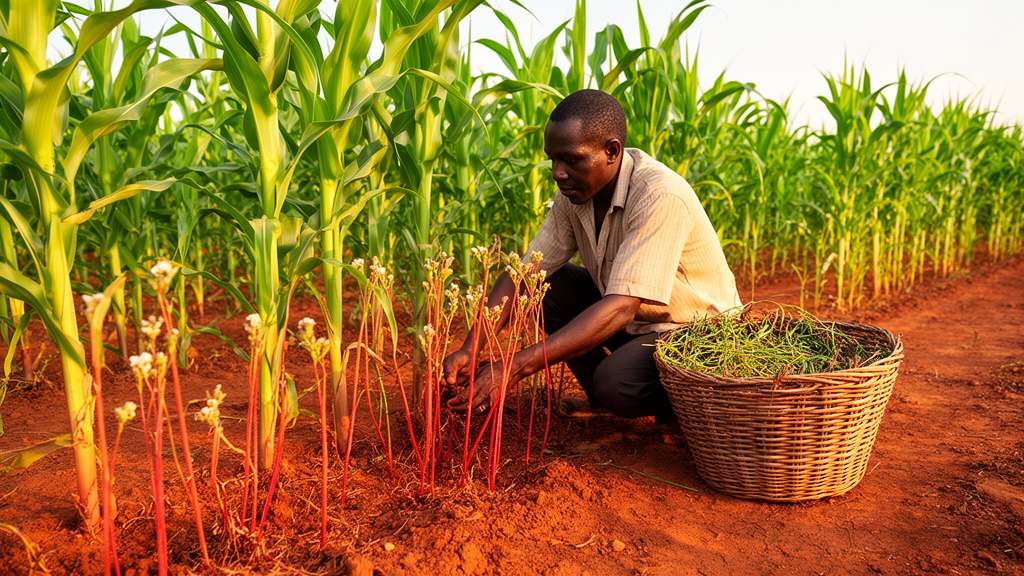
Across the maize fields of sub-Saharan Africa, an invisible enemy drains more than a billion dollars from the harvest every year. Striga, a genus of parasitic weeds known to farmers as witchweed, attaches itself to the roots of maize plants and silently steals water, nutrients, and yield long before any visible damage appears. A new study published in Nature Communications has now produced the most spatially detailed economic assessment of this threat to date, and its findings point to a strikingly efficient way to fight back: concentrate resources on a small fraction of heavily infested land while preventing the weed from colonizing new frontiers.
The research, led by Franck B. N. Tonle and Alcade C. Segnon of the International Center for Tropical Agriculture in Dakar, together with colleagues at CIMMYT, icipe, IITA, and the African Union’s phytosanitary council, addresses a problem that has frustrated policymakers for decades. Estimates of Striga’s economic toll have varied wildly, not because the weed’s impact is in doubt, but because the data needed to quantify it are scattered, incomplete, or simply missing across much of the continent. Without reliable numbers, governments and donors have struggled to decide where scarce intervention funds should go.
To overcome this data scarcity, the team built a spatially explicit modeling framework that combines three complementary approaches. First, they used agroecological similarity mapping to identify regions where climatic and soil conditions resemble those of known Striga-infested zones, allowing them to infer risk in areas where direct surveys are absent. Second, machine learning algorithms were trained on available field observations, environmental covariates, and cropping system data to predict where the parasite is likely to occur and how severely it suppresses maize yields. Third, stochastic modeling was applied to propagate uncertainty through every stage of the analysis, producing confidence intervals rather than single-point estimates that would falsely suggest precision.
The headline result resolves a long-standing ambiguity. The researchers estimate that Striga causes annual economic losses of US$1.04 billion across African maize production systems, with a 95 percent confidence interval running from US$0.94 billion to US$1.15 billion. That narrow band, achieved despite sparse input data, is what makes the study methodologically significant. By explicitly quantifying uncertainty rather than hiding it, the framework gives planners a defensible range within which to budget control programs, instead of forcing them to choose among contradictory historical figures.
Perhaps the most consequential finding is geographic. The losses are extraordinarily concentrated: less than 6 percent of the infested area generates half of the total economic damage. This pattern reflects the uneven distribution of both the parasite and the maize systems it attacks. Certain hotspots, where favorable conditions for Striga coincide with intensive maize cultivation and vulnerable smallholder livelihoods, account for a disproportionate share of the harm. For intervention planners, this concentration is an opportunity. It means that a modest, well-aimed investment in the highest-loss zones can deliver returns that would be impossible under a uniform, blanket approach.
The study also looks forward, and the future it projects is sobering. Agricultural expansion, the conversion of new land to maize cultivation as populations grow and demand rises, emerges as the primary risk pathway for the coming decades. Under the modeled scenarios, losses could triple by 2050, not because existing infestations worsen dramatically, but because Striga colonizes previously uninfested areas opened up by cropland expansion. The weed’s biology makes this especially dangerous: a single Striga plant produces tens of thousands of tiny seeds that persist in the soil for years, so once a new field is contaminated, eradication becomes nearly impossible and management costs compound indefinitely.
This forward-looking analysis leads directly to the paper’s central policy recommendation. The authors argue that interventions achieve maximum impact through a dual strategy: spatial targeting of the high-loss zones where damage is already concentrated, coupled with prevention in the agricultural expansion areas where the parasite has not yet taken hold. Targeting concentrates proven control measures, such as resistant or tolerant maize varieties, soil fertility management, and integrated weed management packages, where they buy back the most yield per dollar. Prevention, meanwhile, is far cheaper than cure; keeping Striga out of a new frontier costs a fraction of what it takes to suppress an established infestation.
Crucially, the researchers show that this targeted dual approach outperforms uniform intensification, the strategy of spreading resources evenly across all affected areas. Uniform programs dilute effort across landscapes where marginal returns are low, while the concentrated strategy exploits the skewed loss distribution to its advantage. The finding has implications well beyond Striga. The framework was explicitly designed for data-scarce regions, and the authors present it as a blueprint for managing agricultural pests more broadly in settings where field surveys are sparse, monitoring budgets are thin, and decisions cannot wait for perfect information.
The stakes could hardly be higher. More than 300 million Africans depend on maize as a staple crop, and Striga is one of the most biologically formidable threats they face. Unlike ordinary weeds, it is an obligate parasite: it germinates only in response to chemical signals exuded by host roots, then penetrates and taps directly into the plant’s vascular system. Above ground, the first symptoms, pale wilting leaves and stunted growth, often appear only after the parasite has already done irreversible damage underground. By the time a farmer sees the distinctive purple flowers, the season’s yield is largely decided.
For the scientists and institutions behind the study, the next step is translating the maps into action. The framework’s outputs identify precisely where targeting and prevention dollars should flow, and the funding acknowledgment from the AICCRA project, supported by the World Bank’s International Development Association, signals that climate-resilient agricultural development programs are already positioned to act on such evidence. If the dual strategy is adopted at scale, the study suggests, Africa’s billion-dollar witchweed problem becomes not an intractable scourge but a manageable one, with the heaviest losses contained in a handful of hotspots and the expanding frontiers guarded before the first seed ever takes root.
Subject of Research: Spatially explicit economic modeling of Striga parasitic weed impacts on African maize production and targeted intervention strategies
Article Title: Spatial targeting and expansion prevention offer effective pathways to protect African maize from parasitic weeds
Article References: Spatial targeting and expansion prevention offer effective pathways to protect African maize from parasitic weeds. (n.d.). https://doi.org/10.1038/s41467-026-78614-6
Image Credits: AI Generated
DOI: 10.1038/s41467-026-78614-6
Keywords: Striga, witchweed, maize, parasitic weeds, food security, sub-Saharan Africa, spatial modeling, machine learning, agricultural expansion, economic losses, crop protection, Nature Communications
News Source: Alan Morgan. (October 16, 2026). Targeted Maps Reveal How Africa Can Shield Its Maize From a Billion-Dollar Parasitic Weed. Scienmag.