• HOME
  • NEWS
  • EXPLORE
    • CAREER
      • Companies
      • Jobs
    • EVENTS
    • iGEM
      • News
      • Team
    • PHOTOS
    • VIDEO
    • WIKI
  • BLOG
  • COMMUNITY
    • FACEBOOK
    • INSTAGRAM
    • TWITTER
Wednesday, May 13, 2026
BIOENGINEER.ORG
No Result
View All Result
  • Login
  • HOME
  • NEWS
  • EXPLORE
    • CAREER
      • Companies
      • Jobs
        • Lecturer
        • PhD Studentship
        • Postdoc
        • Research Assistant
    • EVENTS
    • iGEM
      • News
      • Team
    • PHOTOS
    • VIDEO
    • WIKI
  • BLOG
  • COMMUNITY
    • FACEBOOK
    • INSTAGRAM
    • TWITTER
  • HOME
  • NEWS
  • EXPLORE
    • CAREER
      • Companies
      • Jobs
        • Lecturer
        • PhD Studentship
        • Postdoc
        • Research Assistant
    • EVENTS
    • iGEM
      • News
      • Team
    • PHOTOS
    • VIDEO
    • WIKI
  • BLOG
  • COMMUNITY
    • FACEBOOK
    • INSTAGRAM
    • TWITTER
No Result
View All Result
Bioengineer.org
No Result
View All Result
Home NEWS Science News Chemistry

Taming defective porous materials for robust and selective heterogeneous catalysis

Bioengineer by Bioengineer
May 6, 2019
in Chemistry
Reading Time: 2 mins read
0
IMAGE
Share on FacebookShare on TwitterShare on LinkedinShare on RedditShare on Telegram

IMAGE

Credit: Manuel A. Ortuño (ICIQ)

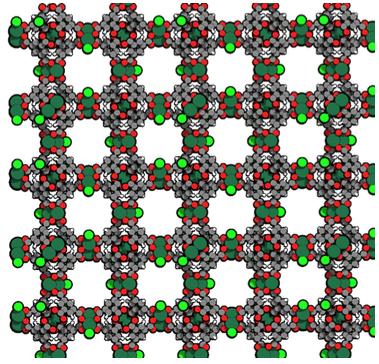
The production of 1-butene via ethylene dimerization is one of the few industrial processes that employs homogeneous catalysis due to their high selectivity–despite the massive amounts of activators and solvents required. Now, a new paper by the University of the Basque Country (UPV/EHU), in collaboration with the López group at the Institute of Chemical Research of Catalonia (ICIQ) and RTI International, shows a more sustainable alternative via metal-organic frameworks (MOFs), a family of porous materials formed by metallic nodes connected through organic ligands.

The scientists demonstrate that tailored MOFs under condensation regimes catalyze the ethylene dimerization to 1-butene with high selectivity and stability in the absence of activators and solvent. The research, published in Nature Communications, opens new avenues to develop robust heterogeneous catalysts for a wide variety of gas-phase reactions.

Know your defects…

The researchers have engineered defects in the MOF (Ru)HKUST-1 without compromising the framework structure via two strategies: a conventional ligand exchange approach during MOF synthesis and a pioneering post-synthetic thermal approach. The researchers then characterized the defects — which have been shown to be catalytically active for ethylene dimerization.

Thanks to the computational resources of the Barcelona Supercomputing Center (BSC), which belongs to the “Red Española de Supercomputación” (RES), the researchers were able to simulate realistic MOF systems to characterize the defects and compute the reaction mechanism. They found that unsaturated metal centers induced by defects drive activity, while the bimetallic nature of the node controls selectivity. After testing the catalytic performance of the system, they next improved the recyclability and robustness of the catalyst through one crucial condition: intrapore condensation.

…and fill the pores

Production of 1-butene via ethylene dimerization occurs in gas phase. When the reaction happens at low reactant pressure, some catalytic sites get deactivated due to the coordination of oligomers. But as pressure increases, the reactant molecules can condensate inside the pores of the material. Such a concentration effect avoids deactivation thus enhancing the stability of the catalyst.

The next steps of the project would involve the use of MOF catalysts based on first-row transition metals as well as the application of the novel intrapore condensation strategy to other gas-phase reactions.

###

Media Contact
Berta Carreño
[email protected]

Related Journal Article

http://dx.doi.org/10.1038/s41467-019-10013-6

Tags: Chemistry/Physics/Materials SciencesIndustrial Engineering/ChemistryMaterialsResearch/Development
Share12Tweet8Share2ShareShareShare2

Related Posts

How Olympic Weightlifting Harnesses the Barbell’s ‘Whip’ for Peak Performance #ASA190 — Chemistry

How Olympic Weightlifting Harnesses the Barbell’s ‘Whip’ for Peak Performance #ASA190

May 13, 2026
Just how effective are torpedo bats? #ASA190 — Chemistry

Just how effective are torpedo bats? #ASA190

May 13, 2026

Liquid-like Behavior Observed in Gold Nanoparticles

May 13, 2026

Vortex-Induced Triboelectric Nanogenerator Enables Efficient Multidirectional Wind Energy Harvesting in Low Wind and High Humidity Conditions

May 13, 2026
Please login to join discussion

POPULAR NEWS

  • Research Indicates Potential Connection Between Prenatal Medication Exposure and Elevated Autism Risk

    842 shares
    Share 337 Tweet 211
  • New Study Reveals Plants Can Detect the Sound of Rain

    728 shares
    Share 290 Tweet 182
  • Salmonella Haem Blocks Macrophages, Boosts Infection

    62 shares
    Share 25 Tweet 16
  • Breastmilk Balances E. coli and Beneficial Bacteria in Infant Gut Microbiomes

    57 shares
    Share 23 Tweet 14

About

We bring you the latest biotechnology news from best research centers and universities around the world. Check our website.

Follow us

Recent News

Engineered Water Channels Boost MRI Nanoprobe Sensitivity

Fearless Young Scientist Reveals Hidden Biodiversity in Snow and Glacier Ecosystems of Remote Antarctic Island

Boosting Microglia Repair Accelerates Stroke Recovery

Subscribe to Blog via Email

Success! An email was just sent to confirm your subscription. Please find the email now and click 'Confirm' to start subscribing.

Join 82 other subscribers
  • Contact Us

Bioengineer.org © Copyright 2023 All Rights Reserved.

Welcome Back!

Login to your account below

Forgotten Password?

Retrieve your password

Please enter your username or email address to reset your password.

Log In
No Result
View All Result
  • Homepages
    • Home Page 1
    • Home Page 2
  • News
  • National
  • Business
  • Health
  • Lifestyle
  • Science

Bioengineer.org © Copyright 2023 All Rights Reserved.