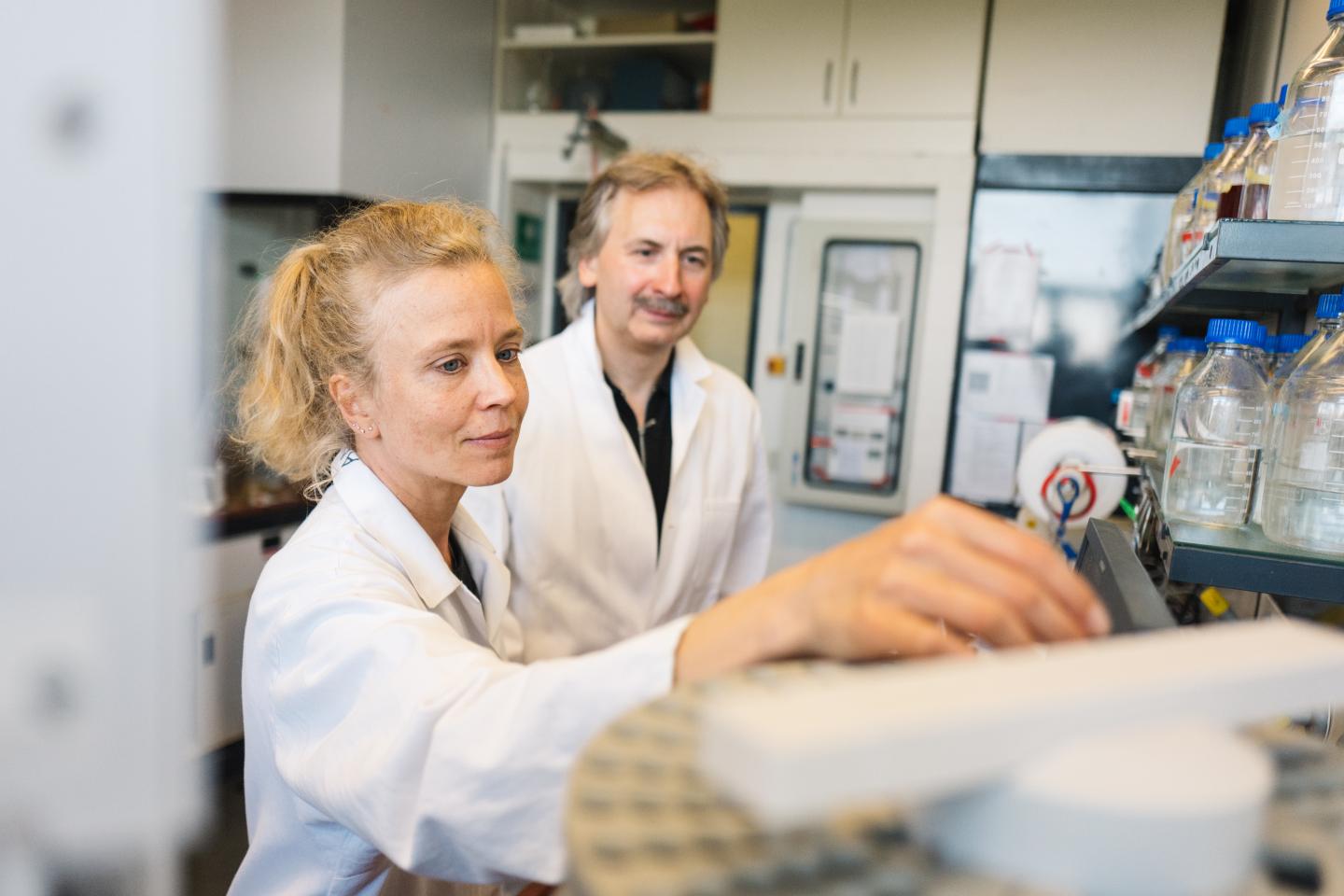
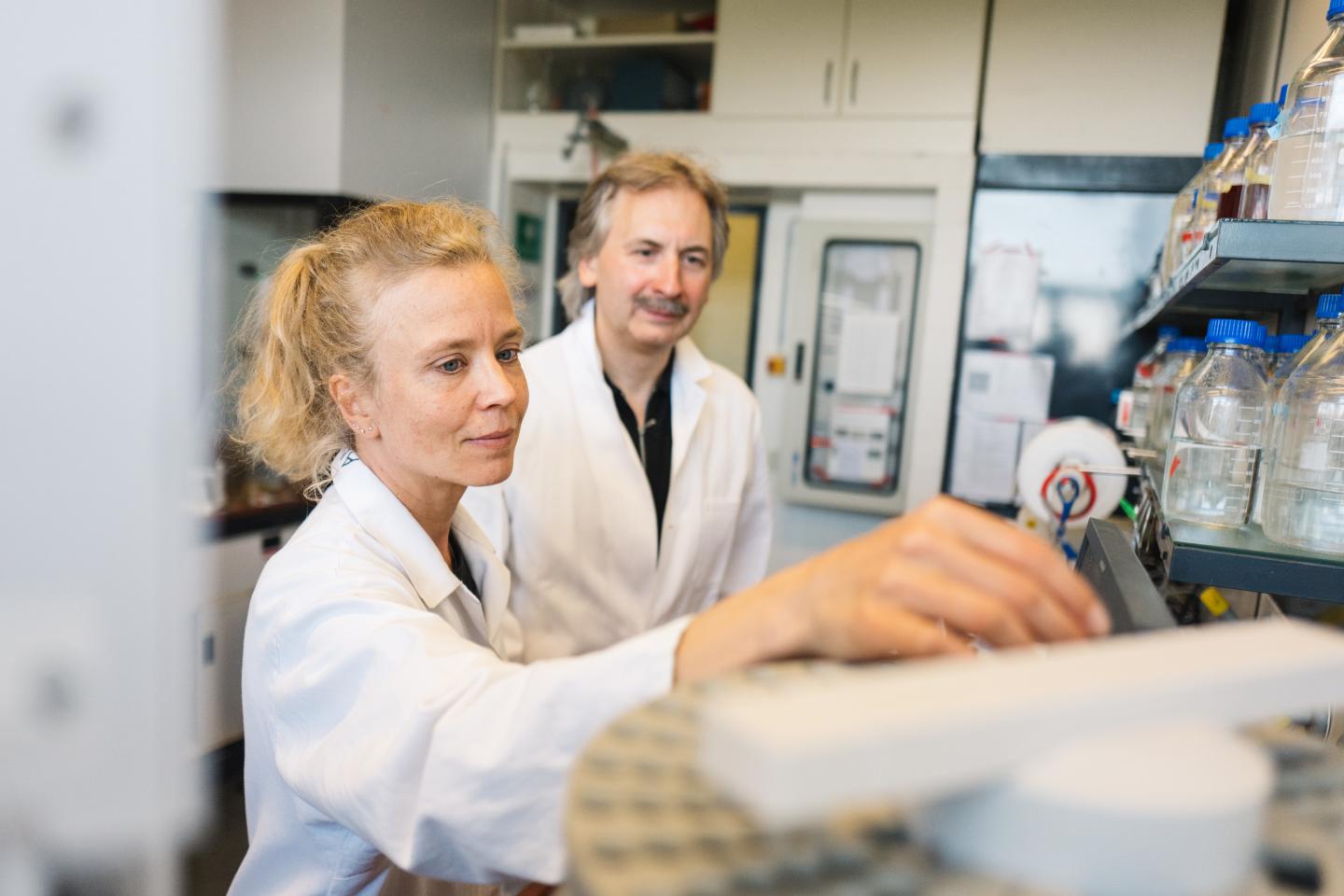
Credit: RUB, Kramer
Enzymes perform very specific functions and require only little energy – which is why the biocatalysts are also of interest to the chemical industry. In a review article published in the journal Nature Reviews Chemistry, Professor Thomas Happe and Associate Professor Anja Hemschemeier from the Photobiotechnology work group at Ruhr-Universität Bochum have provided a summary on what is known about the mechanisms of enzymes in nature. Moreover, the authors outline a future vision: artificial biocatalysts that are not protein-based, as they usually are in nature, but which are rather made from DNA. The article was published on 17 August 2018.
"Establishing a bio-based, enzyme-powered industry would be of tremendous value both for the sake of climate protection and for economic reasons", says Thomas Happe.
Protein-cofactor interactions are crucial
In nature, the most complicated and energy-intensive reactions are frequently performed by highly complex proteins. They contain cofactors that do not consist of proteins; rather, they are based on inorganic substances, often metals. In their article, Hemschemeier and Happe elaborate on the importance of atomic details for protein-cofactor interactions in so-called metalloenzymes.
The cofactor's chemical makeup is a crucial element towards understanding a metalloenzyme's precise reaction mechanism. Researchers have been manipulating individual atoms of a cofactor in order to decode its significance. "However, this is not always an easy task," says Happe. "That's because chemists have to artificially generate the cofactor, and the synthetic construct has to interact with the enzyme's protein part in a natural manner."
Semi-synthetic enzyme manufactured
A few years ago, a team headed by Thomas Happe succeeded in characterising the hydrogen-producing enzyme hydrogenase. In collaboration with chemists, the biologists developed a semi-synthetic hydrogenase enzyme, in which they can replace every single atom of the cofactor. This allows them to unravel how exactly protein and cofactor work together.
Hydrogenases may be usefully deployed in industry, in order to produce the potential energy carrier hydrogen. But natural hydrogenases are not very stable, especially when they are exposed to air. "Therefore, we wondered if we could redesign these enzymes towards more robust versions," explains Thomas Happe.
"Literature already provides many examples for the design of artificial proteins," elaborates Anja Hemschemeier. "However, proteins are often too unstable to meet the industry's requirements."
More stability through DNA
Consequently, the biotechnologists from Bochum have chosen a new approach: they intend to replace proteins by DNA, which is much more stable.
Researchers have known since the 1980s that nucleic acids are capable of catalysing chemical reactions, and this property has been studied in depth ever since. "We've found examples of nucleic acids that feature protein-like characteristics," says Hemschemeier. "They do, for instance, form precise 3D structures that facilitate specific chemical reactions."
In their review article, Happe and Hemschemeier therefore conclude: it is quite possible that in a not too distant future our industry will be able to utilise DNA-based catalysts that mimic biocatalysts as complex as the hydrogenase.
###
Media Contact
Anja Hemschemeier
[email protected]
49-234-322-3830
@ruhrunibochum
http://www.ruhr-uni-bochum.de
Original Source
http://news.rub.de/english/press-releases/2018-08-20-biotechnology-synthetic-dna-based-enzymes http://dx.doi.org/10.1038/s41570-018-0029-3