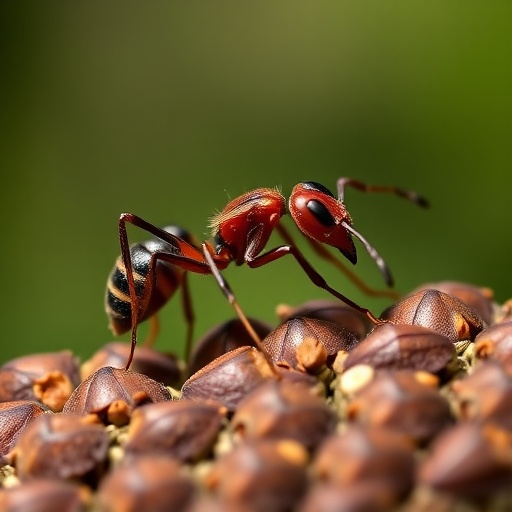
A sudden surge in ant activity after pesticide bait is placed in a home or garden may not mean the treatment has failed. New research from the University of California, Riverside, shows that Argentine ants can undergo striking behavioral changes as insecticides move through their colonies. Some poisoned ants become unusually active and wander far beyond the nest, while others stop foraging and crowd together near water. The findings suggest that what people see in the hours and days after applying bait may reflect neurological or physiological disruption rather than an increase in the colony’s strength.
The study, conducted in the laboratory of UC Riverside entomology professor Dong Hwan Choe, examined how invasive Argentine ants respond to two commonly used bait insecticides: thiamethoxam and boric acid. Argentine ants are among the most widespread household and garden pests in Southern California, where their interconnected colonies can extend across large areas. Although both chemicals killed most of the worker ants in the experiments, they acted at different speeds and produced sharply contrasting patterns of behavior. Thiamethoxam killed all workers in approximately seven days, whereas boric acid killed about 90 percent within roughly two weeks.
To observe the effects in detail, Choe and his students built transparent laboratory colonies that allowed them to monitor ants both inside their nesting chambers and in the surrounding foraging area. In an undisturbed colony, workers distribute themselves according to the needs of the group. Many remain inside the nest to care for the queen, larvae and other workers, while a smaller number leave to locate food and transport it back to the colony. This division of labor is essential to colony survival because it ensures that food collection, brood care and nest maintenance continue simultaneously.
After the ants encountered thiamethoxam, that normal organization broke down. A much larger proportion of workers moved outside the nest and began roaming through the available foraging space. Instead of following efficient food-searching routes, many appeared to wander aimlessly before eventually becoming immobile and dying. The behavior was particularly noticeable during the first one or two days after exposure, when the colony could appear more active than usual. According to Choe, the pattern may be explained by the insecticide’s effects on the nervous system, which can interfere with the signals that coordinate movement, orientation and normal behavioral responses.
Thiamethoxam belongs to the neonicotinoid class of insecticides. These compounds act on nicotinic acetylcholine receptors, proteins involved in transmitting signals between nerve cells and muscles. In insects, neonicotinoids bind to these receptors and stimulate them persistently rather than allowing normal, brief nerve impulses. The resulting overstimulation can produce tremors, disorganized movement and excessive activity before the nervous system becomes paralyzed. Thiamethoxam is therefore capable of making poisoned ants appear restless or hyperactive before it ultimately kills them. Choe compared the effect to a state in which the ants were “high on nicotine,” emphasizing that the insecticide had compromised their nervous systems.
The researchers observed an almost opposite response in colonies exposed to boric acid. Rather than streaming into the foraging area, affected ants largely stopped leaving the nest. They gathered tightly inside the nesting space, often close to sources of water. Boric acid is not primarily a neurotoxin like thiamethoxam. Once ingested, it can damage the lining of the ant’s midgut, the digestive region responsible for breaking down food and absorbing nutrients. It may also impair the Malpighian tubules, specialized excretory organs that regulate water balance and remove metabolic waste. The ants’ attraction to water could therefore be associated with disruption of their internal fluid regulation, although the study does not establish that mechanism conclusively.
These behavioral differences have practical consequences for anyone trying to interpret the results of ant baiting. If ants abruptly disappear after encountering boric acid, the colony may not have been eliminated. Surviving workers may simply have stopped foraging and retreated into the nest, creating the impression of a rapid victory. Their activity can resume later if the poison does not reach enough individuals or if the queen remains alive. With thiamethoxam, the visual signal can be reversed. Poisoned ants may wander into sinks, garages, windowsills or other conspicuous areas, making an infestation look worse even though the colony is being progressively weakened.
The study also highlights the biological challenge of delivering poison throughout a social insect colony. Worker ants exchange food through trophallaxis, the process of passing liquid food from one individual to another. This behavior allows insecticide-laced bait to move from foragers to nestmates, larvae and potentially the queen, but it also distributes and dilutes the chemical. The dose received by any individual ant may depend on how much bait a worker consumes, how often it shares food and how long it survives afterward. Choe suggested that lower doses of thiamethoxam might prolong the period of abnormal roaming, potentially extending the time during which poisoned workers remain visibly active.
Although both chemicals were highly effective against worker ants under laboratory conditions, neither treatment necessarily guaranteed the death of the queen. This is one reason ant control often provides only temporary relief. A colony can lose large numbers of workers and still recover if the queen survives and produces a new generation. In Argentine ants, the problem may be intensified by the species’ extensive networks of interconnected nests and multiple queens. New workers can eventually restore the colony’s foraging force, while nearby colonies may reinvade treated areas. The research therefore cautions against judging success solely by the number of ants visible immediately after bait application.
The project took more than two years and involved substantial contributions from students in Choe’s laboratory. By linking pesticide exposure with changes in movement, nest use and water-seeking behavior, the researchers provide a clearer picture of how insecticides affect ants before death occurs. The findings may help pest-control professionals and manufacturers design baits that better exploit the social biology of ants while reducing risks to non-target species. Thiamethoxam is highly effective against many insects but is subject to tighter restrictions because neonicotinoids can harm bees, particularly when used on flowering plants. Stationary bait systems can reduce exposure outside the intended target, but they still require careful handling. For consumers, the central message is straightforward: unusual ant activity after treatment may be evidence that the poison is working, not that it has failed.
Subject of Research: Behavioral and physiological responses of invasive Argentine ants to thiamethoxam and boric acid insecticides
News Publication Date: 29-Jul-2026
Web References: https://www.mdpi.com/2075-4450/17/8/785 ; https://doi.org/10.3390/insects17080785
References: Insects, DOI: 10.3390/insects17080785
Image Credits: Dong Hwan Choe/UCR
Keywords: Argentine ants, ants, insecticides, pesticides, thiamethoxam, boric acid, neonicotinoids, pest control, insect physiology, entomology, insect behavior, Hymenoptera
Tags: Ant behavior disruption from pesticide exposureant foraging and navigation disruption due to pesticidesArgentine ant colony responses to insecticidesbehavioral changes in ants after bait applicationeffects of thiamethoxam and boric acid on invasive antsimpact of pesticide bait on ant colony dynamicsinsecticide effects on household and garden pest antslaboratory studies on pesticide impactpesticide-induced neurological and physiological changes in antsrapid behavioral shifts in ants exposed to pesticidesrole of pesticide in ant activity and movement patterns