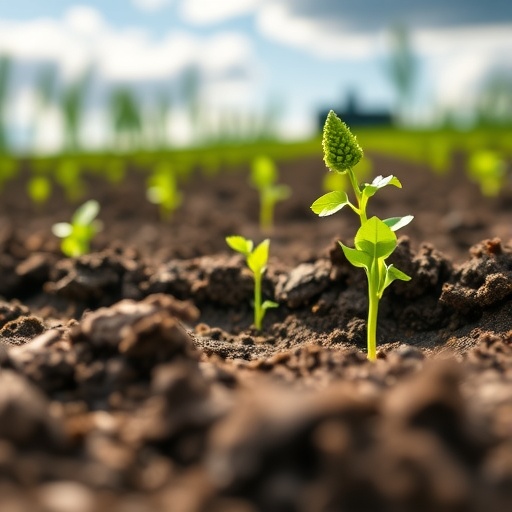
Acidic soils may have found an unlikely ally: communities of bacteria collected from the very environments that make farming difficult. In a new experimental study, researchers developed a two-member “synthetic community” of native soil microorganisms that reduced acidity around plant roots, improved nutrient availability, altered key microbial functions, and dramatically increased lettuce growth in greenhouse trials. The approach combines microbial ecology with an agricultural byproduct, offering a potential new strategy for restoring nutrient-poor soils without relying exclusively on conventional chemical amendments.
Soil acidification is a widespread agricultural problem. As soil pH falls, essential nutrients such as phosphorus, calcium, magnesium, and molybdenum can become difficult for plants to access, while potentially toxic forms of aluminum and manganese may become more soluble. Low pH can also disrupt the microbial communities responsible for decomposing organic matter and cycling nitrogen and phosphorus. Although farmers can apply lime and other materials to raise soil pH, these treatments may be expensive, short-lived, or difficult to apply across large areas. The researchers behind the new study asked whether microorganisms already adapted to acidic, nutrient-limited environments could help repair the biological condition of the soil from within.
To find suitable bacteria, the team sampled the rhizosphere—the narrow but biologically intense layer of soil directly surrounding plant roots—from strongly acidic red soil in Guangxi, China. This region provides a demanding natural environment in which microorganisms must tolerate both low pH and limited supplies of available carbon. In the laboratory, the scientists gradually reduced the carbon available to their microbial cultures. This enrichment process acted as a biological filter, favoring bacteria capable of surviving under the combined stresses of acidity and carbon scarcity rather than organisms that could thrive only under comfortable laboratory conditions.
Among the microorganisms that survived, two strains stood out: Paracoccus communis C4 and Paracoccus communis C5. Instead of applying either strain alone, the researchers combined them into a synthetic microbial community, known as a SynCom. Synthetic communities are deliberately assembled groups of microorganisms selected for complementary traits. The goal is not simply to introduce the largest possible number of bacteria, but to create a stable partnership in which different members perform different functions. In this case, the two Paracoccus strains displayed strong acid tolerance and worked together to modify their environment while producing compounds that could benefit plant development.
The SynCom changed the chemistry of its surrounding medium in laboratory cultures, raising the pH to 8.3 through the production of alkaline substances. That activity is important because microbial alkalinization could gradually reduce acid stress in the root zone, where plants absorb water and nutrients. The bacteria also produced 35.53 milligrams per liter of indole-3-acetic acid, or IAA. IAA is a naturally occurring auxin, a class of plant hormones that regulates cell elongation, root initiation, and the development of lateral roots. By combining an acid-neutralizing effect with the production of a plant-growth regulator, the bacterial community appeared to attack the problem from two directions: improving the soil environment and stimulating the plant’s capacity to explore it.
The researchers then faced a practical challenge that often limits microbial soil treatments: keeping beneficial bacteria alive after they leave the laboratory. To improve their survival and delivery, the team used filter mud, an organic residue generated during sugarcane processing, as a carrier material. The byproduct provided a protective matrix and potentially an additional source of nutrients for the microorganisms. The resulting amendment was applied to greenhouse pots containing lettuce grown in acidic soil. This design allowed the scientists to monitor both plant performance and the behavior of the introduced community in the root zone under controlled conditions.
The results were striking. After treatment, the SynCom successfully established itself in the lettuce rhizosphere, where it increased soil pH from 4.73 to 5.50. That change may appear modest, but even a shift of less than one pH unit represents a substantial change in hydrogen-ion concentration and can alter the solubility and availability of multiple nutrients. Compared with untreated lettuce, plants receiving the microbial amendment were 120.60 percent taller, had 527.83 percent greater fresh weight, and contained 33.80 percent more chlorophyll. Fresh weight is influenced by water content as well as biomass, but the scale of the increase nevertheless indicates a major improvement in overall plant performance under the greenhouse conditions.
The effects were not limited to what could be seen above the soil. Treated lettuce developed more extensive root systems, including increases in lateral root formation, total root length, and root surface area. A larger and more highly branched root system can provide plants with greater access to water and nutrients, while also creating additional habitat for beneficial microorganisms. The treatment was associated with improved nitrogen availability and broader changes in the chemical and biological conditions of the rhizosphere. These results are consistent with a feedback loop in which bacteria improve the root environment, plants grow more vigorously, and expanding roots in turn provide additional carbon compounds that support microbial activity.
To investigate that feedback at the molecular level, the team performed metagenomic analysis, examining the genetic potential of the microbial community in treated and untreated soil. The SynCom reshaped functions linked to carbon, nitrogen, and phosphorus cycling. One of the most pronounced changes involved cbbL, a gene associated with microbial carbon fixation. Its abundance increased approximately 25-fold compared with the untreated control. Genes related to nitrogen fixation, ammonium production, phosphorus solubilization, and phosphorus transport also became more abundant. These changes suggest that the bacteria did more than simply neutralize acidity. They helped create a more active rhizosphere in which microorganisms could contribute to carbon transformation and sequestration, release or mobilize nutrients, and potentially make phosphorus more accessible to plants.
The study presents native microbial communities as a possible foundation for a new generation of biofertilizers designed for specific soil conditions. Because the bacteria were collected from acidic, carbon-limited soil, they may be better prepared to survive in the environments where they are intended to work than microorganisms imported from unrelated ecosystems. The use of sugarcane filter mud also points toward a circular approach, turning an agricultural byproduct into a carrier for soil restoration. However, the findings remain preliminary. The experiments were conducted in greenhouse pots rather than open fields, where temperature fluctuations, rainfall, competing microorganisms, crop diversity, and uneven soil chemistry could all influence performance. Field trials will be necessary to determine whether the SynCom remains stable, consistently improves crop yields, and produces lasting changes in soil health. Even so, the results offer a compelling glimpse of how carefully designed microbial partnerships could transform acidic farmland from a hostile growing environment into a more productive and biologically active ecosystem.
Subject of Research: Native synthetic microbial communities for improving acidic soil, nutrient cycling, and crop growth
Article Title: Mechanism of synthetic communities in improving acidic soil and promoting crop growth
News Publication Date: 30-Jul-2026
Web References: https://doi.org/10.48130/aee-0026-0018; Agricultural Ecology and Environment
References: Rong Q, Lu S, Huang J, Wei J, Zhang Z, et al. 2026. “Mechanism of synthetic communities in improving acidic soil and promoting crop growth.” Agricultural Ecology and Environment 2: e020. DOI: 10.48130/aee-0026-0018
Image Credits: Qun Rong, Siting Lu, Jingyun Huang, Junrong Wei, Zengyu Zhang, Shu Yang, Chaolan Zhang & Xiaofeng Li
Keywords
Acidic soil, synthetic microbial community, SynCom, Paracoccus communis, soil bacteria, biofertilizer, rhizosphere, lettuce growth, nutrient cycling, plant hormones, indole-3-acetic acid, phosphorus solubilization, nitrogen cycling, sustainable agriculture, microbial ecology