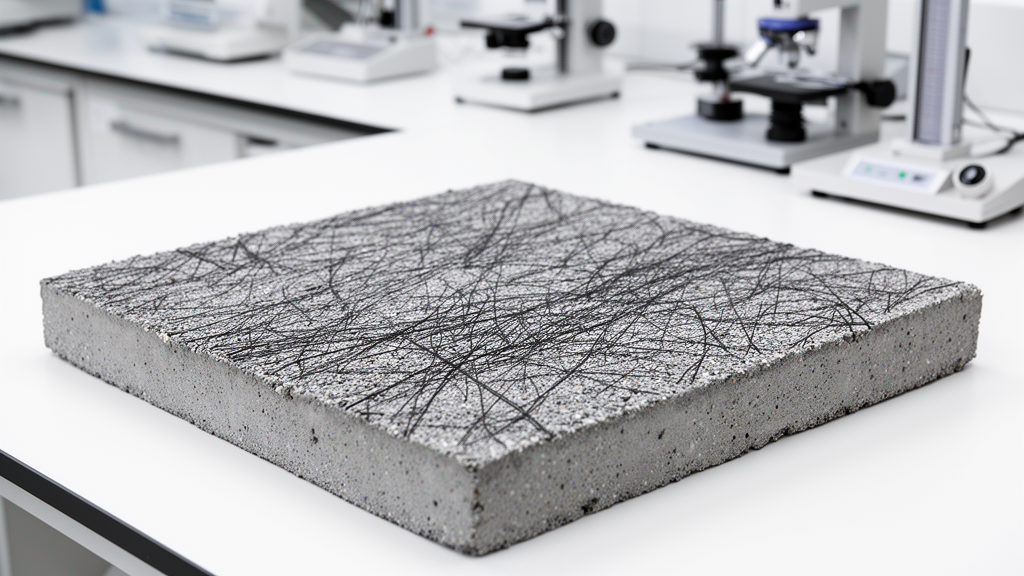
Civil engineering researchers have demonstrated that generative machine learning techniques can significantly enhance the predictive modeling of electrical conductivity in multifunctional cementitious composites, particularly when empirical laboratory data remain severely restricted. Conventional cement-based materials are universally valued for their mechanical capacity and structural durability, yet standard formulations possess inherent limitations regarding active functional responses such as real-time internal strain sensing, environmental thermal regulation, and dynamic energy conversion. To address these functional shortcomings, investigators have increasingly formulated conductive cementitious composites engineered with specialized conductive additives. These responsive composites enable practical infrastructure innovations, including highway bridges capable of autonomously detecting microcrack initiation, highway pavements embedded with resistive de-icing functionalities, and transportation surfaces that harvest mechanical kinetic energy. However, successfully implementing these smart civil structures demands meticulous control and highly accurate quantitative prediction of material electrical conductivity based on complex mixture proportions and component ratios.
Predicting the electrical performance of conductive concrete has historically posed major modeling challenges because electrical conductivity behaves in an intensely nonlinear manner rather than changing monotonically as conductive filler contents increase. As functional conductive particles are incrementally added to a cementitious matrix, the material reaches a critical percolation threshold where continuous electrical transport pathways spontaneously bridge across the matrix, resulting in sharp, order-of-magnitude increases in overall electrical conductivity. Conversely, incorporating excessive amounts of conductive particles frequently promotes physical particle agglomeration and exacerbates internal matrix porosity, which disrupts uniform conductive network continuity and causes conductivity values to plateau or paradoxically diminish. Furthermore, external experimental inconsistencies, variations in two-probe versus four-probe electrical measurement setups, ambient curing humidity, temperature fluctuations, and variable filler dispersion mechanisms introduce considerable statistical noise and low cross-study uniformity into published material records, severely constraining the volume of reliable training data available for data-driven computational algorithms.
To overcome these data scarcity and distributional obstacles, an investigative team compiled an empirical dataset comprising one hundred and seventy experimental records gathered across multiple independent published investigations. Rather than discarding highly conductive mixtures that reached conductivity levels as high as approximately 24.5 siemens per meter, the investigators intentionally retained these elevated measurements within the modeling corpus, recognizing that they represented deliberately designed functional formulations rather than random experimental outliers. To ensure robust mathematical comparability across disparate laboratory sources, the researchers standardized all conductivity units and physical parameter definitions while structuring a clean nine-variable input feature space. These selected independent variables encompassed key conductive material geometric characteristics alongside fundamental concrete formulation parameters, including conductive filler mixing amount, carbon content, filler aspect ratio, specific surface area, water-to-cement ratio, sand content, silica fume proportion, fly ash content, and superplasticizer dosage.
Prior to machine learning training, the researchers conducted systematic feature screening and statistical preprocessing to eliminate severe multicollinearity and stabilize numerical calculations. Diagnostic variance inflation factor evaluations revealed that raw cement content, raw water content, and a derived conductive index exhibited variance inflation factors well above the acceptable threshold of 5.0, registering values of 8.18, 7.50, and 5.67 respectively. By removing these three redundant variables, the team reduced all remaining input feature variance inflation factors below 5.0, confirming the elimination of detrimental multicollinearity. To handle the pronounced right-skewed asymmetry of raw electrical conductivity measurements, which could otherwise distort loss functions and overly emphasize extreme values, the researchers executed a logarithmic plus one transformation on the target property. Feature scaling was then conducted via a standard scalar applied strictly to training folds based solely on training statistics, thereby strictly avoiding any data leakage across validation splits.
Addressing the fundamental barrier of small sample size, the researchers deployed a tabular variational autoencoder to perform generative data augmentation directly on the training dataset. Unlike basic mathematical resampling or interpolation techniques, a tabular variational autoencoder learns the comprehensive joint distribution and underlying latent structures of heterogeneous tabular features, generating synthetic entries that preserve complex multivariate interrelationships. Utilizing the generative autoencoder on the training split, the team generated two hundred and thirty-eight synthetic records, precisely doubling the training volume to yield a total augmented training pool of three hundred and fifty-seven records, while keeping the independent evaluation set entirely untouched.
Rigorous statistical validation confirmed that the synthetic observations closely reproduced the geometric and correlation characteristics of the actual physical mixtures. Quantitative distribution comparisons yielded an average Kolmogorov-Smirnov statistic of 0.255 and a median Wasserstein distance of 28.3, demonstrating minimal distribution disparity between synthetic and real measurements across all nine dimensions. Furthermore, the synthetic dataset exhibited a spatial coverage index of 0.991, verifying that artificial points covered approximately ninety-nine percent of the empirical support domain, while a small Frobenius norm difference of 0.72 confirmed that pairwise correlation structures remained intact. Principal component analysis and t-distributed stochastic neighbor embedding visualizations corroborated that the global variance trajectories and local cluster geometries of the augmented samples aligned smoothly with empirical records, providing a robust statistical substrate for downstream machine learning architectures without introducing artificial data leakage into five-fold cross-validation folds.
The researchers conducted exhaustive benchmark comparisons across nine distinct machine learning algorithms spanning six algorithmic families: linear regression, distance-based k-nearest neighbors, kernel-based support vector regression, single decision trees, tree-based ensemble models including random forest, extreme gradient boosting, and categorical boosting, Gaussian process regression, and multilayer perceptron neural networks. Baseline testing on unaugmented data underscored the severe inadequacy of linear modeling, as basic linear regression achieved the poorest predictive accuracy, underestimating higher conductivity values due to its inability to represent nonlinear percolation transitions.
When the models were retrained on the tabular variational autoencoder augmented datasets, the resulting performance trajectories diverged dramatically depending on underlying model architectures. The categorical boosting algorithm, CatBoost, exhibited the most extraordinary enhancement, reducing its cross-validation root mean squared error by 61.1 percent from 1.3861 down to 0.5395, dropping its mean absolute error by 52.5 percent from 0.3839 to 0.1824, and raising its coefficient of determination from 0.9342 to 0.9841. Random forest and extreme gradient boosting similarly retained exceptional, highly stable predictive accuracy across augmented conditions. Conversely, distance-based k-nearest neighbors suffered from distorted local distance metrics, while multilayer perceptron neural networks experienced pronounced degradation due to their extreme sensitivity to distributional shifts under small tabular sample regimes, demonstrating that data augmentation is not universally beneficial across different machine learning paradigms.
To evaluate generalization capability and identify latent overfitting, the research team implemented a comprehensive objective function metric that mathematically balances training error, testing error, sample set sizes, and correlation coefficients. CatBoost demonstrated remarkable generalization stability after generative data augmentation, exhibiting a marked decline in its objective function value that reflected an effective structural regularization effect. In contrast, non-ensemble methods such as k-nearest neighbors, support vector regression, and multilayer perceptrons exhibited sharply elevated objective function scores on augmented sets, revealing that synthetic data introduced variance that disrupted their decision boundaries. Furthermore, a comparative exploration between Gaussian process Bayesian optimization and tree-structured Parzen estimator hyperparameter tuning revealed that tree ensembles consistently adapted well across both optimization strategies, whereas kernel and neural models proved vulnerable to hyperparameter-induced over-smoothing.
To demystify internal model reasoning and extract actionable physical insights, the authors applied feature importance calculations alongside Shapley additive explanations to the top-performing CatBoost and extreme gradient boosting models. Although specific ranking hierarchies exhibited minor model-dependent variations, Shapley analysis converged on the total mixing amount of conductive materials, specific surface area, and fly ash content as the most universally dominant variables governing electrical conductivity. Higher mixing amounts generated consistently positive Shapley contributions across both algorithms, confirming that expanding filler fractions actively drives conductive network formation toward and beyond percolation. Specific surface area displayed predominantly negative contributions at higher values, reflecting the detrimental impact of excessive surface area on particle agglomeration and matrix dispersion quality.
Intriguingly, Shapley attribution unveiled a highly complex, nonlinear, value-dependent contribution pattern for supplementary fly ash content across mixture formulations. At lower concentration levels, fly ash incorporation exerted predominantly negative Shapley values, actively reducing predicted electrical conductivity by altering pore structure geometry, densifying the cementitious matrix, and heightening base matrix electrical resistivity. However, at higher concentration ranges, fly ash contributions stabilized near zero with occasional positive shifts, demonstrating that secondary mineral admixtures fundamentally alter conductive particle spacing and matrix transport dynamics in subtle, non-monotonic ways. Meanwhile, secondary parameters such as silica fume content, water-to-cement ratio, superplasticizer dosage, and aspect ratio displayed symmetrical distributions around zero, indicating modest secondary influences relative to the primary percolation drivers.
The study authors concluded that while generative data augmentation via tabular variational autoencoders offers an effective, low-cost computational methodology for mitigating data scarcity in smart construction materials research, its implementation must be carefully paired with compatible tree-based ensemble architectures such as CatBoost. The researchers emphasized that computational predictions derived from augmented datasets should function as an intelligent decision-support mechanism to screen prospective mixture designs and narrow experimental trial parameters prior to physical fabrication. Future research initiatives must focus on compiling comprehensive field-scale experimental datasets that systematically record environmental temperatures, curing humidity, and standardized electrical probe geometries, ultimately integrating physics-informed structural constraints with machine learning frameworks to ensure robust, real-world deployment in self-monitoring concrete infrastructure.
Subject of Research: Machine learning prediction of electrical conductivity in conductive cementitious composites
Article Title: Enhancing Machine Learning-Based Prediction of Electrical Conductivity in Cementitious Composites
Article References: Sung, J., Kang, M.-C., Hu, J. W., You, I., Pyo, S., & Lee, S.-J. (2026). Enhancing Machine Learning-Based Prediction of Electrical Conductivity in Cementitious Composites. International Journal of Concrete Structures and Materials, 20(1), Article 82. https://doi.org/10.1186/s40069-026-00953-x
Image Credits: AI Generated
DOI: 10.1186/s40069-026-00953-x
Keywords: Conductive cementitious composites, Electrical conductivity, Machine learning, Data augmentation, Tabular variational autoencoder, CatBoost, XGBoost, Random forest, Support vector regression, Decision tree, Gaussian process regression, Bayesian optimization, Tree-structured Parzen estimator, Cross-validation, Feature engineering, Shapley additive explanations, Fly ash, Mixing amount, Percolation threshold, Materials informatics
News Source: Teresa Odom. (November 19, 2026). Synthetic Data Augmentation Improves Machine Learning Predictions of Electrically Conductive Concrete. Scienmag.