• HOME
  • NEWS
  • EXPLORE
    • CAREER
      • Companies
      • Jobs
    • EVENTS
    • iGEM
      • News
      • Team
    • PHOTOS
    • VIDEO
    • WIKI
  • BLOG
  • COMMUNITY
    • FACEBOOK
    • INSTAGRAM
    • TWITTER
Friday, September 25, 2026
BIOENGINEER.ORG
No Result
View All Result
  • Login
  • HOME
  • NEWS
  • EXPLORE
    • CAREER
      • Companies
      • Jobs
        • Lecturer
        • PhD Studentship
        • Postdoc
        • Research Assistant
    • EVENTS
    • iGEM
      • News
      • Team
    • PHOTOS
    • VIDEO
    • WIKI
  • BLOG
  • COMMUNITY
    • FACEBOOK
    • INSTAGRAM
    • TWITTER
  • HOME
  • NEWS
  • EXPLORE
    • CAREER
      • Companies
      • Jobs
        • Lecturer
        • PhD Studentship
        • Postdoc
        • Research Assistant
    • EVENTS
    • iGEM
      • News
      • Team
    • PHOTOS
    • VIDEO
    • WIKI
  • BLOG
  • COMMUNITY
    • FACEBOOK
    • INSTAGRAM
    • TWITTER
No Result
View All Result
Bioengineer.org
No Result
View All Result
Home NEWS Science News Biology

Synthes, in silico molecular docking & pharmacokinetic studies

Bioengineer by Bioengineer
January 11, 2019
in Biology
Reading Time: 2 mins read
0
IMAGE
Share on FacebookShare on TwitterShare on LinkedinShare on RedditShare on Telegram

This article by Dr. Navin B. Patel et al. is published in Current Computer-Aided Drug Design Volume 14 , Issue 4 , 2018
IMAGE

Credit: Bentham Science Publishers, Navin B. Patel


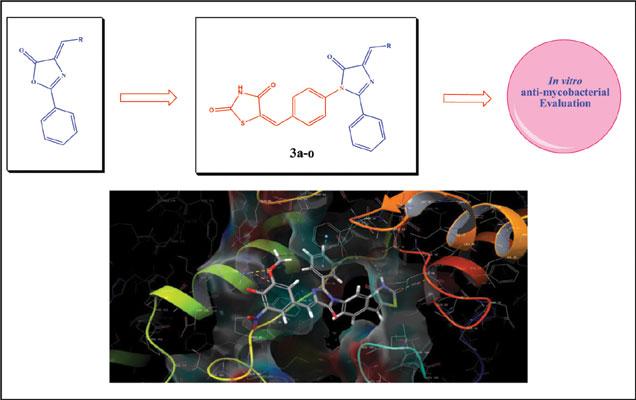
Researchers from the Department of Chemistry, Veer Narmad South Gujarat University, India have designed and synthesized azole scaffolds (a series of A series of (E)-5-(4-((Z)-4-substitutedbenzylidene-2-thienylmethylene-5-oxo- 2-phenyl-4,5-dihydro-1H-imidazol-1-yl) benzylidene)thiazolidine-2,4-diones). Analysis of ligand-protein interactions was also conducted using molecular docking studies with (InhA) Enoyl-ACP reductase of the type II fatty acid synthase (FAS-II) system along with an investigation of the ADME properties of the scaffolds for use in oral medicine.

In vitro antimycobacterial activity was carried out against the M. tuberculosis H37Rv strain using Lowenstein-Jensen medium and antimicrobial activity against two gram-positive bacteria (S. aureus, S. pyogenes), two gram-negative bacteria (E. coli, P. aeruginosa) and three fungal species (C. albicans, A. niger, A. clavatus) using the broth microdilution method. In silico molecular docking studies were carried out using Glide (grid-based ligand docking) program incorporated in the Schrödinger molecular modeling package by Maestro 11.0 and ADME properties of synthesized compounds was performed using DruLito software.

Patel et al’s investigations revealed 6 compounds that exhibited promising antimicrobial activity and 1 compound (labelled 3n) which showed very good antimycobacterial activity along with Gilde docking score (-8.864) and with the one violation in Lipinski’s rule of five.

The researchers note that this is a preliminary result which gives directions for improving pharmaceutical derivatives for the treatment of tuberculosis. This article is Open Access. To obtain the article please visit http://www.eurekaselect.com/162197

###

Media Contact
Faizan ul Haq
[email protected]

Related Journal Article

http://dx.doi.org/10.2174/1573409914666180516113552

Tags: Atomic/Molecular/Particle PhysicsBiochemistryCell BiologyMedicine/HealthMolecular BiologyMolecular Physics
Share12Tweet8Share2ShareShareShare2

Related Posts

Cell Death Regulator BI-1 Emerges as Key Switch in Plant Immunity Against Oomycete Pathogens

Cell Death Regulator BI-1 Emerges as Key Switch in Plant Immunity Against Oomycete Pathogens

September 25, 2026
Chemists Turn to Eudesmol Isomers to Grade the World’s Priciest Wood

Chemists Turn to Eudesmol Isomers to Grade the World’s Priciest Wood

September 25, 2026

AI-Guided Modeling Uncovers Hidden Switches That Could Heat Up Cold Pancreatic Tumors

September 25, 2026

NAD+ Collapse Drives Senescent CD8+ T Cells That Worsen Ulcerative Colitis

September 25, 2026
Please login to join discussion

POPULAR NEWS

  • Baby Teeth Reveal a Narrow Window Around Birth When Arsenic Weakens Vaccine Immunity

    29 shares
    Share 12 Tweet 7
  • Cell Death Regulator BI-1 Emerges as Key Switch in Plant Immunity Against Oomycete Pathogens

    29 shares
    Share 12 Tweet 7
  • One Robot, Three Rules: How Japan, China and Hong Kong See AI Harm Differently

    29 shares
    Share 12 Tweet 7
  • Rare Brain Calcification Disorder and Cerebellar Tumor Collide in One Patient

    29 shares
    Share 12 Tweet 7

About

We bring you the latest biotechnology news from best research centers and universities around the world. Check our website.

Follow us

Recent News

Baby Teeth Reveal a Narrow Window Around Birth When Arsenic Weakens Vaccine Immunity

Cell Death Regulator BI-1 Emerges as Key Switch in Plant Immunity Against Oomycete Pathogens

One Robot, Three Rules: How Japan, China and Hong Kong See AI Harm Differently

Subscribe to Blog via Email

Enter your email address to subscribe to this blog and receive notifications of new posts by email.

Join 85 other subscribers
  • Contact Us

Bioengineer.org © Copyright 2023 All Rights Reserved.

Welcome Back!

Login to your account below

Forgotten Password?

Retrieve your password

Please enter your username or email address to reset your password.

Log In
No Result
View All Result
  • Homepages
    • Home Page 1
    • Home Page 2
  • News
  • National
  • Business
  • Health
  • Lifestyle
  • Science

Bioengineer.org © Copyright 2023 All Rights Reserved.