• HOME
  • NEWS
  • EXPLORE
    • CAREER
      • Companies
      • Jobs
    • EVENTS
    • iGEM
      • News
      • Team
    • PHOTOS
    • VIDEO
    • WIKI
  • BLOG
  • COMMUNITY
    • FACEBOOK
    • INSTAGRAM
    • TWITTER
Thursday, March 26, 2026
BIOENGINEER.ORG
No Result
View All Result
  • Login
  • HOME
  • NEWS
  • EXPLORE
    • CAREER
      • Companies
      • Jobs
        • Lecturer
        • PhD Studentship
        • Postdoc
        • Research Assistant
    • EVENTS
    • iGEM
      • News
      • Team
    • PHOTOS
    • VIDEO
    • WIKI
  • BLOG
  • COMMUNITY
    • FACEBOOK
    • INSTAGRAM
    • TWITTER
  • HOME
  • NEWS
  • EXPLORE
    • CAREER
      • Companies
      • Jobs
        • Lecturer
        • PhD Studentship
        • Postdoc
        • Research Assistant
    • EVENTS
    • iGEM
      • News
      • Team
    • PHOTOS
    • VIDEO
    • WIKI
  • BLOG
  • COMMUNITY
    • FACEBOOK
    • INSTAGRAM
    • TWITTER
No Result
View All Result
Bioengineer.org
No Result
View All Result
Home NEWS Science News Biology

Synthes, in silico molecular docking & pharmacokinetic studies

Bioengineer by Bioengineer
January 11, 2019
in Biology
Reading Time: 2 mins read
0
IMAGE
Share on FacebookShare on TwitterShare on LinkedinShare on RedditShare on Telegram

This article by Dr. Navin B. Patel et al. is published in Current Computer-Aided Drug Design Volume 14 , Issue 4 , 2018
IMAGE

Credit: Bentham Science Publishers, Navin B. Patel


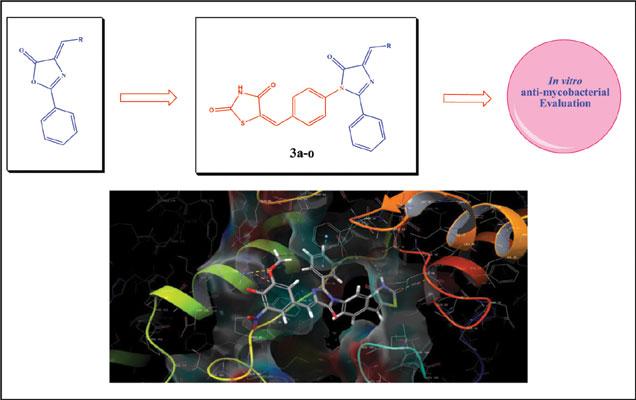
Researchers from the Department of Chemistry, Veer Narmad South Gujarat University, India have designed and synthesized azole scaffolds (a series of A series of (E)-5-(4-((Z)-4-substitutedbenzylidene-2-thienylmethylene-5-oxo- 2-phenyl-4,5-dihydro-1H-imidazol-1-yl) benzylidene)thiazolidine-2,4-diones). Analysis of ligand-protein interactions was also conducted using molecular docking studies with (InhA) Enoyl-ACP reductase of the type II fatty acid synthase (FAS-II) system along with an investigation of the ADME properties of the scaffolds for use in oral medicine.

In vitro antimycobacterial activity was carried out against the M. tuberculosis H37Rv strain using Lowenstein-Jensen medium and antimicrobial activity against two gram-positive bacteria (S. aureus, S. pyogenes), two gram-negative bacteria (E. coli, P. aeruginosa) and three fungal species (C. albicans, A. niger, A. clavatus) using the broth microdilution method. In silico molecular docking studies were carried out using Glide (grid-based ligand docking) program incorporated in the Schrödinger molecular modeling package by Maestro 11.0 and ADME properties of synthesized compounds was performed using DruLito software.

Patel et al’s investigations revealed 6 compounds that exhibited promising antimicrobial activity and 1 compound (labelled 3n) which showed very good antimycobacterial activity along with Gilde docking score (-8.864) and with the one violation in Lipinski’s rule of five.

The researchers note that this is a preliminary result which gives directions for improving pharmaceutical derivatives for the treatment of tuberculosis. This article is Open Access. To obtain the article please visit http://www.eurekaselect.com/162197

###

Media Contact
Faizan ul Haq
[email protected]

Related Journal Article

http://dx.doi.org/10.2174/1573409914666180516113552

Tags: Atomic/Molecular/Particle PhysicsBiochemistryCell BiologyMedicine/HealthMolecular BiologyMolecular Physics
Share12Tweet8Share2ShareShareShare2

Related Posts

How to sway group opinions: Encourage opponents to stay undecided

How to sway group opinions: Encourage opponents to stay undecided

March 23, 2026
Deep Learning Model Maps How Individual Cells Shape Disease Outcomes

Deep Learning Model Maps How Individual Cells Shape Disease Outcomes

March 20, 2026

Removing only 15 female sharks annually could endanger the entire population, scientists warn

March 20, 2026

Scientists Urge Fragrance Industry to Transition from Sustainability Talk to Active Funding of Plant Conservation

March 20, 2026
Please login to join discussion

POPULAR NEWS

  • blank

    Revolutionary AI Model Enhances Precision in Detecting Food Contamination

    96 shares
    Share 38 Tweet 24
  • Imagine a Social Media Feed That Challenges Your Views Instead of Reinforcing Them

    1003 shares
    Share 397 Tweet 248
  • Uncovering Functions of Cavernous Malformation Proteins in Organoids

    54 shares
    Share 22 Tweet 14
  • Promising Outcomes from First Clinical Trials of Gene Regulation in Epilepsy

    51 shares
    Share 20 Tweet 13

About

We bring you the latest biotechnology news from best research centers and universities around the world. Check our website.

Follow us

Recent News

In-Sensor Cryptography Links Physical Process to Digital Identity

Can Psychosocial Factors Influence Cancer Risk?

Depression Factors in Elderly: Pre vs. Post-COVID Analysis

Subscribe to Blog via Email

Success! An email was just sent to confirm your subscription. Please find the email now and click 'Confirm' to start subscribing.

Join 78 other subscribers
  • Contact Us

Bioengineer.org © Copyright 2023 All Rights Reserved.

Welcome Back!

Login to your account below

Forgotten Password?

Retrieve your password

Please enter your username or email address to reset your password.

Log In
No Result
View All Result
  • Homepages
    • Home Page 1
    • Home Page 2
  • News
  • National
  • Business
  • Health
  • Lifestyle
  • Science

Bioengineer.org © Copyright 2023 All Rights Reserved.