• HOME
  • NEWS
  • EXPLORE
    • CAREER
      • Companies
      • Jobs
    • EVENTS
    • iGEM
      • News
      • Team
    • PHOTOS
    • VIDEO
    • WIKI
  • BLOG
  • COMMUNITY
    • FACEBOOK
    • INSTAGRAM
    • TWITTER
Tuesday, July 7, 2026
BIOENGINEER.ORG
No Result
View All Result
  • Login
  • HOME
  • NEWS
  • EXPLORE
    • CAREER
      • Companies
      • Jobs
        • Lecturer
        • PhD Studentship
        • Postdoc
        • Research Assistant
    • EVENTS
    • iGEM
      • News
      • Team
    • PHOTOS
    • VIDEO
    • WIKI
  • BLOG
  • COMMUNITY
    • FACEBOOK
    • INSTAGRAM
    • TWITTER
  • HOME
  • NEWS
  • EXPLORE
    • CAREER
      • Companies
      • Jobs
        • Lecturer
        • PhD Studentship
        • Postdoc
        • Research Assistant
    • EVENTS
    • iGEM
      • News
      • Team
    • PHOTOS
    • VIDEO
    • WIKI
  • BLOG
  • COMMUNITY
    • FACEBOOK
    • INSTAGRAM
    • TWITTER
No Result
View All Result
Bioengineer.org
No Result
View All Result
Home NEWS Science News Biology

SUTD researchers developed new methods to create microfluidic devices with fluoropolymers

Bioengineer by Bioengineer
February 7, 2019
in Biology
Reading Time: 2 mins read
0
IMAGE
Share on FacebookShare on TwitterShare on LinkedinShare on RedditShare on Telegram

IMAGE

Credit: SUTD

Currently, a wide range of applications has been demonstrated using microfluidic devices made of silicone rubbers (such as polydimethylsiloxane (PDMS)), including materials syntheses, separation and sorting, diagnostics and bioanalysis. The reason for the popularity of PDMS in academic laboratories is the simplicity of the fabrication and well-characterised properties of PDMS. However, PDMS are not compatible with strong organic solvents; they quickly swell silicone-based materials. To this end, microfluidic channels possessing chemical and solvent compatibility would be desirable.

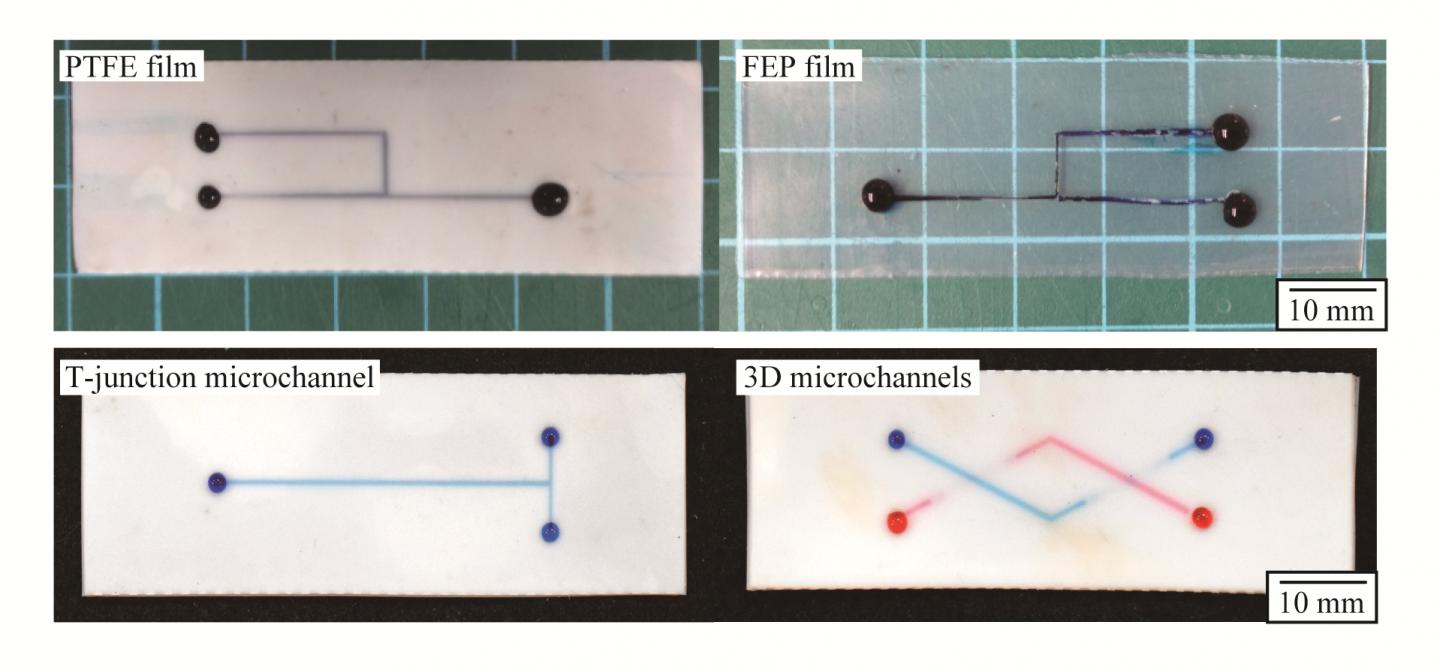
A research team from the Singapore University of Technology and Design (SUTD), led by Assistant Professor Michinao Hashimoto, developed a simple method to fabricate microchannels using fluoropolymers – a general class of polymers including TeflonTM that are highly inert against the exposure to chemicals and solvents. The research group applied xurography (i.e. a method of digital fabrication to cut films with a motion-controlled razor blade to create stencils) to cut films of fluoropolymers and heat-press to from microchannels. It takes less than 1 hour to make microchannels from designing to assembling using this method.

The research team has identified proper conditions of heat pressing (i.e. temperature, time and pressure) for two common fluoropolymers: polytetrafluoroethylene (PTFE) and fluorinated ethylene propylene (FEP). Furthermore, the team confirmed the fluoropolymer microfluidic channels’ resistance to a set of organic solvents that would not be compatible with typical devices fabricated in PDMS.

Principal investigator, Dr Hashimoto said: “This work is the first demonstration to bridge the gap to rapidly fabricate microfluidic channels using fluoropolymers. Microchannels consisting of fluoropolymers can be useful in performing organic syntheses of materials and drugs as well as regulating adhesion of biological molecules, cells and bacteria. This method is extremely simple, and we believe it can be performed by literally any researcher–including non-engineers–for various applications that require the inert and non-reactive properties of the channels.”

This new prototyping technique has been published in Biomicrofluidics, a reputable journal focused on research in unique microfluidic and nanofluidic techniques. An SUTD visiting students (Takuma Hizawa) and two postdoctoral researchers (Atsushi Takano, Pravien Parthiban) participated in this project together with the senior authors (Prof. Eiji Iwase, Waseda University, Japan, and Prof. Patrick Doyle, MIT, USA).

###

Media Contact
Melissa Koh
[email protected]
65-649-98742

Related Journal Article

http://dx.doi.org/10.1063/1.5051666

Tags: Biomedical/Environmental/Chemical EngineeringBiotechnologyTechnology/Engineering/Computer Science
Share12Tweet8Share2ShareShareShare2

Related Posts

Here are a few rewritten headlines for a science magazine post, each with a slightly different tone: Intriguing & poetic: How do organs sculpt themselves? Sea stars hold the secret Direct & research-focused: Sea stars reveal the hidden rules of organ formation Metaphorical & inviting: Tiny architects beneath the waves: What sea stars teach us about building organs Short & punchy: Star-shaped clues to how our organs take shape Question-led: Could a sea star show us how organs form? Elegant & feature-style: The body’s blueprint, glimpsed in a sea star’s arm

July 6, 2026
Bacteria evolve faster with unconventional gene copies — Biology

Bacteria evolve faster with unconventional gene copies

July 6, 2026

Neighbours rewire soil feedback via root microbiome shifts

July 6, 2026

Evolution-Inspired Biosensors Revolutionize Lipid Tracking in Real Time

July 2, 2026
Please login to join discussion

POPULAR NEWS

  • Detection of EDCs in Breast Milk and Infant Urine Up to Six Months Highlights Early Exposure Risks

    77 shares
    Share 31 Tweet 19
  • New Drug Candidate Developed at McMaster Shows Potential for Treating Brain Cancer

    58 shares
    Share 23 Tweet 15
  • Saying Goodbye to PGY-6: Pediatric Fellowship Realities

    103 shares
    Share 41 Tweet 26
  • KTU Researchers Explore Ultrasound’s Role in Enhancing Blood Flow Beyond Diagnostics

    53 shares
    Share 21 Tweet 13

About

We bring you the latest biotechnology news from best research centers and universities around the world. Check our website.

Follow us

Recent News

Flame retardant BDE-209 targets molecularly linked to ulcerative colitis

Ultra-high frequency particle impacts mimic rockbursts to shatter hard rock

Kidney transplant outcomes in older adults studied by German researchers

Subscribe to Blog via Email

Enter your email address to subscribe to this blog and receive notifications of new posts by email.

Join 83 other subscribers
  • Contact Us

Bioengineer.org © Copyright 2023 All Rights Reserved.

Welcome Back!

Login to your account below

Forgotten Password?

Retrieve your password

Please enter your username or email address to reset your password.

Log In
No Result
View All Result
  • Homepages
    • Home Page 1
    • Home Page 2
  • News
  • National
  • Business
  • Health
  • Lifestyle
  • Science

Bioengineer.org © Copyright 2023 All Rights Reserved.