• HOME
  • NEWS
  • EXPLORE
    • CAREER
      • Companies
      • Jobs
    • EVENTS
    • iGEM
      • News
      • Team
    • PHOTOS
    • VIDEO
    • WIKI
  • BLOG
  • COMMUNITY
    • FACEBOOK
    • INSTAGRAM
    • TWITTER
Sunday, May 10, 2026
BIOENGINEER.ORG
No Result
View All Result
  • Login
  • HOME
  • NEWS
  • EXPLORE
    • CAREER
      • Companies
      • Jobs
        • Lecturer
        • PhD Studentship
        • Postdoc
        • Research Assistant
    • EVENTS
    • iGEM
      • News
      • Team
    • PHOTOS
    • VIDEO
    • WIKI
  • BLOG
  • COMMUNITY
    • FACEBOOK
    • INSTAGRAM
    • TWITTER
  • HOME
  • NEWS
  • EXPLORE
    • CAREER
      • Companies
      • Jobs
        • Lecturer
        • PhD Studentship
        • Postdoc
        • Research Assistant
    • EVENTS
    • iGEM
      • News
      • Team
    • PHOTOS
    • VIDEO
    • WIKI
  • BLOG
  • COMMUNITY
    • FACEBOOK
    • INSTAGRAM
    • TWITTER
No Result
View All Result
Bioengineer.org
No Result
View All Result
Home NEWS Science News Chemistry

Surprising number of exoplanets could host life

Bioengineer by Bioengineer
July 31, 2020
in Chemistry
Reading Time: 3 mins read
0
IMAGE
Share on FacebookShare on TwitterShare on LinkedinShare on RedditShare on Telegram

New insight to inform future NASA missions
IMAGE

Credit: NASA/JPL-Caltech

Our solar system has one habitable planet — Earth. A new study shows other stars could have as many as seven Earth-like planets in the absence of a gas giant like Jupiter.

This is the conclusion of a study led by UC Riverside astrobiologist Stephen Kane published this week in the Astronomical Journal.

The search for life in outer space is typically focused on what scientists call the “habitable zone,” which is the area around a star in which an orbiting planet could have liquid water oceans — a condition for life as we know it.

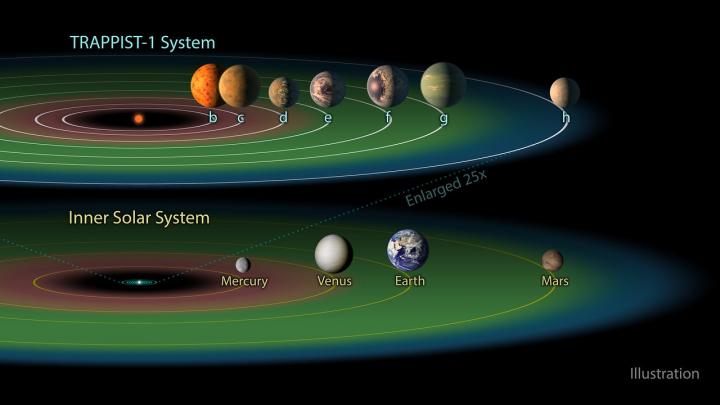
Kane had been studying a nearby solar system called Trappist-1, which has three Earth-like planets in its habitable zone.

“This made me wonder about the maximum number of habitable planets it’s possible for a star to have, and why our star only has one,” Kane said. “It didn’t seem fair!”

His team created a model system in which they simulated planets of various sizes orbiting their stars. An algorithm accounted for gravitational forces and helped test how the planets interacted with each other over millions of years.

They found it is possible for some stars to support as many as seven, and that a star like our sun could potentially support six planets with liquid water.

“More than seven, and the planets become too close to each other and destabilize each other’s orbits,” Kane said.

Why then does our solar system only have one habitable planet if it is capable of supporting six? It helps if the planets’ movement is circular rather than oval or irregular, minimizing any close contact and maintain stable orbits.

Kane also suspects Jupiter, which has a mass two-and-a-half times that of all the other planets in the solar system combined, limited our system’s habitability.

“It has a big effect on the habitability of our solar system because it’s massive and disturbs other orbits,” Kane said.

Only a handful of stars are known to have multiple planets in their habitable zones. Moving forward, Kane plans to search for additional stars surrounded entirely by smaller planets. These stars will be prime targets for direct imaging with NASA telescopes like the one at Jet Propulsion Laboratory’s Habitable Exoplanet Observatory.

Kane’s study identified one such star, Beta CVn, which is relatively close by at 27 light years away. Because it doesn’t have a Jupiter-like planet, it will be included as one of the stars checked for multiple habitable zone planets.

Future studies will also involve the creation of new models that examine the atmospheric chemistry of habitable zone planets in other star systems.

Projects like these offer more than new avenues in the search for life in outer space. They also offer scientists insight into forces that might change life on our own planet one day.

“Although we know Earth has been habitable for most of its history, many questions remain regarding how these favorable conditions evolved with time, and the specific drivers behind those changes,” Kane said. “By measuring the properties of exoplanets whose evolutionary pathways may be similar to our own, we gain a preview into the past and future of this planet — and what we must do to main its habitability.”

###

Media Contact
Jules Bernstein
[email protected]

Original Source

https://news.ucr.edu/articles/2020/07/31/surprising-number-exoplanets-could-host-life

Related Journal Article

http://dx.doi.org/10.3847/1538-3881/ab9ffe

Tags: AstronomyAstrophysicsExperiments in SpacePlanets/MoonsSatellite Missions/ShuttlesSpace/Planetary ScienceStars/The Sun
Share13Tweet8Share2ShareShareShare2

Related Posts

Miniature Sensor Uses Light to Detect Touch — Chemistry

Miniature Sensor Uses Light to Detect Touch

May 8, 2026
Iron Minerals Determine Whether Dissolved Organic Matter Fuels Microbes or Becomes Long-Term Carbon Storage — Chemistry

Iron Minerals Determine Whether Dissolved Organic Matter Fuels Microbes or Becomes Long-Term Carbon Storage

May 8, 2026

Kate Evans Appointed Associate Lab Director for Biological and Environmental Systems Science at ORNL

May 8, 2026

Advancing Multiscale Modeling and Overcoming Operational Challenges in Autothermal COâ‚‚-to-Methanol Reactors

May 8, 2026
Please login to join discussion

POPULAR NEWS

  • Research Indicates Potential Connection Between Prenatal Medication Exposure and Elevated Autism Risk

    840 shares
    Share 336 Tweet 210
  • New Study Reveals Plants Can Detect the Sound of Rain

    727 shares
    Share 290 Tweet 181
  • Scientists Investigate Possible Connection Between COVID-19 and Increased Lung Cancer Risk

    68 shares
    Share 27 Tweet 17
  • Salmonella Haem Blocks Macrophages, Boosts Infection

    61 shares
    Share 24 Tweet 15

About

We bring you the latest biotechnology news from best research centers and universities around the world. Check our website.

Follow us

Recent News

Evaluating Digoxin Use in Patients with Symptomatic Rheumatic Heart Disease

Evaluating the Effectiveness and Safety of Digitalis Glycosides in Treating Heart Failure

Urdu Fall Risk Questionnaire Adapted for Elderly

Subscribe to Blog via Email

Enter your email address to subscribe to this blog and receive notifications of new posts by email.

Join 82 other subscribers
  • Contact Us

Bioengineer.org © Copyright 2023 All Rights Reserved.

Welcome Back!

Login to your account below

Forgotten Password?

Retrieve your password

Please enter your username or email address to reset your password.

Log In
No Result
View All Result
  • Homepages
    • Home Page 1
    • Home Page 2
  • News
  • National
  • Business
  • Health
  • Lifestyle
  • Science

Bioengineer.org © Copyright 2023 All Rights Reserved.