A 50-year-old woman with relapsing–remitting multiple sclerosis who had exhausted nearly every standard treatment for trigeminal neuralgia remained free of right-sided facial pain 43 months after an unusual operation that combined microsurgical nerve combing with a precisely placed glycerol injection along the trigeminal nerve root. The case, published in Chinese Neurosurgical Journal, is described by its authors as the first published report of this combined technique for multiple sclerosis–related trigeminal neuralgia, though they caution that a single patient cannot establish whether the surgery itself produced the lasting relief.
Trigeminal neuralgia associated with multiple sclerosis is an uncommon but debilitating condition affecting a minority of patients with demyelinating disease. Compared with the idiopathic form of the disorder, the MS-related version tends to bring more severe symptoms, higher rates of treatment failure, and less durable pain control. The underlying problem differs mechanistically: demyelination at or near the trigeminal root entry zone is thought to promote ectopic impulse generation and ephaptic transmission—abnormal cross-talk between nerve fibres—rather than compression of the nerve by a blood vessel. That distinction matters surgically, because microvascular decompression, a mainstay operation for classical trigeminal neuralgia, is frequently not feasible or effective when no compressive vascular target exists.
The woman presented with severe, medically refractory right-sided trigeminal neuralgia predominantly affecting the maxillary and mandibular (V2/V3) divisions of the nerve. The pain was paroxysmal and electric shock-like, provoked by speaking, eating, and facial contact, and it substantially impaired her daily activities. Her preoperative pain severity corresponded to a Barrow Neurological Institute pain intensity score of V, the scale’s most severe grade. Her neurological history included optic neuritis with approximately 80 percent visual loss, registration as blind, and a history of migraine. Despite ongoing anticonvulsant therapy with carbamazepine and baclofen, she continued to experience breakthrough pain even after medication escalation.
Her treatment history before referral was extensive. An initial percutaneous retrogasserian glycerol rhizotomy produced no meaningful benefit. A repeat glycerol rhizotomy performed in July 2021 under general anaesthesia with fluoroscopic guidance again failed to deliver durable pain relief. When symptoms remained medically refractory, she underwent Gamma Knife radiosurgery in December 2021. Even then, recurrent paroxysmal facial pain persisted, requiring ongoing anticonvulsant therapy, and no clear or sustained clinical improvement was documented before her surgical team considered posterior fossa exploration.
Magnetic resonance imaging of the brain showed multiple areas of demyelinating signal abnormality consistent with her known multiple sclerosis, with prominent brainstem involvement extending toward the trigeminal root entry zones on both sides. Dedicated cranial nerve sequences, however, did not demonstrate convincing neurovascular conflict involving the right trigeminal nerve, and comparison with earlier imaging showed no significant interval change in the brainstem lesion adjacent to the root entry zone. With no surgically meaningful vascular compression target and medical, percutaneous, and radiosurgical options exhausted, the team judged that further escalation of conventional therapy was unlikely to provide durable benefit. The plan was discussed in a multidisciplinary setting involving neurosurgery, pain, neurology, clinical psychology, and neuroradiology teams, and written informed consent covered the risks of persistent pain, facial sensory disturbance, and general operative complications.
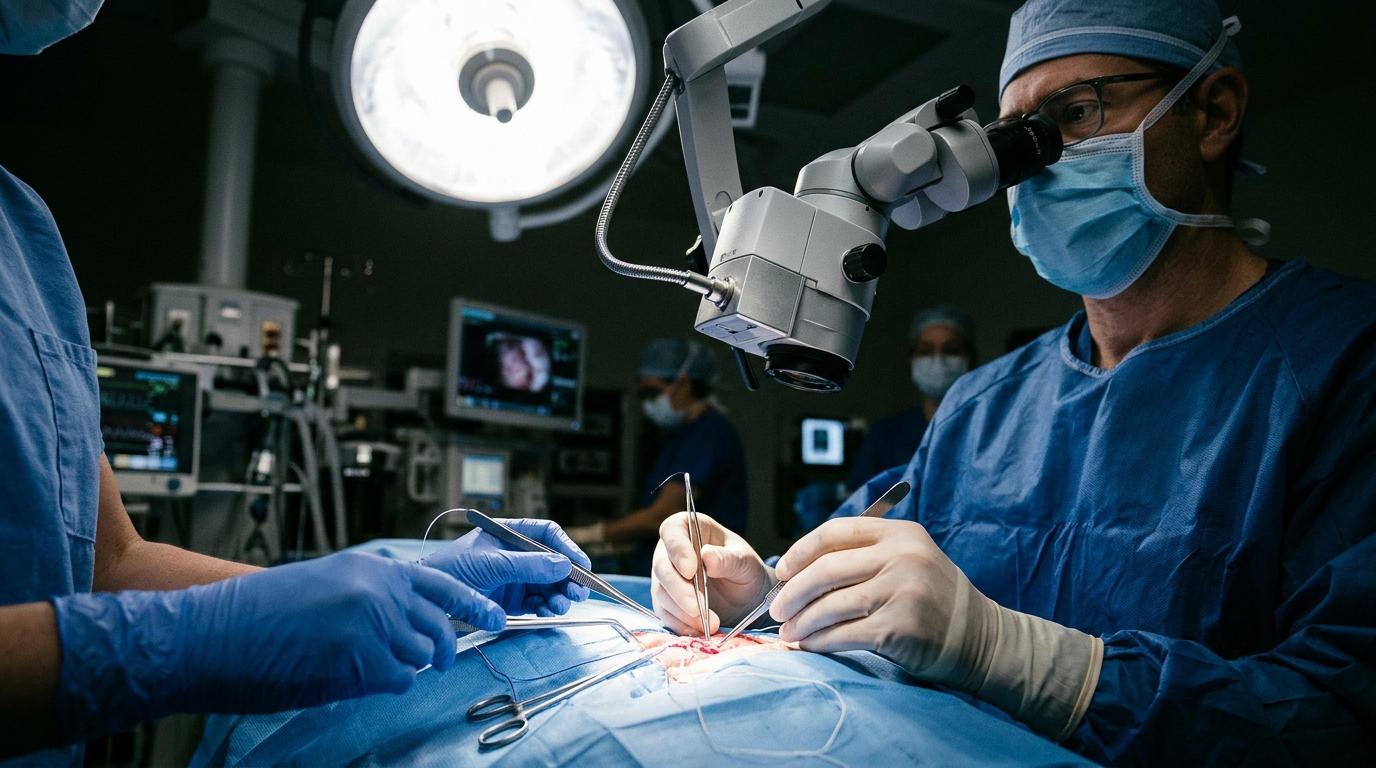
The operation itself proceeded through a standard microsurgical route. The patient was positioned park-bench right lateral, and after induction of general anaesthesia a lumbar puncture removed 20 millilitres of cerebrospinal fluid to relax the cerebellum. A right retrosigmoid craniotomy followed. Under the operating microscope, the surgeons encountered dense arachnoidal adhesions around the trigeminal nerve, which appeared displaced superiorly; Dandy’s vein traversed the nerve without evidence of compression, and no neurovascular conflict was identified. Internal neurolysis—nerve combing—was then performed using Rhoton microinstruments, including a straight dissector and a 45-degree 3-millimetre ball probe. Approximately 8 to 10 fascicular cleavage planes were developed across the full width of the nerve, extending to within roughly 2 millimetres of the dorsal root entry zone, as controlled interfascicular separation without intentional rhizotomy or fascicular sectioning.
The adjunctive step targeted a segment the patient’s earlier percutaneous procedures had not reached. Following completion of the neurolysis, 0.3 millilitres of 100 percent anhydrous glycerol was delivered through a 1-millilitre syringe fitted with a 30G half-inch needle into a confined perineural plane along the surface of the trigeminal root, within the perineurial layer, at the inferior third of the proximal cisternal segment anterior to the dorsal root entry zone. This placed the glycerol adjacent to the radiologically relevant demyelinating lesion, rather than at the ganglion or Meckel’s cave region approached during her prior retrogasserian treatments. The volume was chosen pragmatically from amounts commonly used in percutaneous glycerol procedures, with care taken to confine delivery to the intended nerve segment and avoid free spillage into the surrounding cerebrospinal fluid. No intraoperative neurophysiological monitoring was used, and haemostasis was secured before watertight dural and layered wound closure.
Recovery brought both reassurance and a complication. Postoperatively there was no clinically significant new facial numbness or dysaesthesia; corneal reflexes were intact, light-touch sensation in the V1–V3 distributions was preserved on bedside examination, and there was no evidence of masticatory weakness. At 5-month follow-up she reported significant improvement with only occasional residual stabbing pain, and at 12 months she had no recurrence of right-sided pain, a pain status consistent with a BNI score of I, substantially reduced analgesic and anticonvulsant requirements, and ongoing weaning of carbamazepine. Her early course, however, had been complicated by a superficial wound infection requiring surgical washout on postoperative day 11 and antibiotic therapy, with no evidence of intracranial infection or trigeminal-specific neurotoxic sequelae; the authors note she was receiving immunotherapy for multiple sclerosis, which may have been a contributory factor.
At 19 and 26 months she remained free of right-sided trigeminal neuralgia, though she had developed intermittent contralateral facial pain in the left V2/V3 distributions, controlled with low-dose carbamazepine at 100 milligrams twice daily. At 43 months postoperatively she remained pain-free on the operated side, with an overall course consistent with improvement from a preoperative BNI score of V to a postoperative score of I. The authors emphasise that long-term follow-up is particularly important in MS-related trigeminal neuralgia, because disease progression may produce bilateral symptoms, recurrence, or evolution of the pain phenotype independent of the treated side—a dynamic her contralateral pain illustrates.
Interpretation demands caution, and the authors are explicit about it. Internal neurolysis aims to mechanically disrupt abnormal cross-talk between demyelinated fascicles, while focal glycerol may provide adjunctive chemical neurolysis with preferential effects on nociceptive fibres, consistent with longstanding lesioning principles in trigeminal pain surgery; the two interventions may have acted through partially distinct mechanisms whose relative contributions cannot be determined from a single case. A further major confound is her Gamma Knife treatment within the preceding year, since delayed or cumulative radiosurgical effects cannot be excluded, meaning the long-term relief cannot be causally attributed to the open procedure. The report therefore cannot establish efficacy, reproducibility, comparative benefit, or procedural safety, and does not demonstrate superiority over internal neurolysis alone. The authors position the technique as hypothesis-generating rather than practice-defining: a highly selective salvage strategy, with any adjunctive proximal root intervention regarded as experimental and reserved for carefully counselled patients in whom more established options have been exhausted, and with risks including facial sensory disturbance, dysaesthesia, anaesthesia dolorosa, recurrence, and general operative complications weighed against the morbidity of severe refractory facial pain. They suggest the approach may merit further study in selected patients without neurovascular compression after failure of medical, percutaneous, and radiosurgical treatments.
Subject of Research: A single-patient case report of combined internal neurolysis and targeted proximal trigeminal root glycerol injection as a salvage treatment for refractory multiple sclerosis–related trigeminal neuralgia without neurovascular compression.
Article Title: Combined internal neurolysis and targeted proximal trigeminal root glycerol delivery for refractory multiple sclerosis–related trigeminal neuralgia: a case report
Article References: Short, T. P., & Kaliaperumal, C. (2026). Combined internal neurolysis and targeted proximal trigeminal root glycerol delivery for refractory multiple sclerosis–related trigeminal neuralgia: a case report. Chinese Neurosurgical Journal, 12(1), Article 14. https://doi.org/10.1186/s41016-026-00433-x
Image Credits: AI Generated
DOI: 10.1186/s41016-026-00433-x
Keywords: trigeminal neuralgia, multiple sclerosis, internal neurolysis, glycerol rhizotomy, Gamma Knife radiosurgery, retrosigmoid craniotomy, trigeminal root entry zone, demyelination, neurovascular compression, case report, salvage surgery, BNI pain score
News Source: Ophelia Keating. (November 4, 2026). Surgeons combine nerve combing and targeted glycerol in rare case of refractory MS-related facial pain. Scienmag.