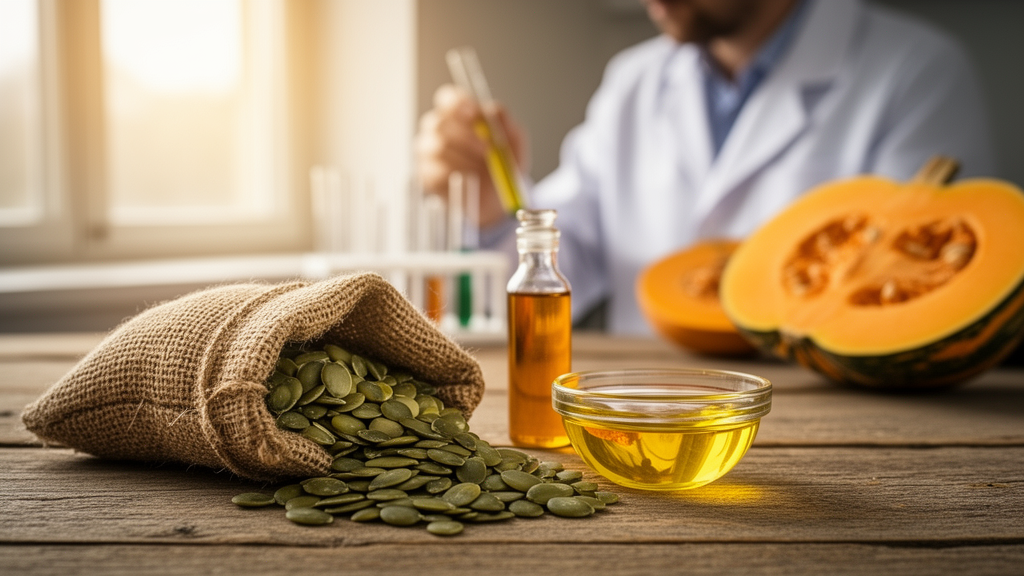
Pumpkin seeds from Sudanese landraces of Cucurbita pepo could be a far more valuable source of edible oil than their underutilized status suggests. A new open-access study analyzed 23 landrace samples collected from six Sudanese regions, measuring oil content, fatty acid and tocopherol composition, and oxidative stability, and used mixed regression modeling on observational data from randomized sampling to identify which characteristics drive oil quality.
The results point to striking regional differences. Oil content varied significantly across regions, with samples from South Kordofan showing the highest mean oil content at 37.6 percent, followed closely by North Kordofan at 31.8 percent. At the level of individual landraces, the South Kordofan/A10 line stood out with an exceptional oil yield of 49.91 percent, a figure that positions it as a leading candidate for selection programs.
Correlation analyses across the samples revealed a positive relationship between oil content and oleic acid, with a correlation coefficient of +0.56, and a negative relationship between oil content and saturated fatty acids, at −0.55. In practical terms, seeds that produce more oil also tend to produce oil with a more favorable unsaturated fatty acid profile.
Oxidative stability, a key determinant of how long an oil resists rancidity during storage and cooking, was assessed by induction time. Three landraces performed best: GZ/A16 with an induction time of 3.32 hours, Gadarif/A17 at 3.13 hours, and SK/A9 at 3.10 hours. These differences, while measured on a scale of hours, distinguish landraces that could suit applications where shelf life matters most.
This analysis confirmed that tocopherol content is a significant driver of oxidative stability, with a correlation of +0.673 and an Elastic Net coefficient of +0.563 at a model R² of 0.451. The moderate R² value indicates that tocopherols explain a substantial but not complete share of the variation in stability, leaving room for other compositional factors.
The study’s recommendations follow directly from these patterns. The authors suggest that analyzing oil content should be done alongside grouping similar landraces, so that genetically similar material can be used most effectively. The Kordofan region is specifically recommended as a source of high oil content, while tocopherol-rich landraces from Gadarif and the Nile basin are identified as ideal candidates for uses that emphasize oxidative stability and potential nutraceutical benefits.
It is worth noting the scope of the evidence. The work is observational, based on randomized sampling of landrace seeds rather than a controlled intervention, and the regression model captures less than half of the variance in stability. The findings therefore describe associations and compositional patterns within the sampled Sudanese material; they do not establish health effects in humans, and any nutraceutical value remains a candidate property to be tested rather than a demonstrated benefit.
Even with those limits, the study offers a concrete basis for conservation and breeding work. Sudanese pumpkin landraces have historically received little attention as an oil crop, and identifying region-specific hotspots of oil content and stability gives breeders and food producers a starting point for selecting superior germplasm. As the authors conclude, these findings provide a foundation for the selection, conservation, and utilization of pumpkin genetic resources in breeding programs and value-added oil production.
Subject of Research: Chemical composition and oxidative stability of pumpkin seed oil from Sudanese Cucurbita pepo landraces analyzed with hybrid regression modeling
Article Title: Chemical composition and oxidative stability of Sudanese pumpkin seed oil assessed using hybrid regression modeling
Article References: Mariod, A., Matthaus, B., Hassan, S. A., Osman, E. G. A., & Elgadir, M. A. (2026). Chemical composition and oxidative stability of Sudanese pumpkin seed oil assessed using hybrid regression modeling. Discover Food. https://doi.org/10.1007/s44187-026-01295-z
Image Credits: AI Generated
DOI: 10.1007/s44187-026-01295-z
Keywords: pumpkin seed oil, Cucurbita pepo, Sudan, fatty acids, tocopherols, oxidative stability, Elastic Net regression, oil content, landraces, food science, Chemical, composition
News Source: Alan Morgan. (October 29, 2026). Sudanese Pumpkin Seed Landraces Show High Oil Yields and Tocopherol-Driven Oxidative Stability. Scienmag.