Using unique 3D imaging technology to find a negative carbon solution
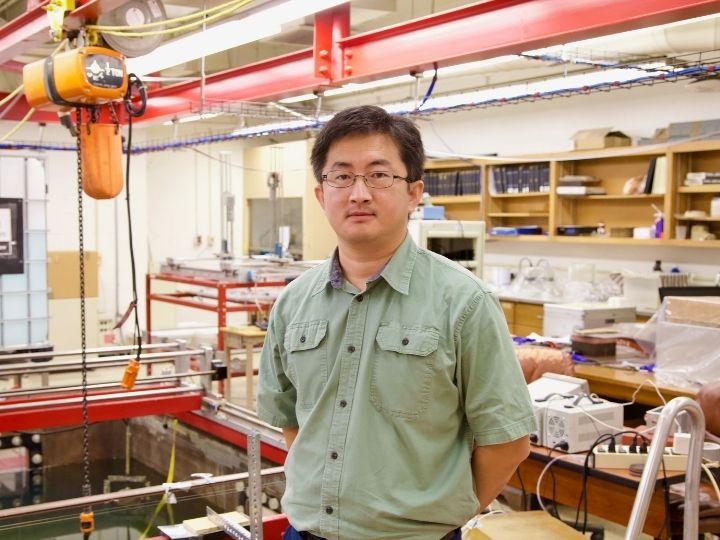
A crucial step in sequestering carbon dioxide and realizing the energy transition means finding where to store it to avoid earthquakes and possible leakage pathways, which Yingcai Zheng at the University of Houston is taking on in collaboration with Los Alamos National Lab and Vecta Oil and Gas with support from the U.S. Department of Energy.
The date is set. According to not only the Paris Agreement but also with support from the city of Houston, 196 participating countries – including the United States, must meet a net-zero carbon emission goal by 2050. With Houston already the energy capital of the world, it is no surprise that the city is positioning itself as the up-and-coming carbon capture, utilization and storage (CCUS) hub of the U.S. Reaching the target means not only pushing green energy, but also supporting more energy efficient, sustainable and environmentally conscious fossil fuels.
In pursuit of net-zero carbon emissions by 2050, the U.S. Department of Energy (DOE) is supporting innovative efforts to realize this new goal. Yingcai Zheng, Robert and Margaret Sheriff Professor in Applied Geophysics at the University of Houston, won a $799,932 award in pursuit of his project to develop technology that detects seismic faults and fractures using 3D imaging and other accompanying data processing systems at a favorable price point.
“When you inject one billion tonnes of carbon dioxide into the subsurface you can destabilize and stress the subsurface, causing earthquakes or possible leakage on the surface,” said Zheng. “This project aims to measure the risk of injecting carbon dioxide more than 800 meters below ground level into permeable rock – at which point the gas turns to a supercritical fluid – using a nine-component surface seismic data set to image the crystalline basement and its overlying sedimentary cover and characterize small scale fractures and big faults in a cost-effective manner.”
The U.S. Gulf Coast, where the bulk of the domestic energy industry is situated strategically near ports and feedstocks, possesses the potential to store up to 130 years of carbon based on the annual US emission rate of 5.1 billion metric tons per year using 2019 estimates, according the DOE. The US is a leading country in carbon capture and represents 80% of the world total capture capacity. However, the carbon capture capability now is only 25 million tonnes per year. In short, there is work to be done. The energy industry alone comprises nearly a quarter of U.S. emissions, per 2019 EPA data. Not surprisingly, a quick win is to sequester the carbon dioxide emissions near production sites along the Gulf Coast and store them.
But proper infrastructure to store carbon beneath the caprock layer in the earth and seal the greenhouse gas requires infrastructure build out based on an affordable but sustainable plan. First steps must incorporate risk management on where to store carbon. Zheng’s proposed project would involve detecting faults beneath the subsurface, under which captured carbon is stored. This would improve the site selection of porous rocks to store carbon and reduce leakages and prevent injecting carbon dioxide in locations at risk for intense seismic activity.
Earthquake magnitude is determined by fault surface area and amount of slip – or relative motion of the rock separated by the fault. By imaging the fault and estimating the historic slip using machine learning, Zheng intends to estimate seismic activity in specific regions. In addition to the faults, by imaging small-scale fractures and their spatial distributions, an estimate of the fluid leakage pathways can be surmised.
Current 3D seismic reflection accumulates high costs for data acquisition, processing and human interpretation of large-scale subsurface faults. This prevents commercialization and creates a time intensive process with limited scope of detection. Imaging small-scale fractures is even more challenging. Other borehole techniques only quantify and locate subsurface migration of carbon fluid at one or a few locations by means of pressure and geochemical monitoring. Zheng’s project utilizes a data set and technology that would provide a quick 3D scan to quantify seismic faults using novel machine learning methods to detect potential leaks and susceptivity to future seismic activity.
Historically, geophysics facilitates hydrocarbon production, but in this instance, it is a key toward a carbon net neutral future by providing a net negative carbon solution.
“Most think of applied geophysics as linked to the oil and gas industry,” said Zheng. “While that is true, when we think of the energy transition and how to achieve our goals, it is important to realize that this cannot happen without studying the geophysics of the subsurface – in a way, it literally holds the well-being of humanity’s future.
###
Media Contact
Nicole Johnson
[email protected]
Original Source
https:/