• HOME
  • NEWS
  • EXPLORE
    • CAREER
      • Companies
      • Jobs
    • EVENTS
    • iGEM
      • News
      • Team
    • PHOTOS
    • VIDEO
    • WIKI
  • BLOG
  • COMMUNITY
    • FACEBOOK
    • INSTAGRAM
    • TWITTER
Tuesday, May 12, 2026
BIOENGINEER.ORG
No Result
View All Result
  • Login
  • HOME
  • NEWS
  • EXPLORE
    • CAREER
      • Companies
      • Jobs
        • Lecturer
        • PhD Studentship
        • Postdoc
        • Research Assistant
    • EVENTS
    • iGEM
      • News
      • Team
    • PHOTOS
    • VIDEO
    • WIKI
  • BLOG
  • COMMUNITY
    • FACEBOOK
    • INSTAGRAM
    • TWITTER
  • HOME
  • NEWS
  • EXPLORE
    • CAREER
      • Companies
      • Jobs
        • Lecturer
        • PhD Studentship
        • Postdoc
        • Research Assistant
    • EVENTS
    • iGEM
      • News
      • Team
    • PHOTOS
    • VIDEO
    • WIKI
  • BLOG
  • COMMUNITY
    • FACEBOOK
    • INSTAGRAM
    • TWITTER
No Result
View All Result
Bioengineer.org
No Result
View All Result
Home NEWS Science News Chemistry

Study sheds light on stellar origin of 60Fe

Bioengineer by Bioengineer
April 16, 2021
in Chemistry
Reading Time: 3 mins read
0
IMAGE
Share on FacebookShare on TwitterShare on LinkedinShare on RedditShare on Telegram

IMAGE

Credit: Physical Review Letters

Researchers from the Institute of Modern Physics (IMP) of the Chinese Academy of Sciences and their collaborators have recently made great progress in the study of the stellar beta-decay rate of 59Fe, which constitutes an important step towards understanding 60Fe nucleosynthesis in massive stars. The results were published in Physical Review Letters on April 12.

Radioactive nuclide 60Fe plays an essential role in nuclear astrophysical studies. It is synthesized in massive stars by successive neutron captures on a stable nucleus of 58Fe and, during the late stages of stellar evolution, ejected into space via a core-collapse supernova.

The characteristic gamma lines associated with the decay of 60Fe have been detected by space gamma-ray detectors. By comparing the 60Fe gamma-ray flux to that from 26Al, which shares a similar origin as 60Fe, researchers should be able to obtain important information on nucleosynthesis and stellar models. However, the observed gamma-ray flux ratio 26Al/60Fe does not match theoretical predictions due to uncertainties in both stellar models and nuclear data inputs.

The stellar beta-decay rate of 59Fe is among the greatest uncertainties in nuclear data inputs. During the nucleosynthesis of 60Fe in massive stars, 59Fe can either capture a neutron to produce 60Fe or beta decay to 59Co. Therefore, the stellar beta-decay rate of 59Fe is critical to the yield of 60Fe.

Although the decay rate of 59Fe has been accurately measured in laboratories, its decay rate may be significantly enhanced in stellar environments due to contributions from its excited states. However, direct measurement of the beta-decay rate from excited states is very challenging since one has to create a high-temperature environment as in stars to keep the 59Fe nuclei in their excited states.

To address this problem, researchers at IMP proposed a new method for measuring the stellar beta-decay rate of 59Fe. “The nuclear charge-exchange reaction is an indirect measurement alternative, which provides key nuclear structure information that can determine those decay rates.” said GAO Bingshui, a researcher at IMP.

The researchers carried out their experiment at the Coupled Cyclotron Facility at Michigan State University. In the experiment, a secondary triton beam produced by the cyclotrons was used to bombard a 59Co target. Then the reaction products, 3He particles and gamma rays, were detected by the S800 spectrometer and GRETINA gamma-ray detection array. Using this information, the beta-decay rates from the 59Fe excited states were determined. This measurement thus eliminated one of the major nuclear uncertainties in predicting the yield of 60Fe.

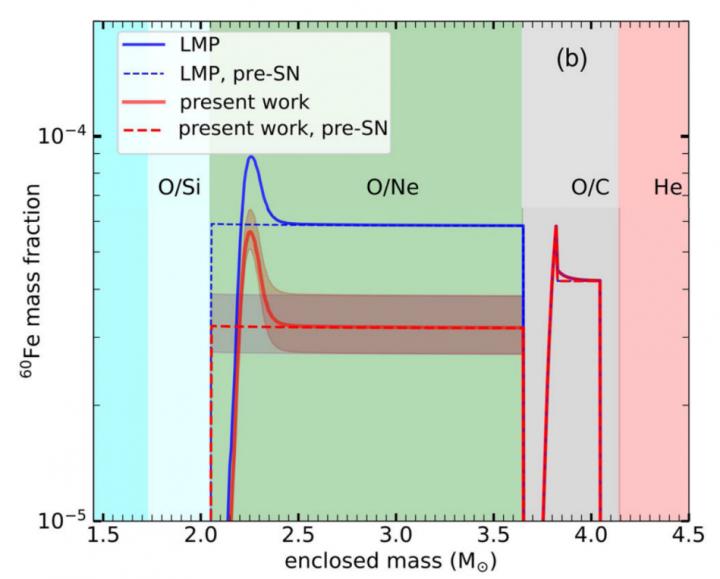
By comparing stellar model calculations using the new decay rate data with previous calculations, the researchers found that, for an 18 solar mass star, the yield of 60Fe is 40% less when using the new data. The result points to a reduced tension in the discrepancy in 26Al/60Fe ratios between theoretical predictions and observations.

“It is an important step towards understanding 60Fe nucleosynthesis in massive stars and it will provide a more solid basis for future astrophysical simulations,” said LI Kuoang, the collaborator of Gao.

###

This work was supported by the National Key Research and Development program and the Strategic Priority Research Program of CAS.

Media Contact
LIU Fang
[email protected]

Related Journal Article

http://dx.doi.org/10.1103/PhysRevLett.126.152701

Tags: Atomic/Molecular/Particle PhysicsChemistry/Physics/Materials SciencesParticle Physics
Share12Tweet8Share2ShareShareShare2

Related Posts

Humans and Zebra Finches Share Similar Speech Learning Techniques #ASA190 — Chemistry

Humans and Zebra Finches Share Similar Speech Learning Techniques #ASA190

May 11, 2026
Unveiling Dark Matter Through Molecular Insights — Chemistry

Unveiling Dark Matter Through Molecular Insights

May 11, 2026

From Touch to Sight: A Bioinspired Multisensory Framework Endows Robots with Human-Like Perception

May 11, 2026

Announcing the 2026 Carbon Future Young Investigator Award Winners

May 11, 2026
Please login to join discussion

POPULAR NEWS

  • Research Indicates Potential Connection Between Prenatal Medication Exposure and Elevated Autism Risk

    841 shares
    Share 336 Tweet 210
  • New Study Reveals Plants Can Detect the Sound of Rain

    728 shares
    Share 290 Tweet 182
  • Salmonella Haem Blocks Macrophages, Boosts Infection

    62 shares
    Share 25 Tweet 16
  • Breastmilk Balances E. coli and Beneficial Bacteria in Infant Gut Microbiomes

    57 shares
    Share 23 Tweet 14

About

We bring you the latest biotechnology news from best research centers and universities around the world. Check our website.

Follow us

Recent News

Humans and Zebra Finches Share Similar Speech Learning Techniques #ASA190

New Study Uncovers How Fungal Parasites Attack Strawberries and Raspberries

City of Hope Researchers to Present Groundbreaking Immunotherapy and Precision Medicine Advances Across Multiple Cancer Types at ASCO 2026

Subscribe to Blog via Email

Enter your email address to subscribe to this blog and receive notifications of new posts by email.

Join 82 other subscribers
  • Contact Us

Bioengineer.org © Copyright 2023 All Rights Reserved.

Welcome Back!

Login to your account below

Forgotten Password?

Retrieve your password

Please enter your username or email address to reset your password.

Log In
No Result
View All Result
  • Homepages
    • Home Page 1
    • Home Page 2
  • News
  • National
  • Business
  • Health
  • Lifestyle
  • Science

Bioengineer.org © Copyright 2023 All Rights Reserved.