Research from scientists at St. Jude Children’s Research Hospital found mutations up to two years before cancer developed, showing an opportunity for early interventions
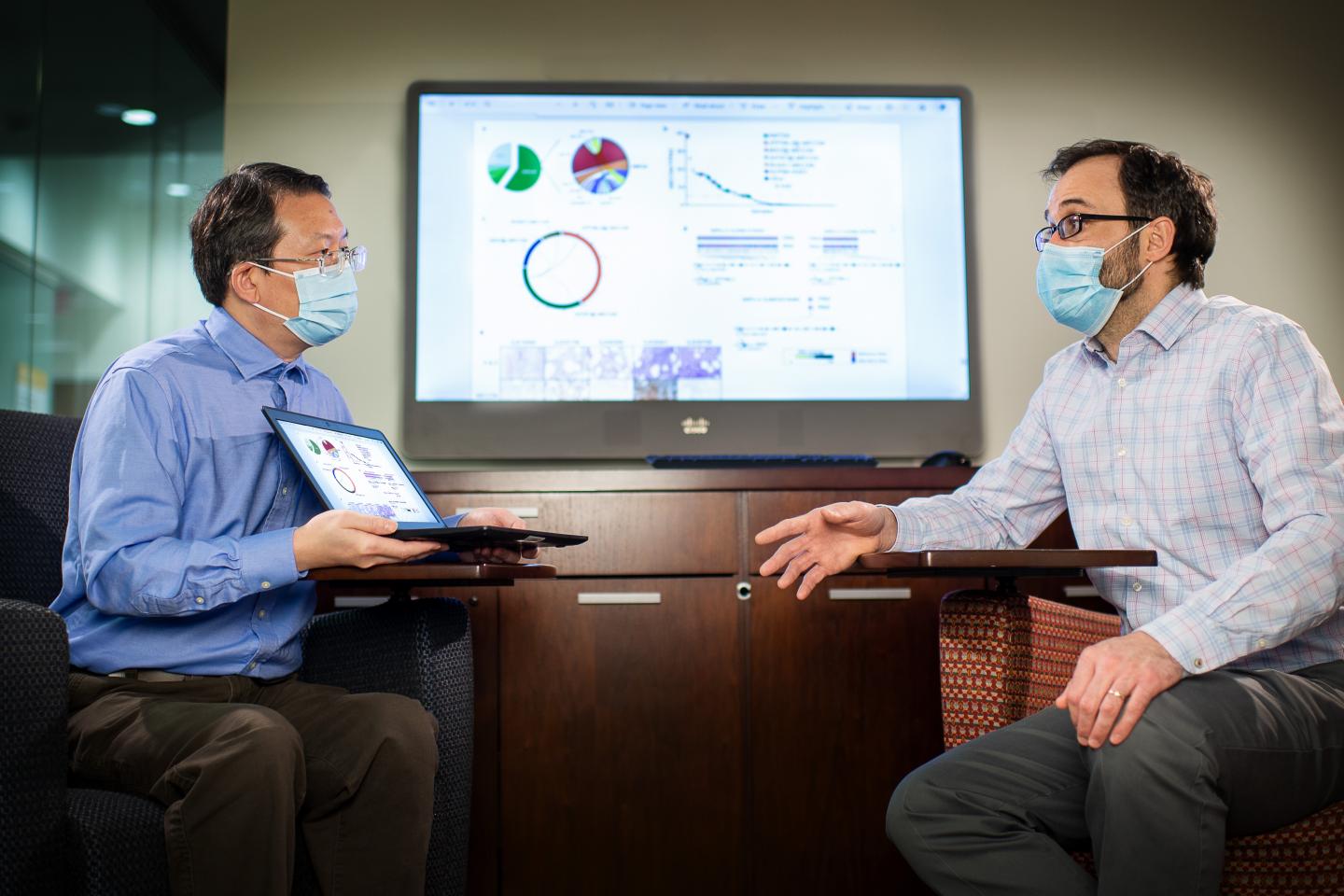
Credit: St. Jude Children’s Research Hospital
Children treated for cancer with approaches such as chemotherapy can develop therapy-related myeloid neoplasms (a second type of cancer) with a dismal prognosis. Scientists at St. Jude Children’s Research Hospital have characterized the genomic abnormalities of 84 such myeloid neoplasms, with potential implications for early interventions to stop the disease. A paper detailing the work was published today in Nature Communications.
The somatic (cancer) and germline (inherited) genomic alterations that drive therapy-related myeloid neoplasms in children have not been comprehensively described, until now. The researchers used a variety of sequencing techniques (whole exome, whole genome and RNA) to characterize the genomic profile of 84 pediatric therapy-related myeloid neoplasms. The data came from patients with leukemia, solid tumors or brain tumors who were treated with different types of chemotherapy and who all later developed myeloid neoplasms.
“One thing that we’ve known for a long time is once kids develop this secondary tumor, the outcome is really poor,” said co-corresponding author Jeffery Klco, M.D., Ph.D., St. Jude Pathology. “The alterations that drive these tumors are different in children than they are in adults, underscoring the need to study these tumors specifically in pediatrics.”
Collaboration yields new understanding
Results of the study revealed several notable mutations in the somatic setting, including changes in the Ras/MAPK pathway, alterations in RUNX1 or TP53, and rearrangements of KMT2A. Additionally, the results showed increased expression of a transcription factor called MECOM, which was associated with MECOM’s abnormal proximity to an enhancer as a result of genetic rearrangements.
The research benefited from computational tools developed at St. Jude that are aimed at reducing error rates, including CleanDeepSeq and SequencErr. These approaches help to discriminate between true mutations and sequencing errors.
With these tools, the researchers could trace the mutations back as far as two years before a therapy-related myeloid neoplasm developed, when early interventions could potentially benefit patients.
“This work indicates that we can detect this type of malignancy early, to study if preventative therapies could benefit patients,” said co-senior author Xiaotu Ma, Ph.D., St. Jude Computational Biology.
###
The study’s other co-corresponding author is Tanja Gruber, Stanford University School of Medicine. Co-first authors are Jason Schwartz, Vanderbilt University Medical Center; Jing Ma, St. Jude; and Jennifer Kamens, Stanford University School of Medicine. Other St. Jude authors of the study are Tamara Westover, Michael Walsh, Samuel Brady, J. Robert Michael, Xiaolong Chen, Lindsey Montefiori, Guangchun Song, Gang Wu, Huiyn Wu, Ryan Hiltenbrand, Kim Nichols, Jamie Maciaszek, Yanling Liu, Priyadarshini Kumar, John Easton, Scott Newman, Jeffrey Rubnitz, Charles Mullighan, Stanley Pounds and Jinghui Zhang. Additional paper authors include Cristyn Branstetter, Arkansas Children’s Northwest Hospital; and Michael Walsh, Memorial Sloan Kettering Cancer Center.
The research was funded in part by grants from the National Institutes of Health (1K08HL150282-01, P30CA021765, R01HL144653), Alex’s Lemonade Stand Foundation, Burroughs Wellcome Fund, EvansMDS Foundation and ALSAC, the fundraising and awareness organization of St. Jude.
St. Jude Children’s Research Hospital
St. Jude Children’s Research Hospital is leading the way the world understands, treats and cures childhood cancer and other life-threatening diseases. It is the only National Cancer Institute-designated Comprehensive Cancer Center devoted solely to children. Treatments developed at St. Jude have helped push the overall childhood cancer survival rate from 20% to 80% since the hospital opened more than 50 years ago. St. Jude freely shares the breakthroughs it makes, and every child saved at St. Jude means doctors and scientists worldwide can use that knowledge to save thousands more children. Families never receive a bill from St. Jude for treatment, travel, housing and food — because all a family should worry about is helping their child live. To learn more, visit stjude.org or follow St. Jude on social media at @stjuderesearch.
Media Contact
Katy Hobgood
[email protected]
Related Journal Article
http://dx.