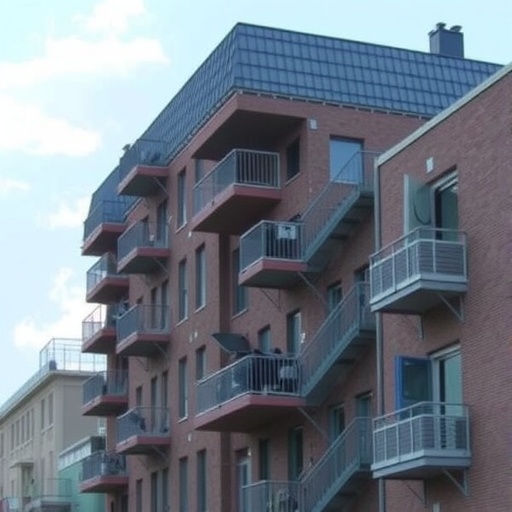
Airborne transmission of infectious diseases has long been recognized as a critical factor in the spread of illnesses, particularly in densely populated urban environments. A recent investigation into the dynamics of viral spread within a multi-family residential building in Santander, Spain, has brought new light to how common ventilation systems may inadvertently facilitate the passage of harmful airborne pathogens such as SARS-CoV-2. This study, conducted during an early phase of the COVID-19 pandemic, explored how bathroom ventilation ducts—specifically those utilizing the “stack effect”—can serve as unexpected conduits for viruses, challenging prevailing assumptions about the safety of isolated living spaces.
In many older residential buildings, particularly those constructed before modern ventilation standards, bathroom air is often vented through vertical shafts that rely on natural convection to harvest stale air. This “stack effect” involves warm air rising naturally through vertical ducts, pulling cooler fresh air into the apartments. Unlike newer systems equipped with mechanical fans or direct exhaust outlets, these designs do not include windows or dedicated exhaust fans in bathrooms, relying instead on natural air movement. However, this architectural feature can become a hidden pathway for aerosolized viral particles to travel through the building vertically, bypassing physical barriers such as closed doors.
The study arose after a COVID-19 outbreak in a seven-story apartment building where the virus inexplicably spread across four separate apartments stacked vertically. What was particularly startling was the absence of direct contact or social interaction between the residents of these apartments. Detailed epidemiological analysis, including genomic sequencing of virus samples from infected occupants, established a strong likelihood that the transmission occurred within the building’s internal air system rather than through traditional person-to-person contact. This finding provided compelling evidence that airborne viruses could navigate through connected ventilation ducts, reflecting a mechanism previously underappreciated in outbreak investigations.
Measurements of air quality parameters exposed the extent of the problem. Remote monitoring of carbon dioxide (CO2) concentrations within an unoccupied apartment demonstrated anomalously high levels, indicating that air from other occupied units was finding its way into the vacant space. Since CO2 is primarily exhaled by humans, elevated concentrations in empty rooms strongly suggested that air—and potentially viral aerosols—was being transported through the shared ventilation shafts. This discovery metaphorically evoked the “ghost in the room” phenomenon, illustrating the invisible and insidious nature of airborne virus dissemination within built environments.
Furthermore, environmental factors such as temperature fluctuations played a pivotal role in altering airflow direction and velocity within these ventilation shafts. On warmer days, pressure dynamics reversed the natural exhaust flow, pushing air back into apartments rather than out through the roof vents. The operation of auxiliary systems like kitchen exhaust hoods exacerbated the problem by creating negative pressure zones that sucked air from bathrooms into adjacent living areas, sometimes within a span of just a few minutes. These mechanical interactions underscored the complex interplay between building design, environmental conditions, and occupant behaviors that can modulate airborne pathogen risks.
The broader ramifications are significant. A precedent for such transmission mechanisms was documented during the 2003 SARS outbreak in a Hong Kong high-rise, where more than 300 people were infected due to virus-laden aerosols traveling via bathroom plumbing and ventilation systems. These historical incidents underscore that older buildings, with their interconnected air spaces and limited ventilation controls, represent an ongoing vulnerability to airborne infectious disease outbreaks. Although the Spanish building from the current study was constructed in 1969, with subsequent building code revisions in 1975 curtailing the use of such ventilation designs, a substantial fraction of European urban housing stock continues to rely on legacy ventilation infrastructures.
The research team involved experts from multiple disciplines, including mechanical engineering, epidemiology, and computational modeling. Their combined approach allowed for sophisticated simulations of airflow patterns and viral particle transport, revealing routes of transmission invisible to conventional investigative methods. These computational models, corroborated by empirical air pressure and chemical tracer measurements, confirm that airborne viral particles could traverse vertical stacks of apartments without ever leaving the ventilation system—a finding that challenges conventional wisdom regarding the isolation afforded by physical separation within buildings.
From a public health perspective, these insights call for urgent reevaluation of ventilation norms and building standards, particularly in high-density urban settings. Installing exhaust fans with backdraft dampers that prevent reverse airflow, retrofitting ventilation shafts with filtration units, and incorporating active air quality monitoring could drastically reduce the risk of similar outbreaks. The experience of one of the authors, who installed a fan equipped with a one-way flap in their personal bathroom and observed no infections within their household, highlights practical mitigation strategies that could be widely adopted.
The implications extend far beyond residential buildings in Spain. Similar principles apply to hotels, office complexes, and even cruise ships, all of which use interconnected ventilation systems that, if not properly managed, can serve as channels for respiratory pathogen dissemination. This universal concern demands heightened awareness and proactive interventions worldwide, especially as the threat of airborne diseases persists with emerging viral variants and other infectious agents.
As urban populations grow and the global community grapples with pandemics, understanding the microenvironmental factors influencing disease transmission within buildings becomes paramount. This study illuminates a “hidden” route of contagion and reinforces the critical role of indoor air quality as a determinant of public health. The scientific community, along with policymakers and building designers, must collaborate to rectify these vulnerabilities and create living environments resilient against airborne infectious diseases.
In summary, the Santander case study serves as a cautionary tale and a springboard for transformative changes in building ventilation design and public health policies. It transcends the specific context of COVID-19 to inform broader strategies for mitigating airborne disease risks in a variety of settings, underscoring that walls and closed doors alone do not guarantee safety when the air itself can carry the invisible threat lurking within shared ventilation pathways.
Subject of Research: Not applicable
Article Title: Potential airborne transmission of SARS-COV-2 through bathroom ventilation ducts associated with an outbreak in a residential building in Santander, Spain, 2020
News Publication Date: 12-May-2026
Web References:
PLOS One Article
2003 SARS Outbreak Study
References:
Higuera et al., “Potential airborne transmission of SARS-COV-2 through bathroom ventilation ducts associated with an outbreak in a residential building in Santander, Spain, 2020,” PLOS One, May 12, 2026.
Yu et al., “Evidence of airborne transmission of SARS virus during the 2003 outbreak in Hong Kong,” 2003.
Keywords: Infectious disease transmission, Epidemiology, Genetic epidemiology, Disease outbreaks, COVID-19, Airborne transmission, Ventilation systems, Building design, SARS-CoV-2, Indoor air quality
Tags: aerosolized virus movement indoorsairborne disease transmission in apartmentsbathroom ventilation duct pathogensCOVID-19 spread through ventilationmulti-family building virus transmissionnatural convection air flow risksolder building ventilation hazardspreventing airborne virus spread in housingshared ventilation system risksstack effect in residential buildingsurban infectious disease spreadventilation design and public health