• HOME
  • NEWS
  • EXPLORE
    • CAREER
      • Companies
      • Jobs
    • EVENTS
    • iGEM
      • News
      • Team
    • PHOTOS
    • VIDEO
    • WIKI
  • BLOG
  • COMMUNITY
    • FACEBOOK
    • INSTAGRAM
    • TWITTER
Sunday, August 9, 2026
BIOENGINEER.ORG
No Result
View All Result
  • Login
  • HOME
  • NEWS
  • EXPLORE
    • CAREER
      • Companies
      • Jobs
        • Lecturer
        • PhD Studentship
        • Postdoc
        • Research Assistant
    • EVENTS
    • iGEM
      • News
      • Team
    • PHOTOS
    • VIDEO
    • WIKI
  • BLOG
  • COMMUNITY
    • FACEBOOK
    • INSTAGRAM
    • TWITTER
  • HOME
  • NEWS
  • EXPLORE
    • CAREER
      • Companies
      • Jobs
        • Lecturer
        • PhD Studentship
        • Postdoc
        • Research Assistant
    • EVENTS
    • iGEM
      • News
      • Team
    • PHOTOS
    • VIDEO
    • WIKI
  • BLOG
  • COMMUNITY
    • FACEBOOK
    • INSTAGRAM
    • TWITTER
No Result
View All Result
Bioengineer.org
No Result
View All Result
Home NEWS Science News Chemistry

Study proves that magma chambers can be totally molten

Bioengineer by Bioengineer
June 9, 2020
in Chemistry
Reading Time: 2 mins read
0
IMAGE
Share on FacebookShare on TwitterShare on LinkedinShare on RedditShare on Telegram

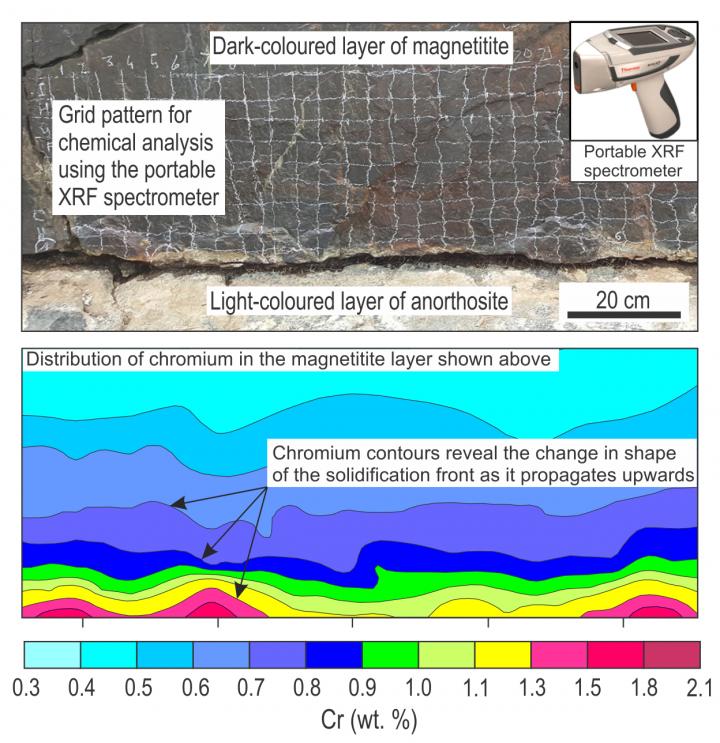
The study challenges a recently-emerged paradigm that magma chambers are huge masses of crystals with just a very small amount of melt.
IMAGE

Credit: Wits University

Wits University (University of the Witwatersrand, Johannesburg, South Africa) PhD student, Willem Kruger’s study on the state of magma within plutonic magmatic systems in the Earth’s crust has been published in the high impact journal, Nature Communications.

Working alongside his PhD supervisor, Professor Rais Latypov, from the Wits School of Geosciences, Kruger’s paper shows that basaltic magma chambers may develop as large bodies of crystal-free melts in the Earth’s crust. This study challenges a recently-emerged paradigm that magma chambers are huge masses of crystal-rich mush – in other words, crystals with just a very small amount of melt.

Attempts to understand the processes that operate in magma chambers in our planet’s crust is incredibly challenging as they are hidden from direct observations. Geologists must follow an indirect approach to study these features, such as examining their ancient fossilised remains that are exposed on Earth’s surface after millions of years of erosion.

To examine the state of magma within a chamber is very demanding, as it requires the study of the very contact between the crystallising margins of magma bodies (also called solidification fronts) and their liquid interiors.

Difficulties in understanding the behaviour of solidification fronts can fortunately be overcome by studying a particularly fascinating rock type, called massive magnetitite, from the Bushveld Complex in South Africa.

“Magnetitite contains chromium that is an extremely sensitive indicator of magma chamber processes and can be used to study solidification fronts in extreme detail,” says Kruger.

“By mapping the distribution of chromium in magnetitite in the field we can observe the two-dimensional propagation patterns of solidification fronts on a scale never done before.”

Kruger and Latypov found that all evolved liquid is effectively removed from the solidification front of magnetitite as it propagates towards the chamber interior. “This is because of extremely effective compositional convection that occurs during the crystallisation of magnetite. The process results in the solidification front to propagate as almost a completely solid surface.” says Latypov.

This research shows that such powerful compositional convection may inhibit the formation of crystal-rich mushes in basaltic magma chambers.

There are many reasons to believe that this process is not unique to magnetitite layers of the Bushveld Complex but will likely operate in other rock types as well, for instance, in the Bushveld’s economically important chromitite layers.

“Our results thus argue for the existence of large, liquid-dominated magma chambers hidden within the Earth’s crust,” says Kruger.

###

Media Contact
Schalk Mouton
[email protected]

Original Source

http://www.wits.ac.za/news/latest-news/research-news/2020/2020-06/phd-students-study-on-the-state-of-magma-in-crustal-reservoirs-published-in-nature-communications.html

Tags: Earth ScienceGeology/SoilGeophysicsGeophysics/GravityMaterialsNaturePlanets/MoonsPlate TectonicsTemperature-Dependent Phenomena
Share12Tweet8Share2ShareShareShare2

Related Posts

Hebrew University Congratulates Haim Sompolinsky on Receiving 2026 Dirac Medal

Hebrew University Congratulates Haim Sompolinsky on Receiving 2026 Dirac Medal

August 8, 2026
New brain model reveals how regional chemistry shapes large-scale neural activity

New brain model reveals how regional chemistry shapes large-scale neural activity

August 8, 2026

Topological coupler breaks bandwidth tradeoff in broadband coupled resonator waveguides

August 8, 2026

Radical Chemistry Selectively Cleaves Strong Bonds While Preserving Weaker Ones

August 7, 2026
Please login to join discussion

POPULAR NEWS

  • How Neuroblastoma Balances Replication Stress and Genome Stability Across Chromosome 17q

    29 shares
    Share 12 Tweet 7
  • Cigar, Cigarillo, and Pipe Smoking: Lung Cancer Risk and Screening Eligibility

    29 shares
    Share 12 Tweet 7
  • How Low Gravity and Pressure Affect Space Manufacturing of Carbon-Fiber Structures

    29 shares
    Share 12 Tweet 7
  • Calreticulin-targeted L-asparaginase–flagellin conjugate boosts Salmonella’s antitumor effectiveness

    29 shares
    Share 12 Tweet 7

About

We bring you the latest biotechnology news from best research centers and universities around the world. Check our website.

Follow us

Recent News

How Neuroblastoma Balances Replication Stress and Genome Stability Across Chromosome 17q

Cigar, Cigarillo, and Pipe Smoking: Lung Cancer Risk and Screening Eligibility

How Low Gravity and Pressure Affect Space Manufacturing of Carbon-Fiber Structures

Subscribe to Blog via Email

Success! An email was just sent to confirm your subscription. Please find the email now and click 'Confirm' to start subscribing.

Join 86 other subscribers
  • Contact Us

Bioengineer.org © Copyright 2023 All Rights Reserved.

Welcome Back!

Login to your account below

Forgotten Password?

Retrieve your password

Please enter your username or email address to reset your password.

Log In
No Result
View All Result
  • Homepages
    • Home Page 1
    • Home Page 2
  • News
  • National
  • Business
  • Health
  • Lifestyle
  • Science

Bioengineer.org © Copyright 2023 All Rights Reserved.