• HOME
  • NEWS
  • EXPLORE
    • CAREER
      • Companies
      • Jobs
    • EVENTS
    • iGEM
      • News
      • Team
    • PHOTOS
    • VIDEO
    • WIKI
  • BLOG
  • COMMUNITY
    • FACEBOOK
    • INSTAGRAM
    • TWITTER
Monday, August 17, 2026
BIOENGINEER.ORG
No Result
View All Result
  • Login
  • HOME
  • NEWS
  • EXPLORE
    • CAREER
      • Companies
      • Jobs
        • Lecturer
        • PhD Studentship
        • Postdoc
        • Research Assistant
    • EVENTS
    • iGEM
      • News
      • Team
    • PHOTOS
    • VIDEO
    • WIKI
  • BLOG
  • COMMUNITY
    • FACEBOOK
    • INSTAGRAM
    • TWITTER
  • HOME
  • NEWS
  • EXPLORE
    • CAREER
      • Companies
      • Jobs
        • Lecturer
        • PhD Studentship
        • Postdoc
        • Research Assistant
    • EVENTS
    • iGEM
      • News
      • Team
    • PHOTOS
    • VIDEO
    • WIKI
  • BLOG
  • COMMUNITY
    • FACEBOOK
    • INSTAGRAM
    • TWITTER
No Result
View All Result
Bioengineer.org
No Result
View All Result
Home NEWS Science News Chemistry

Study of nitinol deformations to enrich understanding of materials with targeted properties

Bioengineer by Bioengineer
May 13, 2021
in Chemistry
Reading Time: 2 mins read
0
IMAGE
Share on FacebookShare on TwitterShare on LinkedinShare on RedditShare on Telegram

A paper by Kazan Federal University appeared in International Journal of Solids and Structures
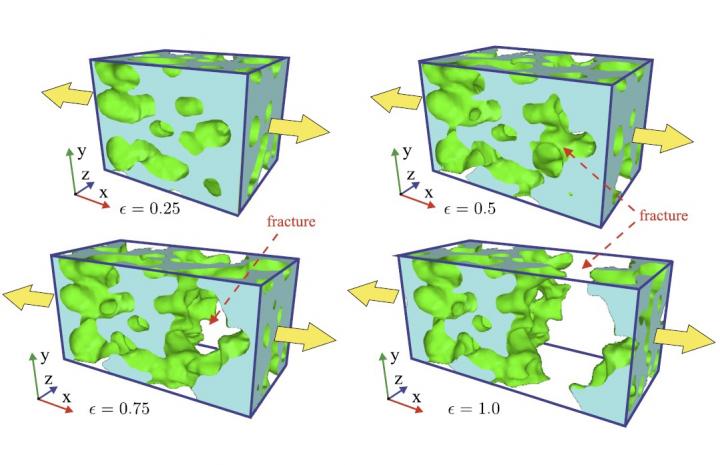
IMAGE

Credit: Kazan Federal University

The work was sponsored by Russian Science Foundation; the project, headed by Professor Anatolii Mokshin, is titled “Theoretical, simulating and experimental research of physico-mechanical traits of amorphous-producing systems with heterogeneous local visco-elastic properties”.

“We performed calculations for porous nitinol,” shares first co-author, Associate Professor Bulat Galimzyanov. “It’s widely used in various industries thanks to its unique physico-mechanical properties, such as low volume weight, high corrosion resistance, high biocompatibility and shape memory. Obtaining nitinol as amorphous foam is very labor-intensive, it requires high temperatures and extremely high melt cooling rate (over 1,000,000 K per second). Obviously, traditional experiments in this case are very costly and complex. We used computer modelling based on molecular dynamics.”

As Galimzyanov explains, amorphous metallic foams are prospective materials.

“Their cell structure comprises a solid metallic frame with gas-filled pores. Pores can be either hermetic or conjoined. The volume ratio of pores and their hermeticity determine the primary physico-chemical properties of the metallic foam, among which are low heat conductivity, high plasticity, and good noise absorption. Thanks to that, metallic foams can find wide applications in the automotive industry, shipbuilding, and aerospace industry,” says the interviewee.

As the research shows, amorphous porous nitinol can sustain major mechanical loads, significantly higher than crystalline nitinol.

Apart from the aforementioned applications, amorphous porous nitinol can also be used in prosthetics and biocompatible materials because it’s much more resistant to stretching and shrinking than bones but has the same porousness.

###

Media Contact
Yury Nurmeev
[email protected]

Original Source

https://eng.kpfu.ru/novosti/mechanical-response-of-nitinol-to-deformations-gives-insight-into-materials-with-targeted-properties/

Related Journal Article

http://dx.doi.org/10.1016/j.ijsolstr.2021.111047

Tags: Chemistry/Physics/Materials SciencesMaterialsMolecular Physics
Share12Tweet8Share2ShareShareShare2

Related Posts

Butterfly-Inspired Technology Could Transform Air Quality Monitoring

August 15, 2026
Artesunate Targets GBA, Triggering Apoptosis in Liver Cancer Cells

Artesunate Targets GBA, Triggering Apoptosis in Liver Cancer Cells

August 15, 2026

New molecule may enable cleaner, more efficient metal recovery

August 15, 2026

Controlled sulfidation enhances supercapacitor electrode performance

August 15, 2026
Please login to join discussion

POPULAR NEWS

  • KAIST develops semiconductor neuron that harnesses noise to selectively process signals

    29 shares
    Share 12 Tweet 7
  • Imagining natural and extra robotic thumbs together strengthens kinesthetic sensorimotor networks

    29 shares
    Share 12 Tweet 7
  • PARP1 Drives Neuropathic Pain Through GPX4-Dependent Ferroptosis in Injured Mice’s Sensory Neurons

    29 shares
    Share 12 Tweet 7
  • Strubbelig–NHL3 Receptor Complex Helps Arabidopsis Respond to Cellulose Deficiency

    29 shares
    Share 12 Tweet 7

About

We bring you the latest biotechnology news from best research centers and universities around the world. Check our website.

Follow us

Recent News

KAIST develops semiconductor neuron that harnesses noise to selectively process signals

Imagining natural and extra robotic thumbs together strengthens kinesthetic sensorimotor networks

PARP1 Drives Neuropathic Pain Through GPX4-Dependent Ferroptosis in Injured Mice’s Sensory Neurons

Subscribe to Blog via Email

Success! An email was just sent to confirm your subscription. Please find the email now and click 'Confirm' to start subscribing.

Join 85 other subscribers
  • Contact Us

Bioengineer.org © Copyright 2023 All Rights Reserved.

Welcome Back!

Login to your account below

Forgotten Password?

Retrieve your password

Please enter your username or email address to reset your password.

Log In
No Result
View All Result
  • Homepages
    • Home Page 1
    • Home Page 2
  • News
  • National
  • Business
  • Health
  • Lifestyle
  • Science

Bioengineer.org © Copyright 2023 All Rights Reserved.