Acoustic communication has played a key role in the evolution of animals especially vertebrates and insects, ranging from mating to warning calls and even social learning. The reconstruction of ancient acoustic signals is challenging, however, due to the extreme rarity of fossilized organs.
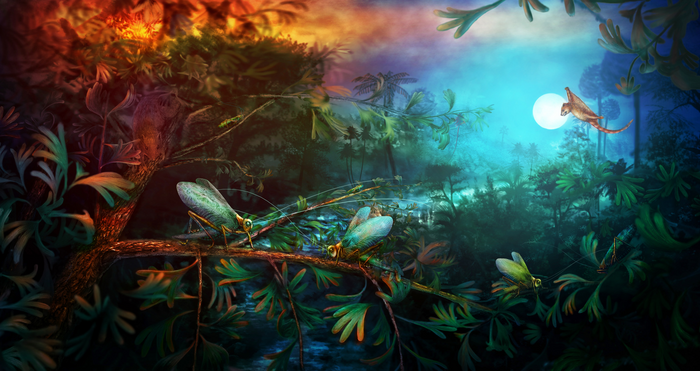
Credit: NIGPAS
Acoustic communication has played a key role in the evolution of animals especially vertebrates and insects, ranging from mating to warning calls and even social learning. The reconstruction of ancient acoustic signals is challenging, however, due to the extreme rarity of fossilized organs.
Insects were the first terrestrial animals to use airborne sound signals for long-distance communication. Among acoustically signaling insects, katydids stand out as an ideal source for investigating the evolution of acoustic organs and behavior.
Recently, Ph.D. student XU Chunpeng, under the supervision of Profs. WANG Bo and ZHANG Haichun from the Nanjing Institute of Geology and Palaeontology of the Chinese Academy of Sciences (NIGPAS), working with an international team of paleoentomologists, carried out a detailed and global investigation of fossil katydids from the Mesozoic Era (commonly referred to as the age of the dinosaurs).
The study provides novel insights on acoustic evolution of Mesozoic katydids and evolution of the Mesozoic soundscape. It was published in PNAS on Dec. 12.
The research team reported the earliest tympanal ears and sound-producing system (stridulatory apparatus) in exceptionally preserved Mesozoic katydids.
“The newly found tympanal ears in prophalangopsid katydids from the Middle Jurassic Daohugou Konservat-Lagerstätte represent the earliest-known insect ears, extending the age range of the modern-type auditory tympana by 100 million years to the Middle Jurassic, some 160 million years ago,” said XU.
The reconstruction of singing frequencies of Mesozoic katydids and oldest tympanal ears demonstrate that katydids had evolved complex acoustic communication, including mating signals, inter-male communication, and directional hearing, at least by the Middle Jurassic.
Also, katydids had evolved a high diversity of singing frequencies, including high-frequency musical calls, accompanied by acoustic niche partitioning, all at least by the Late Triassic (200 million years ago). This suggests that acoustic communication already could have been an important evolutionary driver in the early radiation of terrestrial insects after the Permo-Triassic mass extinction.
The Early and Middle Jurassic katydid transition from extinct haglid- to extant prophalangopsid-dominated insect faunas coincided with the diversification of derived mammalian groups (clades) and improvement of hearing in early mammals, supporting the hypothesis of acoustic co-evolution of mammals and katydids. The high-frequency songs of Mesozoic katydids could even have driven the evolution of intricate hearing systems in early mammals, and conversely, mammals with progressive hearing ability could have exerted selective pressure on the evolution of katydids, including faunal turnover.
These findings demonstrate that insects, especially katydids, dominated choruses during the Triassic—a situation different from the modern soundscape. After the appearance of birds and frogs in the Jurassic, the forest soundscape became almost the same as the modern one in the Cretaceous, except lacking the sound of cicadas (which have fewer musical calls). These results also highlight the ecological significance of insects in the Mesozoic soundscape, which has hitherto been largely unknown in the palaeontological record.
This research was supported by the National Natural Science Foundation of China, the Strategic Priority Research Program of the Chinese Academy of Sciences, and the Deep-time Digital Earth (DDE) Big Science Program.
Journal
Proceedings of the National Academy of Sciences
DOI
10.1073/pnas.2210601119
Article Title
High acoustic diversity and behavioral complexity of katydids in the Mesozoic soundscape
Article Publication Date
12-Dec-2022