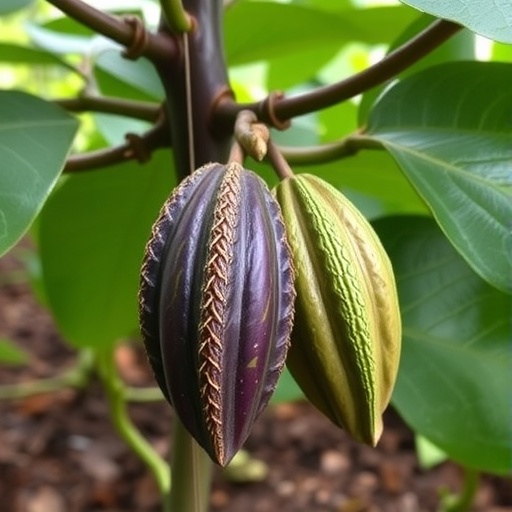
A sweeping genetic survey of cacao trees growing on indigenous farms across Peru has uncovered four entirely new genetic lineages of the plant that forms the backbone of the global chocolate industry, reshaping how scientists view the crop’s deep Amazonian roots. The work, published in PLOS One on July 6, 2026, analyzed single-nucleotide polymorphisms, or SNPs, across 390 wild and semi-wild trees sampled from eight geographically distinct Peruvian departments. SNPs are single-letter variations in the DNA code that act as molecular fingerprints, allowing researchers to measure relatedness and reconstruct ancestral relationships among individuals with exquisite precision. By comparing hundreds of thousands of these markers, the team built a high-resolution picture of cacao’s genetic architecture in a country that has remained relatively unexplored despite being the world’s eighth-largest cocoa producer.
Until now, the prevailing framework grouped traditional Amazonian cacao into ten known genetic clusters, each reflecting a different branch of the tree’s domestication history and geographic spread. The new analysis not only confirmed the presence of these established groups but revealed four additional clusters that are genetically distinct from all previously catalogued varieties. Every Peruvian region examined carried its own diagnostic genetic signature—a mosaic of pure lineages and admixed individuals shaped by local seed exchange, natural pollination, and generations of smallholder cultivation. Some trees represented the genetic essence of a single group, while others were complex hybrids blending multiple ancestries in patterns that mirrored human migration routes and ancient trade networks along the eastern slopes of the Andes and into the lowland Amazon.
The discovery of these hidden lineages matters greatly for the specialty chocolate market, which prizes fine flavor and aromatic complexity. Two of the four new groups possess ancestry that, based on known flavor-associated genetic markers, suggests they could yield beans with exceptionally desirable sensory profiles. The researchers hypothesize that these genotypes, nurtured for centuries in backyard plantings by Indigenous farming families, may carry alleles linked to premium floral and fruity notes that have been eroded in more intensively bred commercial cultivars. Mapping flavor potential at the genomic level is not straightforward—there is no single “chocolate flavor gene”—but regions of the cacao genome associated with the biosynthesis of volatile aromatic compounds and fat composition can point toward quality. The Peruvian lineages expand the catalogue of variation from which breeders can draw, especially as climate change and disease pressure threaten monoculture plantations worldwide.
Technically, the study relied on genotyping-by-sequencing, a reduced-representation method that captures thousands of SNP loci scattered across the genome without requiring a full reference sequence for every sample. After stringent filtering for missing data and low-frequency alleles, the team applied principal component analysis and model-based clustering algorithms to assign individuals to genetic populations. The four novel groups emerged as distinct clusters that remained robust under multiple statistical models, and their validity was further supported by phylogenetic trees showing strong bootstrap support for their branch positions. This level of resolution allowed the researchers to disentangle the genetic contributions behind the widely cultivated CCN 51 variety, a high-yield, disease-resistant clone whose ancestry has long been debated. The data clarify that CCN 51’s genetic background includes segments from several Amazonian gene pools, including material that clusters closely with some of the newly identified Peruvian lineages, suggesting that its resilience may partly derive from alleles preserved in on-farm traditional trees.
Beyond the laboratory, the work underscores a critical conservation message: Peru’s cacao genetic resources are not locked away in ex situ germplasm banks but are living components of agroecosystems managed by smallholder families. The researchers, a collaboration between the Cocoa Research Centre at The University of the West Indies and the Universidad Nacional Toribio Rodríguez de Mendoza in Peru, engaged directly with farmers to sample trees growing in chacras—mixed cultivation plots that also harbor diverse companion plants. In interviews, the authors described the experience of finding invaluable genetic treasures literally growing in farmers’ backyards, ready to be characterized and potentially connected to premium markets that could raise incomes. With more than 80,000 Peruvian families depending on cocoa cultivation as of 2024, tapping into the unique genetic signatures of each region could provide a route to product differentiation and geographic indication labels that pay a premium for origin-specific chocolate.
From a scientific standpoint, the Peruvian case illustrates how fine-scale geographic sampling can overturn broad-brush classifications. The Andes-to-Amazon gradient generates steep environmental transitions over short distances, fostering localized adaptation that becomes encrypted in the genome. The newly discovered lineages likely persisted in relative isolation due to riverine biogeographic barriers and cultural preferences of Indigenous communities that selected distinct tree types for centuries. As deforestation and agricultural modernization accelerate, these repositories of genetic diversity face erosion, making the simultaneous acts of discovery and documentation urgently important. The findings also raise the tantalizing possibility that similar unexplored variation may exist in neighboring Amazonian countries, waiting to be revealed by equally meticulous SNP-based surveys.
The publication adds a tangible new resource for an industry that relies on a notoriously narrow genetic base. Most commercial cacao originates from a handful of lineages that were spread globally during colonial exchanges, and broadening that base with carefully characterized traditional material could improve both sustainability and sensory quality. The study’s authors emphasize that their blueprint should now guide targeted conservation strategies and participatory breeding programs that respect the custodianship of Indigenous farmers. The research was funded by Peru’s CONCYTEC and PROCIENCIA, with no role from funders in the study design or manuscript preparation, and all data are openly accessible.
Subject of Research: Genetic diversity and population structure of traditional cacao (Theobroma cacao) from indigenous Amazonian farms in Peru, based on SNP genotyping of 390 trees, revealing four previously uncharacterized genetic lineages and region-specific genetic signatures.
Article Title: Genetic structure of traditional cacao reveals four new genetic lineages in indigenous Amazonian sites in Peru
News Publication Date: July 6, 2026
Web References: 10.1371/journal.pone.0351690
References: Motilal LA, Calderon MS, Bustamante DE, Gopaulchan D, Tineo D, Márquez-Romero FR, et al. (2026) Genetic structure of traditional cacao reveals four new genetic lineages in indigenous Amazonian sites in Peru. PLoS One 21(7): e0351690. DOI: 10.1371/journal.pone.0351690
Image Credits: Lambert Motilal, University of the West Indies, CC-BY 4.0
Keywords: cacao, Theobroma cacao, genetic lineages, SNPs, Amazonian diversity, Peru, fine flavor chocolate, indigenous farms, conservation genetics, CCN 51, germplasm characterization