• HOME
  • NEWS
  • EXPLORE
    • CAREER
      • Companies
      • Jobs
    • EVENTS
    • iGEM
      • News
      • Team
    • PHOTOS
    • VIDEO
    • WIKI
  • BLOG
  • COMMUNITY
    • FACEBOOK
    • INSTAGRAM
    • TWITTER
Tuesday, May 12, 2026
BIOENGINEER.ORG
No Result
View All Result
  • Login
  • HOME
  • NEWS
  • EXPLORE
    • CAREER
      • Companies
      • Jobs
        • Lecturer
        • PhD Studentship
        • Postdoc
        • Research Assistant
    • EVENTS
    • iGEM
      • News
      • Team
    • PHOTOS
    • VIDEO
    • WIKI
  • BLOG
  • COMMUNITY
    • FACEBOOK
    • INSTAGRAM
    • TWITTER
  • HOME
  • NEWS
  • EXPLORE
    • CAREER
      • Companies
      • Jobs
        • Lecturer
        • PhD Studentship
        • Postdoc
        • Research Assistant
    • EVENTS
    • iGEM
      • News
      • Team
    • PHOTOS
    • VIDEO
    • WIKI
  • BLOG
  • COMMUNITY
    • FACEBOOK
    • INSTAGRAM
    • TWITTER
No Result
View All Result
Bioengineer.org
No Result
View All Result
Home NEWS Science News Health

Study: Nonsurgical treatment options effective for sinus issues

Bioengineer by Bioengineer
October 15, 2019
in Health
Reading Time: 3 mins read
0
IMAGE
Share on FacebookShare on TwitterShare on LinkedinShare on RedditShare on Telegram

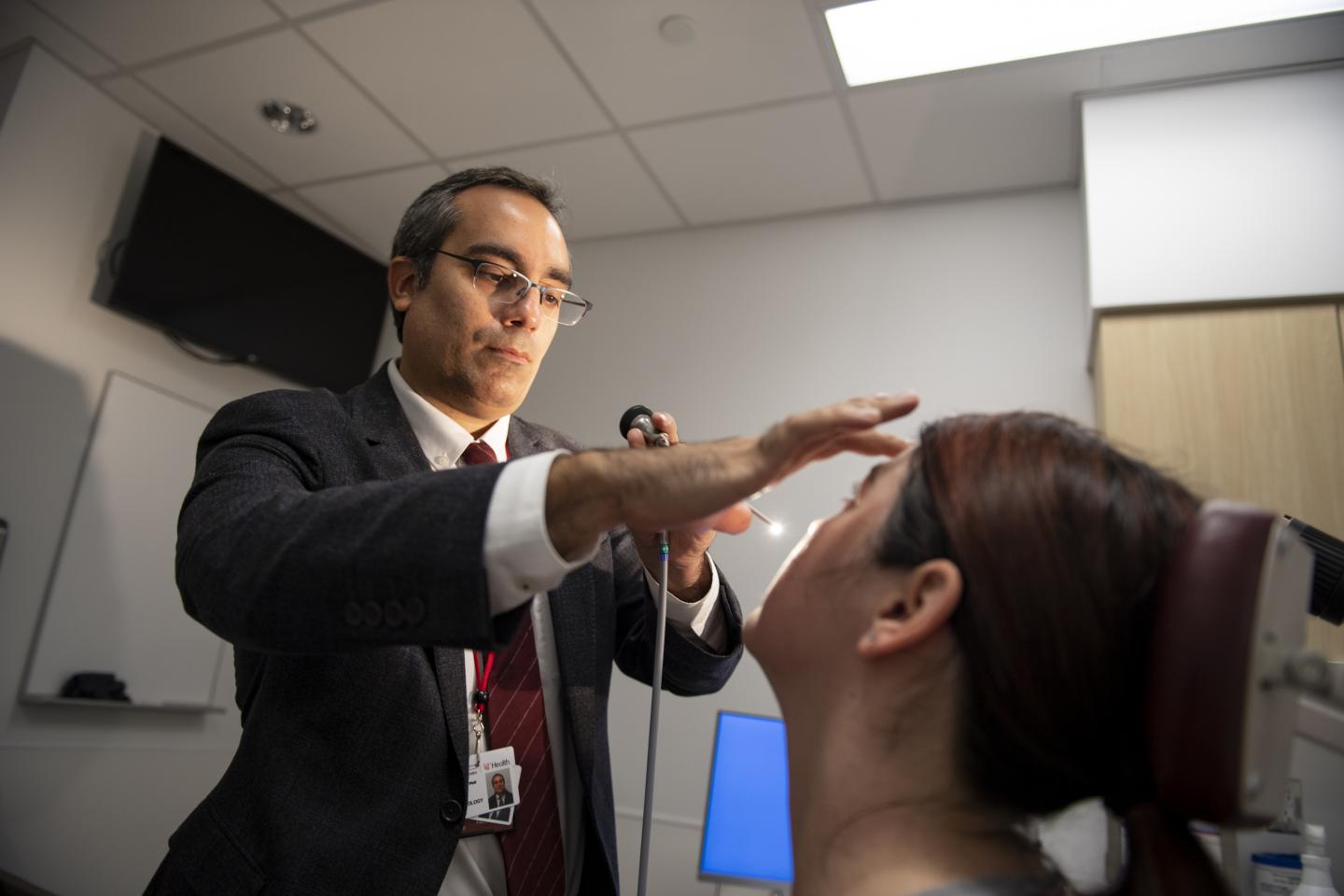
A new study shows medication, not surgery, can be a successful therapeutic option for severe chronic rhinosinusitis with nasal polyps
IMAGE

Credit: Colleen Kelley/University of Cincinnati


CINCINNATI (Oct. 15, 2019) — For sufferers of chronic rhinosinusitis (CRS), surgery is often the only treatment option due to the severity of their condition.

A new study led by a University of Cincinnati researcher may provide another option, however: in a recent clinical study, a regimen of combined oral and topical corticosteroids were effectively used to treat patients who suffer from severe CRS with nasal polyps.

CRS is an inflammatory condition of the sinuses, often described as “asthma of the sinuses.” CRS is prevalent in approximately 5% of the U.S. population, and it significantly decreases quality of life due to chronic symptoms such as nasal blockage, nasal drainage, facial pressure and decreased sense of smell.

In some cases of CRS, severe inflammation leads to growths in the nose and the sinuses called polyps. In some cases, these polyps can completely fill the nasal cavity–completely blocking nasal breathing and one’s sense of smell.

“These patients with the most severe symptoms and the large polyps are the ones for whom many doctors may say, ‘You need sinus surgery,’ rather than struggling through presumably ineffective medical therapy,” said Ahmad R. Sedaghat, MD, PhD, associate professor in the Department of Otolaryngology-Head and Neck Surgery at the UC College of Medicine and an author of the study.

In this study, patients’ CRS was treated with a regimen of a short-course oral corticosteroid taper and topical intranasal corticosteroid irrigations. More than 60 patients with severe CRS with nasal polyps participated in the clinical study, and half had well-controlled symptoms by receiving only this treatment regimen without needing sinus surgery.

This study was the first to demonstrate that even in patients with severe CRS with nasal polyps, a large fraction of patients may experience well-controlled symptoms, and therefore avoid surgery, through a combination regimen of systemic and topical intranasal corticosteroids.

“These patients’ disease is the worst of the worst,” Sedaghat said. “With this regimen, we alleviated their symptoms, helped them avoid surgery and improved their quality of life.”

###

The study was recently published in the International Forum of Allergy & Rhinology. Sedaghat conducted the trial while he was on faculty at Harvard Medical School, and it involved study participants from the school’s affiliated Massachusetts Eye and Ear Infirmary.

Co-authors included Madison V. Epperson, BA, a medical student at the UC College of Medicine; Katie M. Phillips, MD, Department of Otolaryngology-Head and Neck Surgery, Stanford University; David S. Caradonna, MD, DMD, Department of Otolaryngology, Harvard Medical School and the Division of Otolaryngology, Beth Israel Deaconess Medical Center; and Stacey T. Gray, MD, Department of Otolaryngology, Harvard Medical School and the Department of Otolaryngology, Massachusetts Eye and Ear Infirmary.

The study’s authors have no conflicts to report.

Media Contact
Amanda Nageleisen
[email protected]
513-585-8885

Original Source

https://www.uc.edu/news/articles/2019/10/n20865328.html

Related Journal Article

http://dx.doi.org/10.1002/alr.22431

Tags: Medicine/Health
Share12Tweet8Share2ShareShareShare2

Related Posts

Medicaid Expansion Reduces Mortality in Young Adults with Kidney Failure

May 11, 2026

CRISPR Technology Shows Promise in Inhibiting Hepatitis E Virus

May 11, 2026

Mapping Ocular Bioenergetics: Insights into TCA Cycle Intermediates and Gender Differences in Eye Tissues

May 11, 2026

Telemedicine Does Not Drive Higher Medical Utilization or Health Care Costs, Study Finds

May 11, 2026
Please login to join discussion

POPULAR NEWS

  • Research Indicates Potential Connection Between Prenatal Medication Exposure and Elevated Autism Risk

    841 shares
    Share 336 Tweet 210
  • New Study Reveals Plants Can Detect the Sound of Rain

    728 shares
    Share 290 Tweet 182
  • Salmonella Haem Blocks Macrophages, Boosts Infection

    62 shares
    Share 25 Tweet 16
  • Breastmilk Balances E. coli and Beneficial Bacteria in Infant Gut Microbiomes

    57 shares
    Share 23 Tweet 14

About

We bring you the latest biotechnology news from best research centers and universities around the world. Check our website.

Follow us

Recent News

Humans and Zebra Finches Share Similar Speech Learning Techniques #ASA190

New Study Uncovers How Fungal Parasites Attack Strawberries and Raspberries

City of Hope Researchers to Present Groundbreaking Immunotherapy and Precision Medicine Advances Across Multiple Cancer Types at ASCO 2026

Subscribe to Blog via Email

Enter your email address to subscribe to this blog and receive notifications of new posts by email.

Join 82 other subscribers
  • Contact Us

Bioengineer.org © Copyright 2023 All Rights Reserved.

Welcome Back!

Login to your account below

Forgotten Password?

Retrieve your password

Please enter your username or email address to reset your password.

Log In
No Result
View All Result
  • Homepages
    • Home Page 1
    • Home Page 2
  • News
  • National
  • Business
  • Health
  • Lifestyle
  • Science

Bioengineer.org © Copyright 2023 All Rights Reserved.