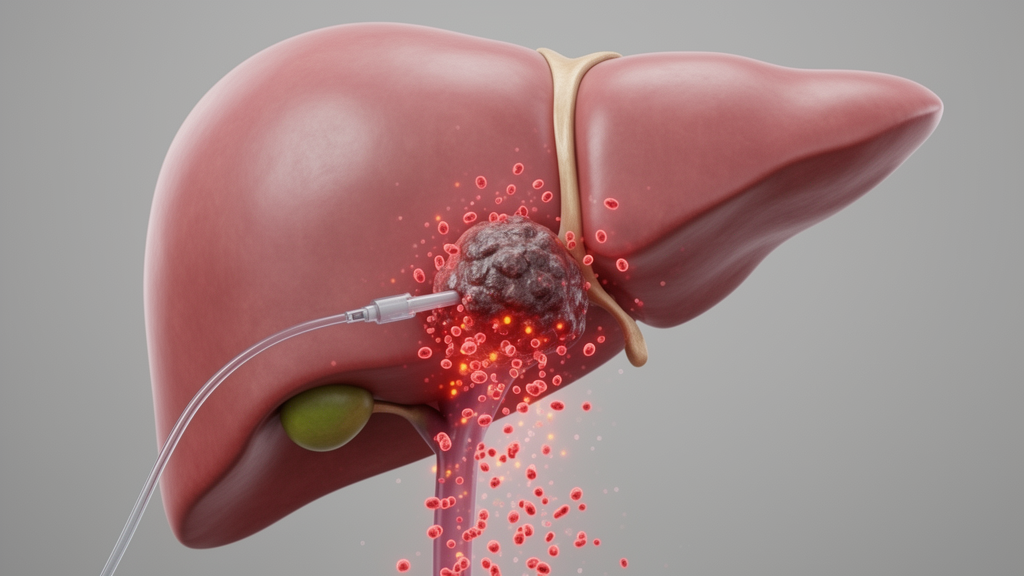
A retrospective, single-center study published in BMC Cancer reports that adding camrelizumab to a regimen of transarterial chemoembolization (TACE) and apatinib was associated with improved treatment response and survival outcomes in elderly patients with intermediate-advanced hepatocellular carcinoma. The research, led by Qingkuang Chen and colleagues, focused on elderly patients aged 60 years and older, a group for which evidence remains limited. The study evaluated both the efficacy and safety of this triple-modality approach compared to a control regimen that excluded the immunotherapy component.
The study design involved a retrospective analysis of 100 elderly patients with intermediate-advanced hepatocellular carcinoma who were treated between June 2021 and June 2024. The researchers utilized propensity score matching with a 1:1 ratio and a caliper of 0.02. This statistical method paired patients in the observation group, who received TACE combined with camrelizumab and apatinib, with patients in the control group, who received TACE and apatinib. Each group consisted of 50 patients.
The study evaluated objective response rate (ORR) and disease control rate (DCR) between the groups. The observation group demonstrated significantly higher rates for both metrics compared to the control group. Specifically, the ORR was 56.0% in the observation group versus 32.0% in the control group, a difference that was statistically significant with a P-value of 0.016. Similarly, the DCR was 86.0% in the observation group compared to 68.0% in the control group, with a P-value of 0.033.
Progression-free survival (PFS) and overall survival (OS) were also compared between groups. The median PFS was significantly prolonged in the observation group, at 11.5 months, compared to 5.9 months in the control group, with a P-value of less than 0.001 based on the log-rank test. Median OS was also higher in the observation group at 15.6 months, compared to 11.6 months in the control group, with a P-value of less than 0.001. Kaplan–Meier curve estimates further supported these findings, showing markedly higher 6-month and 12-month PFS rates in the observation group, at 89.5% versus 46.1% and 45.9% versus 15.2%, respectively. The 12-month OS rate was also higher in the observation group at 70.6% compared to 44.8% in the control group, although the 6-month OS rate was comparable between the two groups at 98.0% and 94.0%.
The study also compared immune function markers and tumor markers between the groups. The observation group showed greater improvements in CD4+ T cell proportion and CD4+/CD8+ ratio. Additionally, there were more pronounced reductions in serum AFP, HSP90α, and CEA levels in the observation group.
The safety profile of the treatment regimens was also assessed, with the overall incidence of adverse events being comparable between the two groups. The observation group had an adverse event rate of 34.0%, while the control group had a rate of 26.0%, a difference that was not statistically significant (P = 0.382). This suggests that the addition of camrelizumab to the TACE and apatinib regimen did not significantly increase the burden of adverse events in this elderly population.
The authors concluded that in this retrospective, single-center study, the addition of camrelizumab to TACE plus apatinib was associated with improved treatment response, immune function, and survival outcomes in elderly patients with intermediate-advanced hepatocellular carcinoma who met the inclusion criteria. However, they emphasized that these findings are limited by the retrospective design and the modest sample size of 100 patients. The authors noted that these findings require confirmation in prospective multicenter studies.
Subject of Research: Efficacy and safety of TACE combined with camrelizumab and apatinib in elderly patients with intermediate-advanced hepatocellular carcinoma
Article Title: Clinical efficacy of TACE combined with camrelizumab and apatinib in the treatment of elderly patients with intermediate-advanced hepatocellular carcinoma
Article References: Chen, Q., Li, S., Wu, H., Wu, S., & Zhao, P. (2026). Clinical efficacy of TACE combined with camrelizumab and apatinib in the treatment of elderly patients with intermediate-advanced hepatocellular carcinoma. BMC Cancer. https://doi.org/10.1186/s12885-026-17285-4
Image Credits: AI Generated
DOI: 10.1186/s12885-026-17285-4
Keywords: hepatocellular carcinoma, transarterial chemoembolization, camrelizumab, apatinib, elderly patients, immunotherapy, targeted therapy, retrospective study, BMC Cancer, Clinical, efficacy, TACE
News Source: Nathaniel Bowman. (November 7, 2026). Study Links TACE Plus Camrelizumab to Better HCC Outcomes. Scienmag.