• HOME
  • NEWS
  • EXPLORE
    • CAREER
      • Companies
      • Jobs
    • EVENTS
    • iGEM
      • News
      • Team
    • PHOTOS
    • VIDEO
    • WIKI
  • BLOG
  • COMMUNITY
    • FACEBOOK
    • INSTAGRAM
    • TWITTER
Monday, August 31, 2026
BIOENGINEER.ORG
No Result
View All Result
  • Login
  • HOME
  • NEWS
  • EXPLORE
    • CAREER
      • Companies
      • Jobs
        • Lecturer
        • PhD Studentship
        • Postdoc
        • Research Assistant
    • EVENTS
    • iGEM
      • News
      • Team
    • PHOTOS
    • VIDEO
    • WIKI
  • BLOG
  • COMMUNITY
    • FACEBOOK
    • INSTAGRAM
    • TWITTER
  • HOME
  • NEWS
  • EXPLORE
    • CAREER
      • Companies
      • Jobs
        • Lecturer
        • PhD Studentship
        • Postdoc
        • Research Assistant
    • EVENTS
    • iGEM
      • News
      • Team
    • PHOTOS
    • VIDEO
    • WIKI
  • BLOG
  • COMMUNITY
    • FACEBOOK
    • INSTAGRAM
    • TWITTER
No Result
View All Result
Bioengineer.org
No Result
View All Result
Home NEWS Science News Health

Study: Hearing develops in tandem with form and function

Bioengineer by Bioengineer
January 2, 2020
in Health
Reading Time: 2 mins read
0
IMAGE
Share on FacebookShare on TwitterShare on LinkedinShare on RedditShare on Telegram

Mouse model insight could focus future hearing loss reversal research on early development
IMAGE

Credit: Oregon Health & Science University


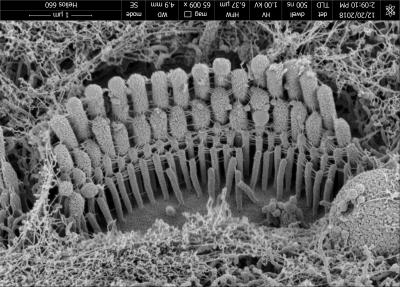
New research reveals a key insight into the development of hair bundles, the intricately complex assemblies in the inner ear responsible for hearing.

Hair bundles are precisely arranged cellular structures deep within the spiral cavity of the inner ear. Together, they convert vibrational energy into electrical signals in the brain that translate into the sensation of hearing. Once they’re lost – whether by loud noise, toxins, disease or aging – they do not naturally regenerate in people and other mammals.

The new research led by scientists at Oregon Health & Science University provides important clues that may help scientists develop new techniques to regenerate hair cells and reverse hearing loss.

In the study published in the journal Current Biology, researchers discovered the development of hair bundles occurs in a kind of feedback loop in which form follows function and function drives form.

Using mice, which closely model human hearing, the researchers found stereocilia, roughly 100 of which are assembled into a hair bundle, widened simultaneously with the onset of mechanotransduction – the action of converting mechanical signals in the form of sound into electrical signals measured within the brain. The stereocilia only elongated to their mature lengths after transduction had been established.

It turns out that form and function are mutually reinforcing.

“We’ve been looking at these as separate pathways,” said lead author Jocelyn Krey, Ph.D., staff scientist in the Oregon Hearing Research Center and the Vollum Institute at OHSU. “But in the course of this research, we observed the change in form occurs at the same time as the conversion of mechanical to electrical signals. So we’re seeing these happen together, and feeding each other in a way we hadn’t seen before.”

The researchers discovered when they examined mice lacking transduction or used a compound to block transduction, the animals did not develop the classic staircase-shaped form of mature hair bundles.

Researchers say the study suggests that new techniques to reverse hearing loss should focus on the critical importance of early development.

“In the future, with the rapid development of gene editing tools like CRISPR, we will be able to turn on genes at will,” said senior author Peter Barr-Gillespie, Ph.D., professor in the Oregon Hearing Research Center and senior scientist in the Vollum Institute. “I have no doubt we will be there in 5 or 10 years.”

###

Barr-Gillespie also serves as OHSU’s chief research officer and executive vice president.

The study was supported by confocal microscopy conducted in the OHSU Advanced Light Microscopy Core through National Institutes of Health grant P30 NS061800; electron microscopy performed at the OHSU Multiscale Microscopy Core; and NIH grants R03 DC014544; R01 DC014720; R01 DC002368 and R01 DC011034.

Media Contact
Erik Robinson
[email protected]
503-494-8231

Related Journal Article

http://dx.doi.org/10.1016/j.cub.2019.11.076

Tags: Cell BiologyHearing/SpeechMedicine/Health
Share13Tweet8Share2ShareShareShare2

Related Posts

Wearable monitor improves diagnosis of heart rhythm disorders after fainting

August 31, 2026

Visualisation of magnetic field-induced nanoparticle clusters and mechanical property changes in a breast phantom for inductive moderate hyperthermia

August 31, 2026

Multidisciplinary intervention in frail elderly patients with cardiovascular diseases: a multicentre, single-blinded, randomised controlled trial

August 31, 2026

Machine Learning Model Development and Evaluation for Non-contact Lower Limb Injury Risk Prediction in Elite Male Rugby Union: A Multi-team, Multi-season Analysis

August 31, 2026
Please login to join discussion

POPULAR NEWS

  • β-Sitosterol from Ipomoea carnea Jacq. As a promising anti-inflammatory agent: Evidence from in silico modeling and in vitro validation

    29 shares
    Share 12 Tweet 7
  • Design, fabrication and characterization of a wearable Fiber Bragg grating sensor for cardiorespiratory monitoring using finger plethysmography

    29 shares
    Share 12 Tweet 7
  • KAIST opens the era of industrial-scale microbial foods, proposing growth strategies for the next-generation protein market

    29 shares
    Share 12 Tweet 7
  • Virologist awarded $2 million NIH grant to investigate how virus-infected cells live and die

    29 shares
    Share 12 Tweet 7

About

We bring you the latest biotechnology news from best research centers and universities around the world. Check our website.

Follow us

Recent News

β-Sitosterol from Ipomoea carnea Jacq. As a promising anti-inflammatory agent: Evidence from in silico modeling and in vitro validation

Design, fabrication and characterization of a wearable Fiber Bragg grating sensor for cardiorespiratory monitoring using finger plethysmography

KAIST opens the era of industrial-scale microbial foods, proposing growth strategies for the next-generation protein market

Subscribe to Blog via Email

Enter your email address to subscribe to this blog and receive notifications of new posts by email.

Join 85 other subscribers
  • Contact Us

Bioengineer.org © Copyright 2023 All Rights Reserved.

Welcome Back!

Login to your account below

Forgotten Password?

Retrieve your password

Please enter your username or email address to reset your password.

Log In
No Result
View All Result
  • Homepages
    • Home Page 1
    • Home Page 2
  • News
  • National
  • Business
  • Health
  • Lifestyle
  • Science

Bioengineer.org © Copyright 2023 All Rights Reserved.