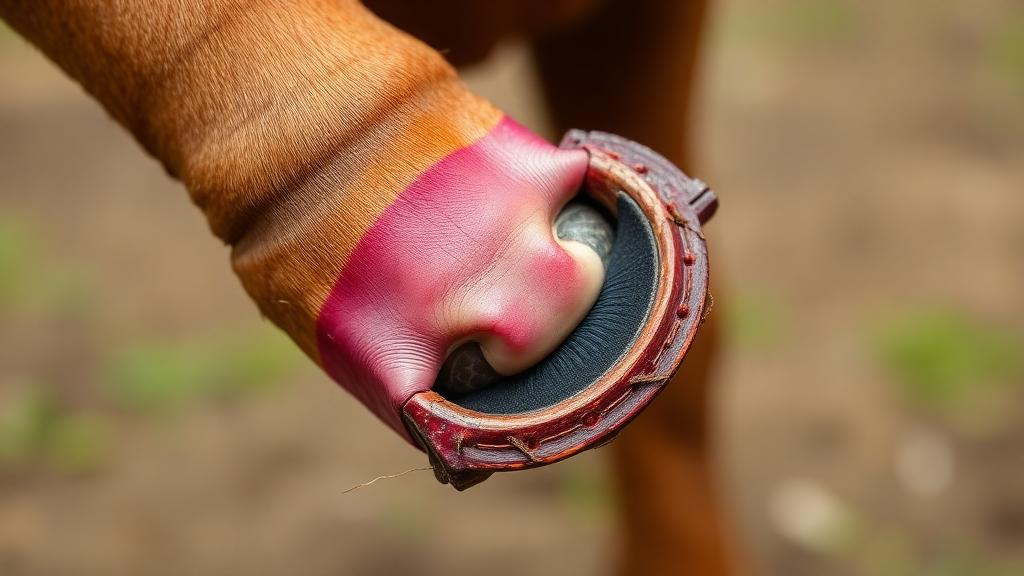
A seemingly routine chore at a horse stable nearly turned fatal for a 69-year-old woman whose case is now drawing attention across the trauma surgery community. While opening the door of a stable, she was kicked in the left lower quadrant of her abdomen by a horse. The initial signs were deceptively mild: she took oral painkillers at home and tried to carry on. But when the pain refused to subside, she was rushed by ambulance to the emergency department roughly three hours after the impact. What clinicians found there, and what a distinctive bruise ultimately helped reveal, offers a striking lesson in how high-energy trauma can hide behind localized, almost innocuous external findings.
The biomechanics of a horse kick explain why such injuries deserve serious respect. Studies of equine impact forces have measured strikes reaching up to 7,000 newtons, roughly equivalent to the weight of a 700-kilogram mass, delivered through a small hoof contact area in a fraction of a second. That concentration of energy over a narrow surface is what makes horse kicks capable of tearing bowel, fracturing ribs, and rupturing solid organs. Yet, paradoxically, the external evidence of such a blow can be minimal. In modern societies, routine contact with horses has become less common, but riding clubs, farms, and stables keep the risk alive, and emergency physicians may see such cases rarely enough that the injury pattern is not immediately at the front of their minds.
On arrival, the patient was alert and her vital signs were reassuring: blood pressure of 148/79 mmHg and a heart rate of 62 beats per minute. Her abdomen, however, told a different story. Examination revealed generalized tenderness with rebound tenderness and muscular guarding, the classic signs of diffuse peritoneal irritation, indicating that the lining of the abdominal cavity was inflamed, often a signal of leaking bowel contents or blood. Most strikingly, the emergency team noted a faint, horseshoe-shaped contusion in the left lower quadrant, a subcutaneous hemorrhage whose curved shape mirrored the contour of the hoof that struck her. The bruise was photographed at presentation, and no other external injuries such as lacerations or fractures were found.
Laboratory results added to the diagnostic puzzle. Her white blood cell count was elevated at 13,400 per microliter, consistent with an inflammatory response, but hemoglobin, platelets, liver enzymes, renal function, and C-reactive protein were all within normal ranges. A focused assessment with sonography for trauma, the bedside ultrasound scan widely used to detect free fluid in injured patients, was negative. Arterial blood gas analysis showed a lactate of 2.4 mmol/L and a base excess of minus 0.9 mmol/L, values suggesting only mild physiological stress. Her overall Injury Severity Score was calculated at 9, a figure that on its own would not suggest a life-threatening injury. This is precisely the trap that trauma surgeons warn about: stable vital signs and modest laboratory abnormalities can coexist with a perforated hollow organ quietly leaking intestinal contents into the peritoneal cavity.
The decisive test was contrast-enhanced computed tomography of the abdomen. The scan demonstrated intraperitoneal free air, an unmistakable marker of bowel perforation, along with focal thickening of the small bowel wall and increased contrast enhancement located directly beneath the horseshoe-shaped contusion. Crucially, there was no injury to the liver, spleen, or any other solid organ. The anatomical correspondence between the skin bruise and the underlying bowel damage was remarkable: the hoof had compressed the jejunal loop against the spine and pelvic ring, crushing the bowel wall at exactly the point where the contusion marked its impact. In blunt abdominal trauma, solid organ injuries are far more common than hollow viscus injuries, so in a patient without hemorrhagic findings, clinical attention can easily drift toward the liver and spleen while a perforated intestine goes unnoticed until peritonitis or sepsis sets in.
With diffuse peritoneal irritation and clear CT evidence of free air, the surgical team made the call for emergency laparotomy, performed approximately six hours after the injury. Through a midline incision, they systematically explored the entire gastrointestinal tract. The culprit was found: a fingertip-sized perforation on the antimesenteric border of the jejunum, the segment of small bowel richest in blood supply, located about 70 centimeters distal to the ligament of Treitz. The injury was classified as Grade III on the American Association for the Surgery of Trauma bowel injury scale. Notably, the surrounding bowel wall appeared viable, without extensive contusion, ischemia, or mesenteric vascular compromise, and no other injuries were found anywhere in the abdomen.
The repair itself was elegantly straightforward, a fact that underscores how early detection changes outcomes. After irrigating the abdominal cavity with 10 liters of normal saline, the surgeons debrided the edges of the injured bowel wall and closed the perforation primarily with simple interrupted 4-0 polydioxanone sutures, an absorbable monofilament that retains tensile strength for weeks. The fascia was closed with heavy #1 polyglactin sutures, the subcutaneous wound was washed with a further 2 liters of saline, and the skin was closed with buried subcuticular stitches. Because the perforation was caught before extensive contamination developed, a bowel resection and stoma, procedures that carry far greater morbidity, were avoided entirely. The horseshoe bruise, in effect, had pointed the surgeons directly to the injury.
Recovery was not entirely smooth. The patient experienced a transient postoperative ileus, a temporary paralysis of bowel function that is a common complication after abdominal surgery, and she received intravenous piperacillin/tazobactam, a broad-spectrum antibiotic combination, for seven days to guard against infection. Oral intake resumed on postoperative day six, and after gradual dietary advancement and confirmation of stable bowel function, she was discharged on postoperative day eleven. At a one-month follow-up visit, she reported no abdominal symptoms, no pain, and no signs of bowel obstruction. For an injury that, if missed, could have progressed to fecal peritonitis, septic shock, and death, the outcome represents the best-case scenario that prompt imaging and timely surgery make possible.
The case also fuels an ongoing debate in trauma surgery about operative strategy. The team chose open laparotomy because of diffuse peritoneal irritation and concern for hollow viscus injury, the traditional and safest approach when bowel perforation is suspected. But the authors note that in hemodynamically stable patients in whom the injury can be reasonably localized, diagnostic and therapeutic laparoscopy may be a reasonable alternative, provided that a thorough exploration of the entire bowel can be achieved and the threshold for converting to an open procedure remains low. Minimally invasive exploration could reduce wound complications and hospital stay, but it demands surgical judgment and institutional capability, and the diffuse peritoneal signs in this patient justified the more definitive open approach.
The broader message for readers is one that emergency physicians and horse handlers alike should take to heart. Isolated small bowel perforation after blunt trauma can present with subtle or nonspecific early findings, and delayed recognition has been repeatedly associated with increased postoperative complications and mortality. Previous reports have described a range of small-bowel injuries from horse kicks, including jejunal perforation and complex injuries involving the mesentery and abdominal wall, but this case stands out for its isolated nature, the striking anatomical match between the horseshoe-shaped contusion and the perforation beneath it, and the early CT diagnosis that enabled simple primary repair. Localized external findings, however reassuring they may appear, do not reliably exclude significant internal injury when abdominal pain or peritoneal signs persist. After any high-energy localized impact, whether from a hoof, a handlebar, or a seatbelt, persistent abdominal pain should trigger early cross-sectional imaging, and when bowel injury is suspected, timely surgical intervention remains the difference between a straightforward suture repair and a catastrophic outcome.
Subject of Research: Isolated jejunal perforation following blunt abdominal trauma from a horse kick
Article Title: Jejunal Perforation Associated With a Horseshoe‐Shaped Abdominal Contusion After a Horse Kick: A Case Report
Article References: Yoshida, J., Hanaki, T., Sakano, Y., & Fujiwara, Y. (2026). Jejunal Perforation Associated With a Horseshoe‐Shaped Abdominal Contusion After a Horse Kick: A Case Report. Clinical Case Reports, 14(10), Article e73687. https://doi.org/10.1002/ccr3.73687
Image Credits: AI Generated
DOI: 10.1002/ccr3.73687
Keywords: horse kick, jejunal perforation, blunt abdominal trauma, hollow viscus injury, computed tomography, emergency laparotomy, peritonitis, trauma surgery, case report, bowel injury, abdominal contusion, injury severity score
News Source: Ophelia Keating. (October 6, 2026). Horse Kick Leaves Horseshoe Bruise That Revealed Hidden Jejunal Perforation. Scienmag.