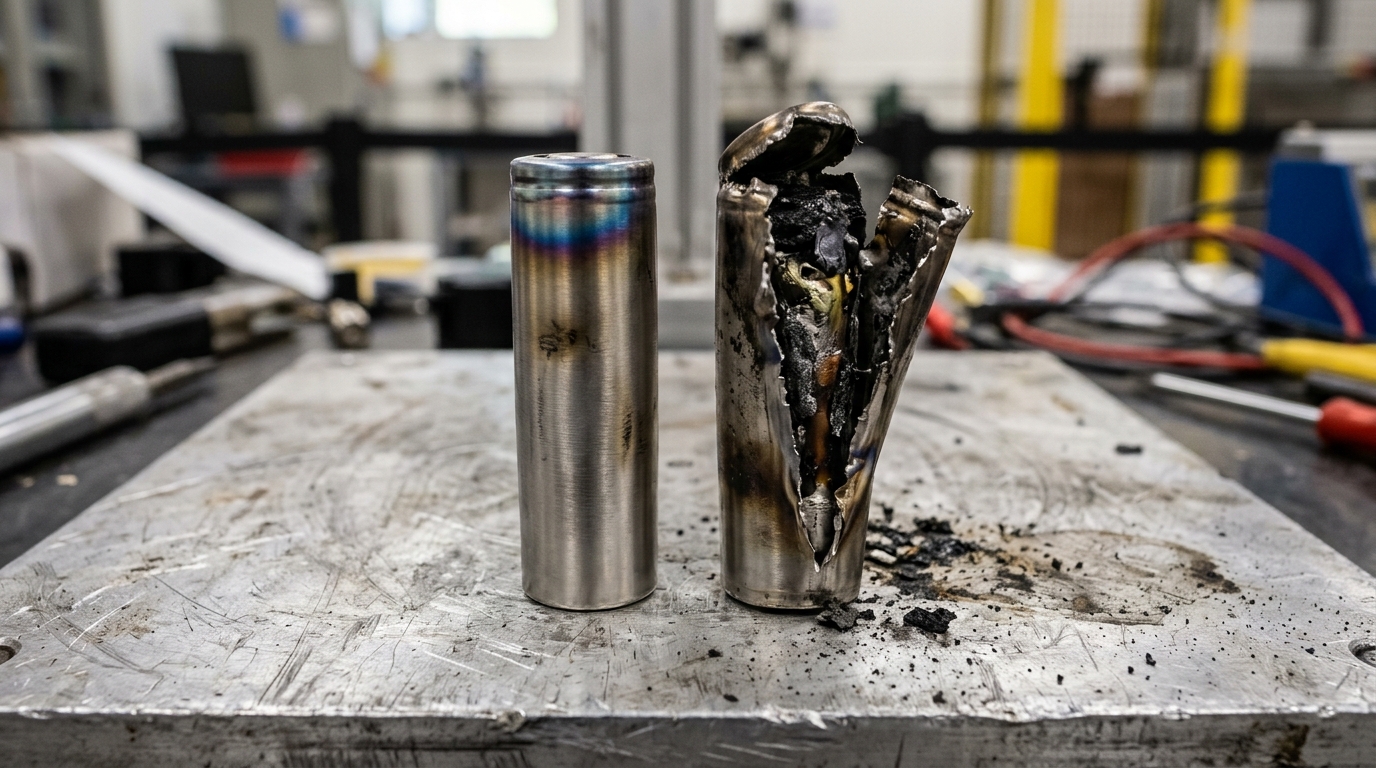
Thermal runaway in lithium-ion batteries is a critical failure mode characterized by rapid temperature rise, gas release, and potential cell-to-cell propagation, yet the severity of these events can vary dramatically even among seemingly identical cells tested under similar conditions. A new empirical analysis of an open battery failure databank investigates this variability by auditing the dispersion of post-failure outcomes relative to pre-test measurements. Researchers found that while initial descriptors such as mass and nominal capacity remain highly consistent across nominally matched test groups, the resulting severity outcomes—including corrected total energy yield and ejecta energy—exhibit substantially higher dispersion. This finding underscores the necessity for safety-engineering systems to be calibrated for high-severity outcomes rather than relying solely on average behavior, as the variability itself represents a significant safety consideration in electric vehicle and energy storage applications.
The study, which examined 365 experimental records from an open-source battery failure databank, focused on identifying the contrast between controlled pre-test state variables and post-runaway severity measurements. By forming 46 near-replicate groups, each containing at least three tests with identical cell-description, format, and trigger-mechanism labels, the team sought to isolate the degree of inherent severity uncertainty. The researchers emphasize that these groups, while nominally matched in the archival records, do not represent strictly controlled technical replicates. The retrospective audit of the source data revealed significant within-group heterogeneity, including variations in experiment series, equipment generations, positive- and negative-side seal configurations, and trigger variables such as heater power and duration. These differences indicate that the archival records reflect a diverse set of real-world testing conditions rather than uniform experimental setups.
To quantify the relative dispersion within these near-replicate groups, the researchers utilized an operational descriptor termed Thermal Runaway Severity Uncertainty Amplification (TR-SUA). This metric is defined as the ratio of the output coefficient of variation (CV) for severity indicators to the baseline input CV of pre-test descriptors. The analysis employed a composite input CV—calculated as the arithmetic mean of the within-group CVs of pre-test mass, nominal capacity, and nominal energy—to establish an auditable initial reference. Because nominal capacity and nominal energy remained constant within all groups, they contributed zero to the variance, effectively reducing the denominator and magnifying the unregularized ratio. The authors specify that TR-SUA is used as a descriptive diagnostic for dispersion patterns rather than a claim of measured causal physical gain or a novel law of uncertainty propagation.
Quantitative results from the study reveal a stark contrast between input and output dispersion. The median three-descriptor input CV across the 46 eligible groups was 0.104%, reflecting the minimal variation in recorded cell characteristics. In contrast, the median output CVs were found to be 7.577% for corrected total energy, 14.730% for total ejecta energy, 21.943% for unrecovered mass, and 21.903% for unrecovered-mass fraction. The statistical difference between the initial input CVs and the outcome CVs was confirmed via one-sided Wilcoxon tests. These results demonstrate that even when cells share similar physical formats and trigger mechanisms, the physical consequences of thermal runaway diverge significantly, a phenomenon the researchers describe as a robust operational dispersion contrast.
To deepen the understanding of the mechanisms underlying this divergence, the study employed a systematic log-decomposition of the energy partition ratio (EPR), defined as the ratio of ejecta energy to corrected total energy yield. By evaluating the algebraic identity linking the logarithmic difference of ejecta energy to the corresponding differences in total energy and EPR, the researchers decomposed ejecta-energy variance into constituent parts. Among 1,094 valid test pairs with at least a 10% ejecta-energy contrast, the absolute EPR log term dominated the total-energy log term in 58.0% of cases. The authors note that this decomposition is strictly algebraic and does not independently observe or temporally locate a physical amplification stage in the runaway process. The presence of signed terms that can counteract or exceed 100% further demonstrates that the EPR term is a descriptive feature of severity partitioning, not an identification of a mechanistic energy-flow stage.
The sensitivity of these results to underlying definitions was addressed through a series of supplementary analyses. The researchers applied denominator floors of 0.5%, 1%, and 2% CV to the TR-SUA ratios to assess how small input denominators influenced the magnitude of the measured dispersion. At a 1% denominator floor, the median TR-SUA ratios for total energy and ejecta energy were 7.577 and 14.730, respectively. These values remained sensitive to the specific input reference chosen—such as using pre-test mass alone compared to the four-descriptor mean including open-circuit voltage. While the magnitude of the ratio varies depending on the applied threshold and input definition, the qualitative pattern of high severity dispersion relative to input stability remains a consistent feature of the data.
Probabilistic risk boundaries were also calculated to provide descriptive high-severity scenario statistics, with P50, P75, P90, and P95 percentiles derived for different triggering mechanisms. However, the study cautions against interpreting these P95 estimates as precise or transportable engineering safety limits. Hierarchical cluster-bootstrap 95% confidence intervals for total-energy P95 were notably wide, highlighting the imprecision inherent in current archival datasets. The authors argue that safety margins should be calibrated based on the intended population of commercial cells and the specific test protocol, as the sampled databank is heterogeneous and not a representative cross-section of all manufactured cells.
An auxiliary machine learning reanalysis provided further insight into the limitations of predicting thermal runaway severity. An initial random forest model displayed high performance, but a follow-up audit identified significant outcome-adjacent feature leakage, particularly due to the inclusion of vent-status predictors in the target variable. Upon restricting the model to pre-test mass, capacity, nominal energy, OCV, and trigger class, the generalization performance dropped markedly. Grouped fivefold validation and leave-one-format-out tests showed poor predictive transfer, with the restricted model failing to detect positive outcomes consistently. This large generalization gap effectively rules out a claims-based transferable prediction model for severity outcomes based on the current available features.
The researchers also synthesized a conceptual kinetic model to provide mechanistic plausibility for these observations. The model portrays thermal runaway as a sequence of coupled electrochemical, thermal, and mechanical stages where heat generation depends exponentially on temperature via Arrhenius kinetics. In this conceptual framework, small initial perturbations can propagate through sequential stages, with effective amplification factors at each stage of the evolution. The authors stress that these equations do not quantitatively reproduce the 365 tests in the databank nor do they demonstrate deterministic chaos. Instead, they serve to articulate a testable hypothesis regarding cascading amplification processes where nonlinear feedbacks turn minor initial differences into large observed severity outcomes.
Ultimately, the study characterizes the observed severity variability as a significant operational reality rather than a proven physical law of uncertainty propagation. The researchers conclude that the current databank evidence supports reporting severity dispersion and uncertainty-qualified upper-tail outcomes, while unobserved cell and protocol conditions prevent a causal physical-amplification claim. Future work in this domain requires prospectively controlled experiments that maintain strict consistency across SOC, SOH, cell lot, chemistry, and thermal boundaries. Furthermore, such experiments must prioritize the measurement of time-resolved diagnostic data—including temperature, pressure, gas flow, and venting events—to move beyond descriptive statistics toward an identification of stage-wise causal gains and the establishment of robust, design-relevant probability distributions for safety engineering.
Subject of Research: Empirical analysis of variability in lithium-ion battery thermal runaway severity.
Article Title: Why similar batteries fail differently: an empirical analysis of thermal runaway severity variability
Article References: Wei, N. (2026). Why similar batteries fail differently: an empirical analysis of thermal runaway severity variability. Journal of King Saud University – Engineering Sciences, 38(8), Article 60. https://doi.org/10.1007/s44444-026-00134-x
Image Credits: AI Generated
DOI: 10.1007/s44444-026-00134-x
Keywords: lithium-ion batteries, thermal runaway, battery safety, severity variability, energy storage systems, experimental uncertainty, thermal abuse testing, coefficient of variation, failure databank, energy partitioning, probabilistic risk analysis, severity dispersion, predictive modeling, kinetic modeling, electrochemical safety, EPR, TR-SUA
News Source: Faith Mcneil. (November 16, 2026). Study Finds Substantial Severity Variability in Similar Lithium-Ion Battery Failures. Scienmag.