A research team has successfully developed a rapid and broadly applicable in planta transformation and genome editing system for citrus, circumventing the limitations of traditional, labor-intensive tissue culture methods. This new approach, which utilizes wounded epicotyls as the primary site for transformation, allows for the efficient production of transgenic plants within approximately 40 days of seed sowing. By using localized agarose-based chambers to sequentially deliver Agrobacterium, plant growth regulators, and antibiotics, the researchers established a system that maintains consistent hormonal availability and selection pressure. This platform facilitates both genetic transformation and CRISPR/Cas9-mediated genome editing, providing a valuable tool for functional genomics and potential genetic improvement in perennial woody species. The study marks a significant progression from conventional regeneration techniques, which have historically been hindered by long juvenile periods, high heterozygosity, and genotype-dependent success rates.
Traditional citrus transformation has largely relied on in vitro tissue culture procedures involving epicotyl segments, internodes, or embryogenic tissues. These conventional methods often require stringent aseptic techniques and span several months, necessitating the frequent transfer of explants to fresh media and the screening of numerous regenerants to identify successful transformants. Furthermore, many genotypes require supplementary in vitro rooting or micrografting steps, which significantly increase the technical complexity and timeframe for generating transgenic materials. The newly established system utilizes an in planta strategy, where transformed shoots regenerate directly from wounded seedlings. This method builds upon previous research on the wound-regeneration capacity of citrus epicotyls and optimizes the delivery of growth factors that were often inconsistently applied in prior in planta attempts.
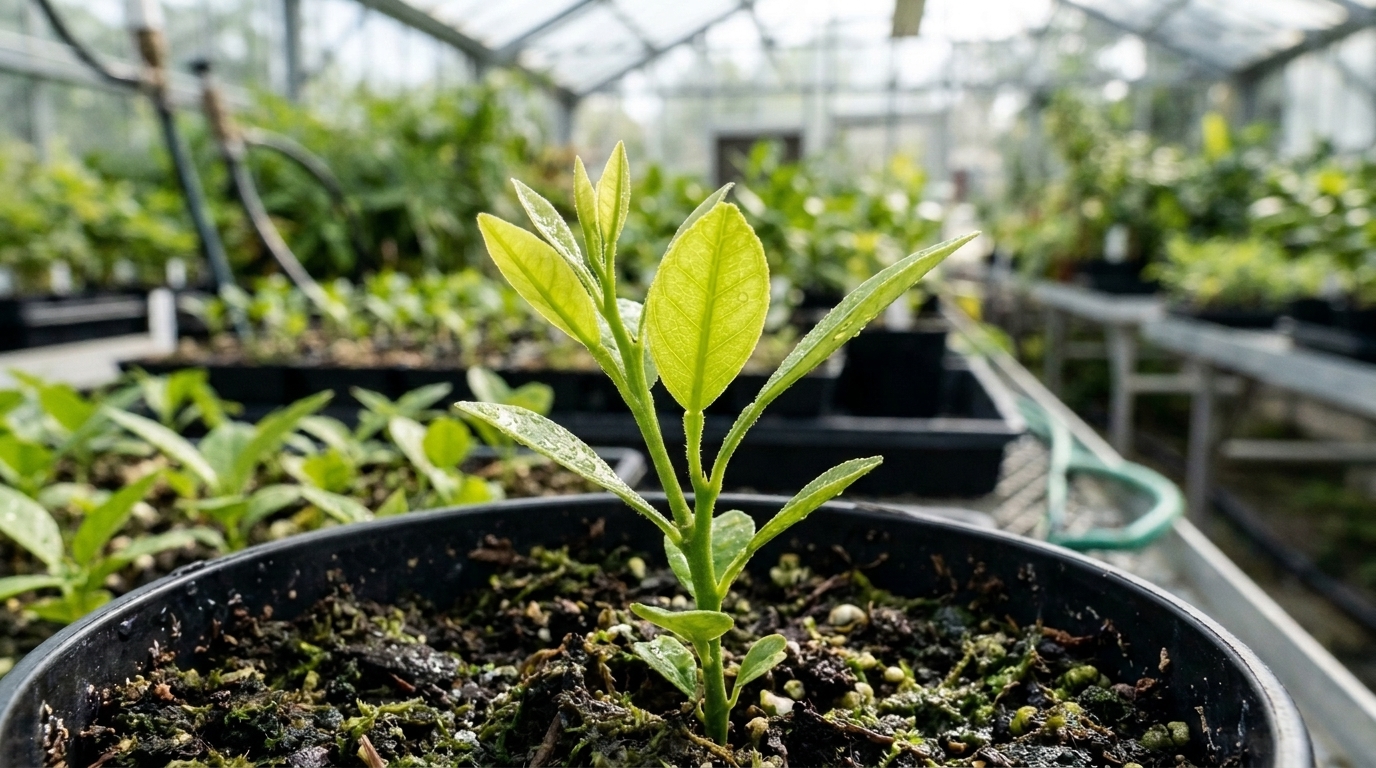
The transformation procedure begins with the decapitation of citrus seedlings grown for 10 to 15 days, leaving an epicotyl of approximately 2 to 3 centimeters. A specialized 20-microliter pipette tip, filled with an Agrobacterium tumefaciens suspension, is then inverted and fitted over the cut surface to initiate inoculation. Following a 1-hour inoculation period, the tip is replaced with one containing an agarose-based coculture medium supplemented with 100 micromolar acetosyringone. Subsequent incubation in dark, high-humidity conditions for 3 days is followed by 5 days of selection using a pipette tip containing an agarose medium with 50 milligrams per liter of kanamycin. This localized approach allows for continuous, controlled exposure to hormones and selection agents, effectively reducing the variability observed when using manual dripping or cotton swabbing techniques reported in earlier studies.
Optimization of the hormone concentrations was critical to the system’s success, particularly concerning the interaction between 6-benzylaminopurine and 1-naphthaleneacetic acid. The research team evaluated nine different combinations of these growth regulators, finding that the optimal ratio—3.0 milligrams per liter of 6-benzylaminopurine and 0.05 milligrams per liter of 1-naphthaleneacetic acid—yielded the highest transformation efficiency of 13.92% in Carrizo citrange. At this concentration, the researchers obtained 11 nonchimeric green fluorescent protein-positive plants from a group of 79 treated seedlings. In contrast, higher concentrations of 6-benzylaminopurine were shown to markedly decrease regeneration efficiency, while excessive concentrations of 1-naphthaleneacetic acid hindered the efficiency of Agrobacterium-mediated transformation, indicating a delicate balance required for effective shoot development from the wounded cambial region.
The broad applicability of this system was demonstrated through successful testing in five additional citrus genotypes, including sweet orange, pummelo, lemon, Citrus junos, and mini-citrus. While transformation efficiencies varied by genotype—ranging from 2.58% in pummelo to 18.68% in Citrus junos—the system consistently produced nonchimeric transgenic plants across all tested varieties. The differences in efficiency are attributed to genotype-dependent variations in wound-induced regeneration capacity, susceptibility to Agrobacterium, and tolerance to antibiotic selection. Nonetheless, the ability to recover healthy, nonchimeric plants that maintained stable marker fluorescence after one year of growth underscores the reliability of this platform for diverse citrus breeding programs.
To evaluate the system’s utility for genome editing, the researchers employed CRISPR/Cas9 to target specific genes, including Zinc Finger Protein 7 and Late Meristem Identity 1. Hi-TOM sequencing analysis of 101 transgenic plants revealed that 80 individuals displayed editing events at the targeted ZINC FINGER PROTEIN 7 locus, with 65 plants showing editing efficiencies exceeding 50% and 42 plants demonstrating complete 100% editing. Additionally, 29 of the 101 plants flowered within three months post-transformation, demonstrating the system’s efficiency in accelerating the typically long citrus juvenile phase. These quantitative results confirm that the system provides a robust framework for high-throughput functional gene analysis and targeted trait modification in citrus.
A significant achievement of the study was the recovery of a putative transgene-free genome-edited plant by targeting the LATE MERISTEM IDENTITY 1 gene, which regulates oil gland development. Given that the disruption of this gene results in a visible loss-of-oil-gland phenotype, the researchers were able to use it as an early morphological marker for screening. Among 275 treated Carrizo citrange seedlings, 63 were positive for the fluorescent marker, and 46 of those showed reduced oil gland development. Detailed analysis of four candidate lines identified one plant that exhibited the edited phenotype while lacking detectable neomycin phosphotransferase II and green fluorescent protein sequences. This plant provided a critical proof-of-concept for the generation of transgene-free genome-edited materials using the in planta system.
Verification of the transgene-free status involved whole-genome resequencing using Oxford Nanopore Technologies to identify any potential integration of exogenous DNA. The analysis confirmed the absence of sequence reads mapping to the T-DNA region or the binary vector backbone, strongly supporting the conclusion that the edited plant was free of stable transgene integration. However, the study also noted that the regenerated plant remained genetically mosaic at the target locus, containing a mixture of edited and wild-type alleles. Despite the presence of these wild-type sequences, the entire plant displayed a uniform absence of oil glands, suggesting that the proportion of edited cells was sufficient to maintain the observed phenotype.
The methodology used for pruning fluorescence-negative tissues was essential for achieving these high-efficiency results. Because multiple adventitious shoots often regenerate from a single wound, the researchers frequently observed chimeric tissues. By systematically removing non-fluorescent apical shoots, they promoted the outgrowth of fluorescence-positive axillary buds, which allowed for the recovery of nonchimeric transgenic plants. This selective pruning strategy significantly improved the reliability of the system, ensuring that once a successful transformation event occurred, the resulting shoots were likely to express the desired trait uniformly throughout the plant. This approach effectively addresses one of the most significant hurdles in plant transformation, the prevalence of chimeric sectors that can complicate the selection of stable, homozygous lines.
Despite the success of the system, the researchers identified specific limitations, particularly regarding the relatively low recovery frequency of transgene-free genome-edited plants and the influence of seedling age on transformation success. They observed that while seedlings between 10 and 15 days of age were optimal for transformation, efficiency dropped significantly in older seedlings due to reduced wound-regeneration capacity. Conversely, excessively young seedlings proved difficult to handle. Furthermore, bacterial overgrowth at the wound site remained a recurring challenge, sometimes necessitating the limitation of the inoculation period. The authors suggest that future refinements, such as the incorporation of additional antibiotics like Timentin in the selection media, could further improve consistency by suppressing residual Agrobacterium growth.
The findings indicate that the developed in planta transformation system serves as an efficient platform for genetic improvement in citrus. By integrating tissue culture-derived hormone protocols with a simplified wound-based framework, the system offers a viable alternative to traditional methodologies. The potential to generate transgene-free edited materials is particularly important, as such plants may bypass certain regulatory requirements associated with genetically modified organisms. This capability positions the platform as a significant asset for functional genomics in citrus, and the researchers anticipate that the principles established in this study might be adapted for other perennial woody species, potentially streamlining breeding efforts across the horticulture sector.
In conclusion, the study successfully addresses longstanding challenges in citrus genetic engineering by providing a rapid, reproducible, and broadly applicable in planta transformation system. The use of localized agarose chambers for the sustained delivery of hormones and antibiotics represents a technical advancement that improves upon previous drip or swab-based methods. With the proven ability to achieve efficient genome editing and the recovery of transgene-free plants, this method holds substantial promise for future agricultural applications. The high throughput and reduced reliance on specialized tissue culture facilities make this platform accessible for laboratories focusing on citrus genomics, while the demonstration of its efficacy across multiple genotypes highlights its versatility for global research and development efforts in citrus crop improvement.
Subject of Research: Genetic engineering and genome editing of citrus using an in planta transformation system.
Article Title: A rapid and broadly applicable in planta transformation and genome editing system involving wounded epicotyls in citrus
Article References: Ren, J., Yin, Q., Song, X., Duan, Y.-Y., Zhang, X., Li, R.-Q., Xie, K.-D., Zhang, F., Irish, V. F., Wu, X.-M., & Guo, W.-W. (2026). A rapid and broadly applicable in planta transformation and genome editing system involving wounded epicotyls in citrus. Horticulture Advances, 4(1), Article 37. https://doi.org/10.1007/s44281-026-00135-5
Image Credits: AI Generated
DOI: 10.1007/s44281-026-00135-5
Keywords: Citrus transformation, In planta, Genome editing, CRISPR/Cas9, Agrobacterium, Carrizo citrange, Functional genomics, Genetic improvement, Epicotyl, Plant biotechnology, Tissue culture, Transgene-free, CsLMI1, CsZFP7, Plant breeding, Perennial crops, Biotechnology
News Source: Juliet Wilcox. (November 16, 2026). Rapid In Planta Citrus Transformation System Enables Efficient Genome Editing. Scienmag.