• HOME
  • NEWS
  • EXPLORE
    • CAREER
      • Companies
      • Jobs
    • EVENTS
    • iGEM
      • News
      • Team
    • PHOTOS
    • VIDEO
    • WIKI
  • BLOG
  • COMMUNITY
    • FACEBOOK
    • INSTAGRAM
    • TWITTER
Tuesday, November 17, 2026
BIOENGINEER.ORG
No Result
View All Result
  • Login
  • HOME
  • NEWS
  • EXPLORE
    • CAREER
      • Companies
      • Jobs
        • Lecturer
        • PhD Studentship
        • Postdoc
        • Research Assistant
    • EVENTS
    • iGEM
      • News
      • Team
    • PHOTOS
    • VIDEO
    • WIKI
  • BLOG
  • COMMUNITY
    • FACEBOOK
    • INSTAGRAM
    • TWITTER
No Result
View All Result
Bioengineer.org
No Result
View All Result
Home NEWS Science News Technology

Construction Rework Driven Primarily by Specification Non-Compliance and Design Changes

by
November 17, 2026
in Technology
Reading Time: 2 mins read
0
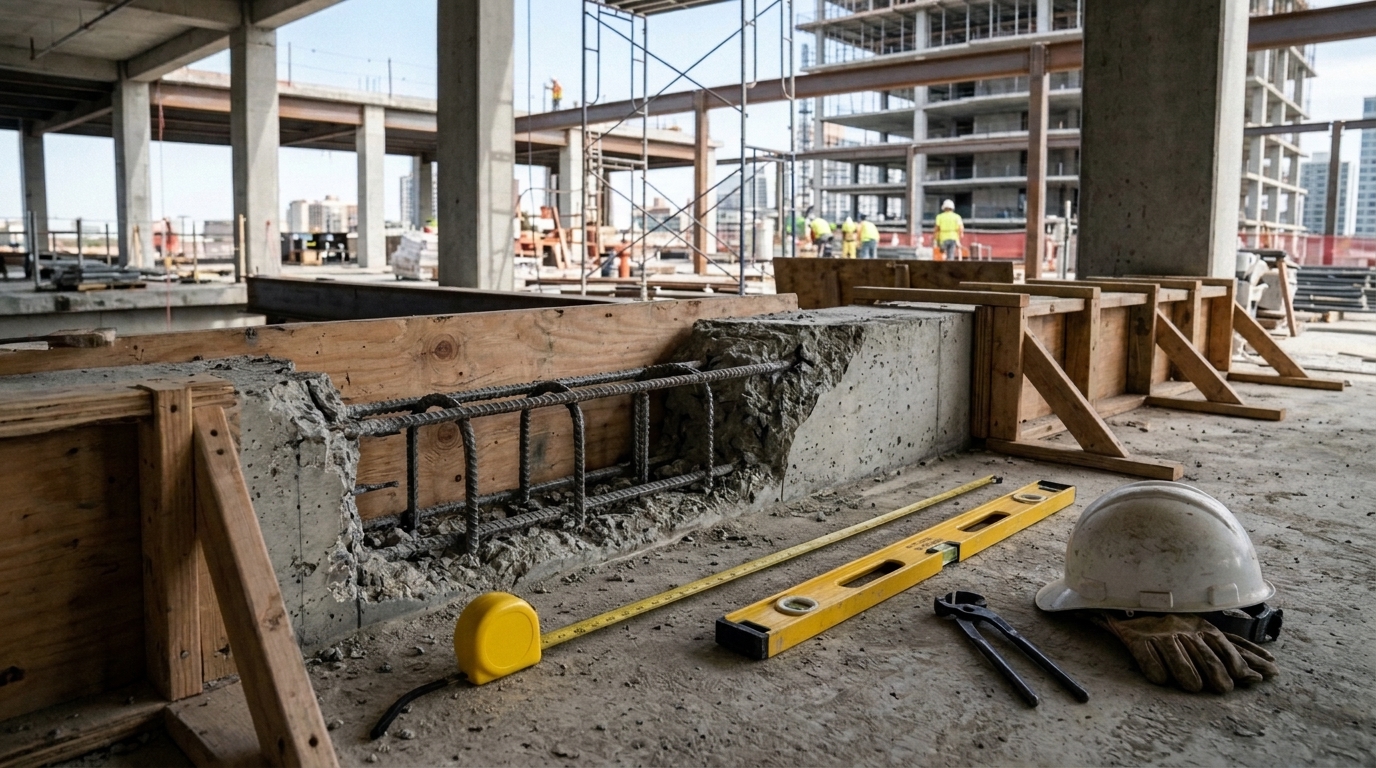
Construction Rework Driven Primarily by Specification Non-Compliance and Design Changes

Construction Rework Driven Primarily by Specification Non-Compliance and Design Changes

Share on FacebookShare on TwitterShare on LinkedinShare on RedditShare on Telegram

Rework in construction projects remains a significant challenge, frequently driving substantial cost overruns and project delays by consuming resources on activities that were incorrectly performed. A new pilot study led by Ghasan Alfalah investigates the primary drivers of this inefficiency across the Middle East, surveying 30 construction specialists—including contractors, consultants, designers, and site engineers—operating in Egypt, Saudi Arabia, Qatar, and the United Arab Emirates. The analysis utilizes the Relative Importance Index (RII) method to quantify the impact of 27 distinct causes of rework, categorized into six primary groups: design and drawings, human resources and supervision, contractor and construction services, material and equipment, client-related issues, and external or environmental factors.

The study identifies the failure to comply with project specifications as the most influential factor, yielding an RII of 0.960. This is closely followed by design modifications occurring during the construction phase, which recorded an RII of 0.953.

Beyond individual factors, the survey assessed the broader categories that contribute to construction site rework. Design and documentation emerged as the leading category, with a mean RII of 0.856, narrowly ahead of client-related issues, which registered an RII of 0.855. These categories were followed by contractor and construction services at 0.849 and human resources and supervision at 0.835. Factors related to material and equipment management and external or environmental influences were found to have comparatively lower impacts on total rework, with RII scores of 0.799 and 0.769, respectively.

Coordination among project stakeholders and site-based quality control practices also featured prominently in the researchers’ findings. Lack of coordination and poor supervision, both scoring 0.927 on the RII scale, were identified as major contributors to rework.

To evaluate the consensus among the participants, the research team employed the Spearman rank-correlation method. The analysis indicated a moderate to strong agreement across different stakeholder groups regarding the primary causes of rework. However, the study also revealed localized disagreements, with the least consensus found between designers and consultants.

The authors openly discuss the methodological limitations of this study, characterizing it as a pilot endeavor with a relatively small sample size of 30 professionals. Furthermore, they report that internal-consistency tests using Cronbach’s alpha produced unreliable and largely negative values for this sample. Rather than omitting these data, the researchers present these findings as a transparent acknowledgment of the study’s methodological constraints.

Subject of Research: Construction project management rework factors

Article Title: Identifying and ranking the causes of rework in construction projects: a Relative Importance Index (RII)-based pilot survey

Article References: Alfalah, G. (2026). Identifying and ranking the causes of rework in construction projects: a Relative Importance Index (RII)-based pilot survey. Journal of Umm Al-Qura University for Engineering and Architecture. https://doi.org/10.1007/s43995-026-00315-4

Image Credits: AI Generated

DOI: 10.1007/s43995-026-00315-4

Keywords: Construction management, Rework, Project cost overruns, Relative Importance Index, Design modification, Specification compliance, Construction engineering, Site management, Stakeholder coordination, Quality control, Infrastructure projects, Middle East construction, Pilot study, Construction survey, Project delays

News Source: Denise Maddox. (November 17, 2026). Construction Rework Driven Primarily by Specification Non-Compliance and Design Changes. Scienmag.


Tags: construction engineeringconstruction managementConstruction surveyDesign modificationInfrastructure projectsMiddle East constructionPilot StudyProject cost overrunsProject delaysquality controlRelative Importance IndexReworkSite managementSpecification complianceStakeholder Coordination
Share12Tweet7Share2ShareShareShare1

Related Posts

Attentive Multi-View Architecture Improves Click-Through Predictions in Video Recommendation Systems

Attentive Multi-View Architecture Improves Click-Through Predictions in Video Recommendation Systems

November 17, 2026
Longitudinal Informetric Framework Maps Nanotechnology Research Maturation in Türkiye

Longitudinal Informetric Framework Maps Nanotechnology Research Maturation in Türkiye

November 17, 2026

Polymer Electrolytes Exceed 3.5 V Stability in Sodium-Sulfur Battery Review

November 17, 2026

Engineering Conductive Networks Improves Electromagnetic Shielding in MXene-Polymer Composites

November 17, 2026

POPULAR NEWS

  • Engineered Myeloid Progenitor Platform Overcomes Allogeneic Barriers in CNS Tumors

    Engineered Myeloid Progenitor Platform Overcomes Allogeneic Barriers in CNS Tumors

    29 shares
    Share 12 Tweet 7
  • Physician Specialty Distribution Lags Behind Global Demographic Aging Trends

    29 shares
    Share 12 Tweet 7
  • Rapid In Planta Citrus Transformation System Enables Efficient Genome Editing

    29 shares
    Share 12 Tweet 7
  • Simulated Reinforcement Learning Model Improves 4G LTE Handover Success and Reliability

    29 shares
    Share 12 Tweet 7

About

We bring you the latest biotechnology news from best research centers and universities around the world. Check our website.

Follow us

Recent News

Continuous Wearable Monitoring May Optimize Postoperative Patient Care Pathways

Review Details Fungal Volatile 6-PP Biosynthesis and Roles in Sustainable Crop Protection

FOXR2 and Metabolic Pathway Proteins Correlate With Ovarian Carcinoma Progression

Subscribe to Blog via Email

Enter your email address to subscribe to this blog and receive notifications of new posts by email.

Join 88 other subscribers
  • Contact Us

Bioengineer.org © Copyright 2023 All Rights Reserved.

Welcome Back!

Login to your account below

Forgotten Password?

Retrieve your password

Please enter your username or email address to reset your password.

Log In
No Result
View All Result
  • Homepages
    • Home Page 1
    • Home Page 2
  • News
  • National
  • Business
  • Health
  • Lifestyle
  • Science

Bioengineer.org © Copyright 2023 All Rights Reserved.