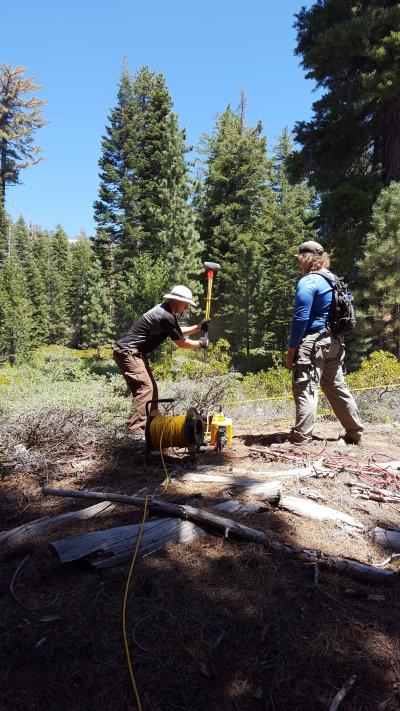
Credit: Russell Callahan
A University of Wyoming researcher and his team discovered that weathering of subsurface rock in the Southern Sierra Nevada Mountains of California occurs due more to rocks expanding than from chemical decomposition, as previously thought.
Porosity, the void space in rock, was conventionally thought to be produced when water flows through the rock, thus resulting in minerals chemically dissolving. Because mountain watershed provides large reservoirs of water, the new findings are relevant to water resource management throughout the U.S.
“It’s important to understand what is going on in the subsurface layer. It has enormous capacity to store water. In mountain landscapes, the saprolite may be the only thing keeping forests alive during times of drought,” says Cliff Riebe, an associate professor in UW’s Department of Geology and Geophysics. “This has been known for a while. What we don’t know is ‘How does the storage space get produced?’ Saprolite is difficult to access. You have to dig down under the soil. It’s rarely been studied. Understanding this layer between the soil and rock is important.”
Saprolite, which Riebe refers to as “rotten rock,” is the zone of weathered rock that retains the relative positions of mineral grains of the parent bedrock and lies between the layer of soil and harder rock underneath.
Riebe was corresponding author of a paper, titled “Porosity Production in Weathered Rock: Where Volumetric Strain Dominates over Chemical Mass Loss,” which was published today (Sept. 18) in Science Advances, an offspring publication of Science. The online journal publishes significant, innovative original research that advances the frontiers of science and extends the standards of excellence established by Science.
Jorden Hayes, a former Ph.D. graduate from UW and now an assistant professor of earth sciences at Dickinson College in Carlisle, Pa., was the paper’s lead author. Contributing writers included Steve Holbrook, a former UW professor of geology and geophysics and now a professor and department head at Virginia Tech University; Brady Flinchum, who was a Ph.D. student at UW at the time the research was conducted; and Peter Hartsough, an assistant project scientist in the Department of Land, Air and Water Resources at the University of California-Davis.
Volumetric strain is defined as the expansion material undergoes during the weathering process. Rock that is all solid has no porosity. Understanding how porosity is produced by volumetric strain and mass loss is important across a broad range of problems in hydrology, biogeochemistry, ecology and geomorphology, Riebe says.
What scientists have commonly assumed, Riebe says, is that expansion of rocks is not that important. What was discovered by Riebe and his team is that expansion in rocks dominates the actual weathering process in the region of study.
“Expansion is hard to measure, so it has been ignored in previous work,” Riebe explains.
“The rock there is actually expanding to more than double the initial volume as it weathers,” Hayes says. “This is surprising because we don’t usually think about rock expanding to such a degree, and scientists conventionally think about rock weathering being dominated by chemical dissolution as rainwater flows from the subsurface.”
Tree roots, for example, can cause expansion of rock by wedging open the saprolite material. Ice cracking during winter would cause the same effect.
“We think part of the story is the vegetation is doing this at higher elevations,” Riebe says. “We think it will be less important at the lower elevations. We expect not as much rooting, so less volumetric expansion and more chemical mass loss. This leads to new potential discoveries.”
The research, which has been ongoing since 2011, builds on existing information about weathering and surface processes at the Southern Sierra Critical Zone Observatory.
“Our finding is especially exciting as we think about other landscapes that also may be subjected to these physical mechanisms and have the ability to store large volumes of water,” Hayes says.
“Saprolite in the Southern Sierra Nevada Mountains is a source of water for ecosystems and humans. Understanding it is important,” Riebe says. “Climate is changing. It helps us understand an important reservoir for water in the U.S. West.”
###
Media Contact
Cliff Riebe
[email protected]
Original Source
http://www.
Related Journal Article
http://dx.