Credit: Wojciech Stephan
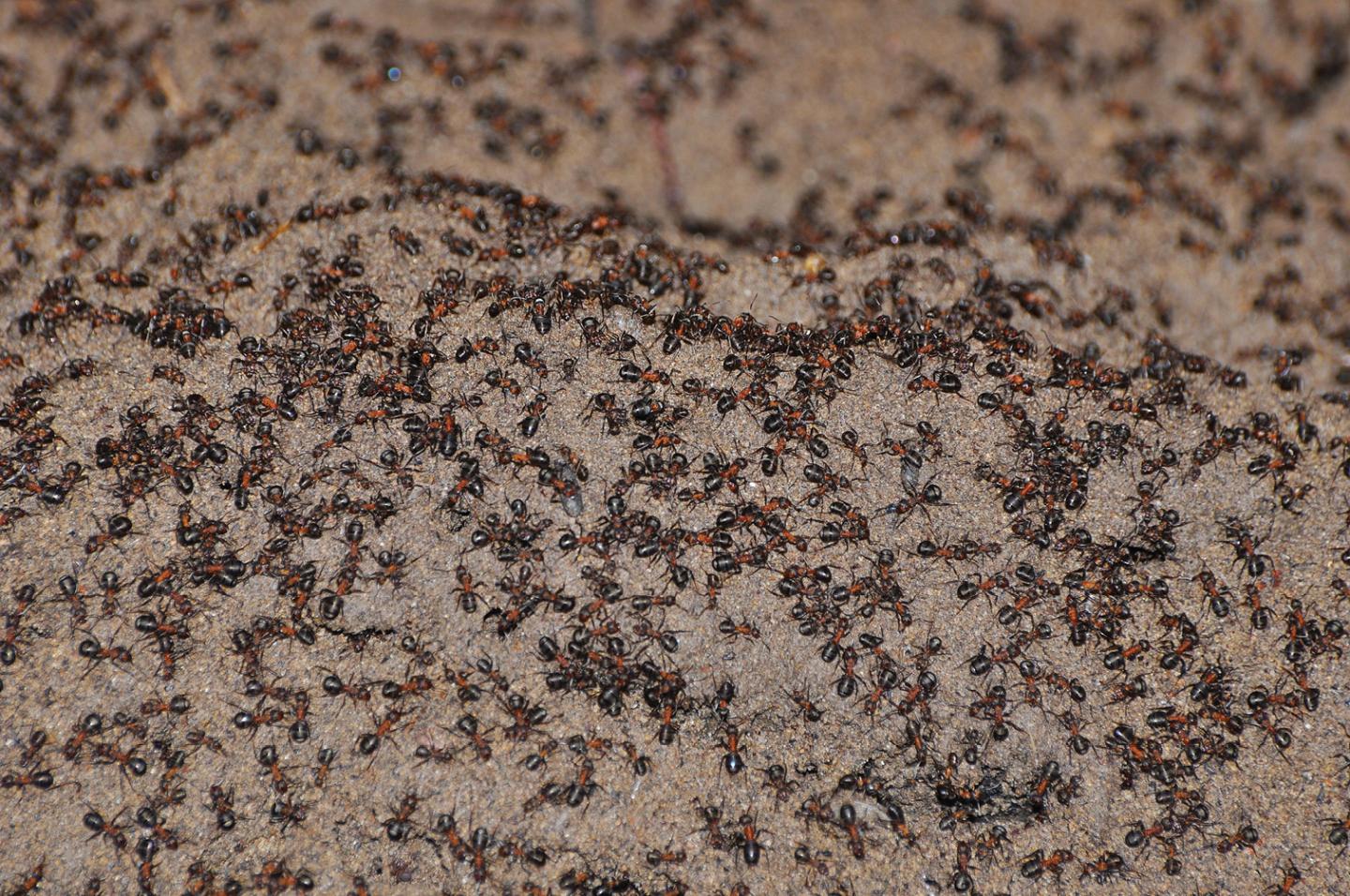
In a recent development of the story about wood ants trapped in a post-Soviet nuclear weapon bunker in Poland, scientists, led by Prof. Wojciech Czechowski, with the decisive contribution of Dr. István Maák, both from the Museum and Institute of Zoology, Polish Academy of Sciences in Warsaw, deduced that the “colony” (in quotation marks because only workers were found), while lacking other food, had to survive on the corpses of imprisoned nestmates. By using an experimentally installed boardwalk, the ants were helped to get through the ventilation pipe that led out of the bunker and back to their maternal nest on the top.
The ants were discovered in 2013 thanks to a yearly campaign set to count hibernating bats in the same bunker. The scientific report was published in 2016 also in Journal of Hymenoptera Research. At that time, the scientists estimated the presence of at least several hundred thousand workers, arguably close to a million. The insects ended up in this situation as a result of large numbers of wood ants continuously falling down a ventilation pipe to never return to their nest on top of the bunker. Several years later, the “colony” still appeared to be thriving, despite being trapped in a confined space with no light, heat and obvious source of food.
In the newly published paper, the scientists sought out whether while lacking alternative food, the wood ants would consume the dead bodies of their conspecifics that were accumulating on the bunker floor. In nature, a similar behaviour occurs frequently during spring, when protein food is scarce. These are the so-called “ant wars”, which serve to set the boundaries of the territories of neighbouring conspecific colonies of wood ants, while simultaneously providing food in the form of the fresh corpses of the numerous victims.
Recent research has also shown that corpse consumption in wood ants is more common than it was previously thought, and that nestmate’s corpses can serve as an important food source not only in periods of food shortage.
Taking into account the clear signs of cannibalism in the bunker with practically no other organisms to feed on the ant cadavers, the scientists could safely deduce that the bunker “colony” survived indeed on consuming mostly dead nestmates.
“The present case adds a dimension to the great adaptive ability of ants to marginal habitats and suboptimal conditions, as the key to understanding their unquestionable eco-evolutionary success”, added the authors.
In the spring of 2016, the scientists decided to free the captive ants. At first, they released a group of one hundred ants from the bunker into the outskirts of the mother nest, in order to confirm the relation between the two partly isolated groups. As expected, no aggressive behaviour was observed. In September, a 3-metre-long vertical boardwalk with one end burrowed in the mound made by the bunker “colony” and the other one tucked inside the ventilation pipe was constructed. Soon, individual ants started to inspect the escape route. By February 2017, the nuclear weapon bunker was almost deserted. Meanwhile, the maternal wood ant colony still nests at the top of the bunker at the outlet of the ventilation pipe, and ants continue to fall down through the pipe. However, the boardwalk now allows them to move freely up and down.
“So, we can expect further intriguing ant behaviour,” comment the scientists.
###
Original source:
Rutkowski T, Maák I, Vepsäläinen K, Trigos-Peral G, Stephan W, Wojtaszyn G, Czechowski W (2019) Ants trapped for years in an old bunker; survival by cannibalism and eventual escape. Journal of Hymenoptera Research 72: 177-184. https:/
Media Contact
Wojciech Czechowski
[email protected]
Related Journal Article
http://dx.