• HOME
  • NEWS
  • EXPLORE
    • CAREER
      • Companies
      • Jobs
    • EVENTS
    • iGEM
      • News
      • Team
    • PHOTOS
    • VIDEO
    • WIKI
  • BLOG
  • COMMUNITY
    • FACEBOOK
    • INSTAGRAM
    • TWITTER
Sunday, May 10, 2026
BIOENGINEER.ORG
No Result
View All Result
  • Login
  • HOME
  • NEWS
  • EXPLORE
    • CAREER
      • Companies
      • Jobs
        • Lecturer
        • PhD Studentship
        • Postdoc
        • Research Assistant
    • EVENTS
    • iGEM
      • News
      • Team
    • PHOTOS
    • VIDEO
    • WIKI
  • BLOG
  • COMMUNITY
    • FACEBOOK
    • INSTAGRAM
    • TWITTER
  • HOME
  • NEWS
  • EXPLORE
    • CAREER
      • Companies
      • Jobs
        • Lecturer
        • PhD Studentship
        • Postdoc
        • Research Assistant
    • EVENTS
    • iGEM
      • News
      • Team
    • PHOTOS
    • VIDEO
    • WIKI
  • BLOG
  • COMMUNITY
    • FACEBOOK
    • INSTAGRAM
    • TWITTER
No Result
View All Result
Bioengineer.org
No Result
View All Result
Home NEWS Science News Chemistry

Structure gives insight into how plants keep their “mouths” shut

Bioengineer by Bioengineer
April 26, 2021
in Chemistry
Reading Time: 2 mins read
0
IMAGE
Share on FacebookShare on TwitterShare on LinkedinShare on RedditShare on Telegram

IMAGE

Credit: IGDB

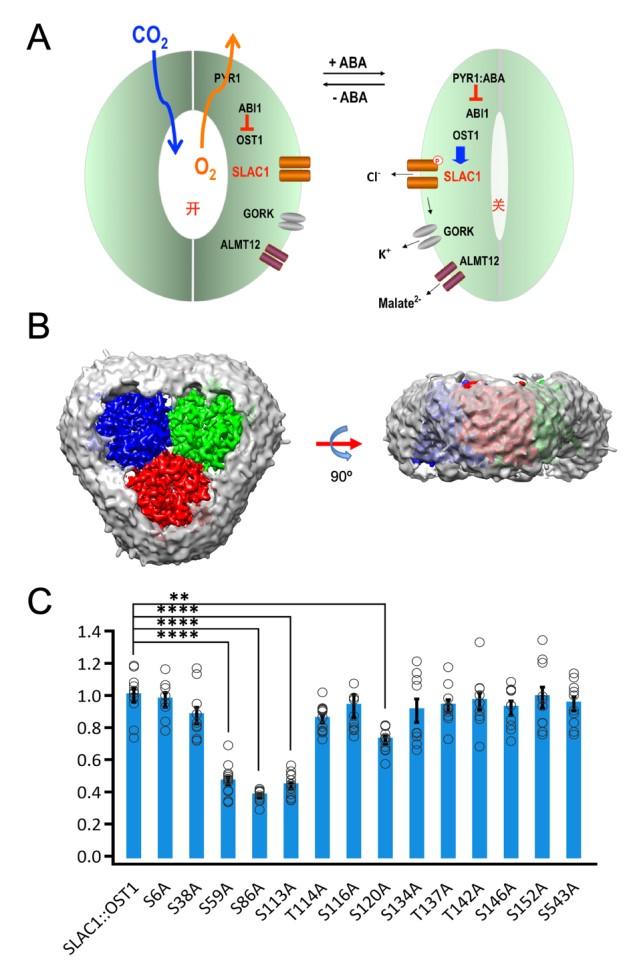
Stomata, formed by a pair of kidney-shaped guard cells, are tiny pores in leaves. They act like mouths that plants use to “eat” and “breathe.” When they open, carbon dioxide (CO2) enters the plant for photosynthesis and oxygen (O2) is released into the atmosphere. At the same time as gases pass in and out, a great deal of water also evaporates through the same pores by way of transpiration.

These “mouths” close in response to environmental stimuli such as high CO2 levels, ozone, drought and microbe invasion. The protein responsible for closing these “mouths” is an anion channel, called SLAC1, which moves negatively charged ions across the guard cell membrane to reduce turgor pressure. Low pressure causes the guard cells to collapse and subsequently the stomatal pore to close down.

As part of a collaborative effort with scientists at Columbia University, researchers at the Institute of Genetics and Developmental Biology of the Chinese Academy of Sciences (CAS) have uncovered the atomic structure of SLAC1 using single particle cryo-electron microscopy (cryo-EM). This structure shows that SLAC1 channel is normally in a closed state, with two spring-loaded phenylalanyl residues in strained conformations that block the pore and prevent anions from passing through them.

Environmental factors affect channel activity by controlling SLAC1 phosphorylation. By using a two-electrode voltage clamp technique, the scientists discovered multiple “on” switches in the SLAC1 channel. When phosphate attaches to the channel, its structure shifts and opens, allowing anions to flow freely. As a result, turgor pressure drops and the stomata close.

However, the scientists discovered by using a two-electrode voltage clamp technique that the SLAC1 channel has multiple “on” switches. These are “turned on” by environmental factors that control SLAC1 phosphorylation. Specifically, when phosphate attaches to the channel, its structure shifts and opens, allowing anions to flow freely. As a result, turgor pressure drops and the stomata close.”

These findings will help scientists understand how plants respond to the environmental changes facing our planet, such as drought and escalating levels of CO2 and ozone. Deep insight into the mechanism of SLAC1 control of stomatal pores will be valuable for designing drought-tolerant or water-efficient plant cultivation.

###

This work, entitled “Structure and activity of SLAC1 channels for stomatal signaling in leaves,” was published in PNAS on April 26. It was funded by the National Key R&D Program of China, the National Natural Science Foundation of China, and the Strategic Priority Research Program of CAS.

Media Contact
CHEN Yuhang
[email protected]

Related Journal Article

http://dx.doi.org/10.1073/pnas.2015151118

Tags: BioinformaticsBiologyBiomechanics/BiophysicsCell BiologyClimate Change
Share12Tweet8Share2ShareShareShare2

Related Posts

Miniature Sensor Uses Light to Detect Touch — Chemistry

Miniature Sensor Uses Light to Detect Touch

May 8, 2026
Iron Minerals Determine Whether Dissolved Organic Matter Fuels Microbes or Becomes Long-Term Carbon Storage — Chemistry

Iron Minerals Determine Whether Dissolved Organic Matter Fuels Microbes or Becomes Long-Term Carbon Storage

May 8, 2026

Kate Evans Appointed Associate Lab Director for Biological and Environmental Systems Science at ORNL

May 8, 2026

Advancing Multiscale Modeling and Overcoming Operational Challenges in Autothermal COâ‚‚-to-Methanol Reactors

May 8, 2026
Please login to join discussion

POPULAR NEWS

  • Research Indicates Potential Connection Between Prenatal Medication Exposure and Elevated Autism Risk

    840 shares
    Share 336 Tweet 210
  • New Study Reveals Plants Can Detect the Sound of Rain

    727 shares
    Share 290 Tweet 181
  • Scientists Investigate Possible Connection Between COVID-19 and Increased Lung Cancer Risk

    68 shares
    Share 27 Tweet 17
  • Salmonella Haem Blocks Macrophages, Boosts Infection

    61 shares
    Share 24 Tweet 15

About

We bring you the latest biotechnology news from best research centers and universities around the world. Check our website.

Follow us

Recent News

Evaluating Digoxin Use in Patients with Symptomatic Rheumatic Heart Disease

Evaluating the Effectiveness and Safety of Digitalis Glycosides in Treating Heart Failure

Urdu Fall Risk Questionnaire Adapted for Elderly

Subscribe to Blog via Email

Enter your email address to subscribe to this blog and receive notifications of new posts by email.

Join 82 other subscribers
  • Contact Us

Bioengineer.org © Copyright 2023 All Rights Reserved.

Welcome Back!

Login to your account below

Forgotten Password?

Retrieve your password

Please enter your username or email address to reset your password.

Log In
No Result
View All Result
  • Homepages
    • Home Page 1
    • Home Page 2
  • News
  • National
  • Business
  • Health
  • Lifestyle
  • Science

Bioengineer.org © Copyright 2023 All Rights Reserved.