Neutrons – Space ice, un-Earthly cold
Researchers from NASA’s Jet Propulsion Laboratory and Oak Ridge National Laboratory successfully created amorphous ice, similar to ice in interstellar space and on icy worlds in our solar system. They documented that its disordered atomic behavior is unlike any ice on Earth.
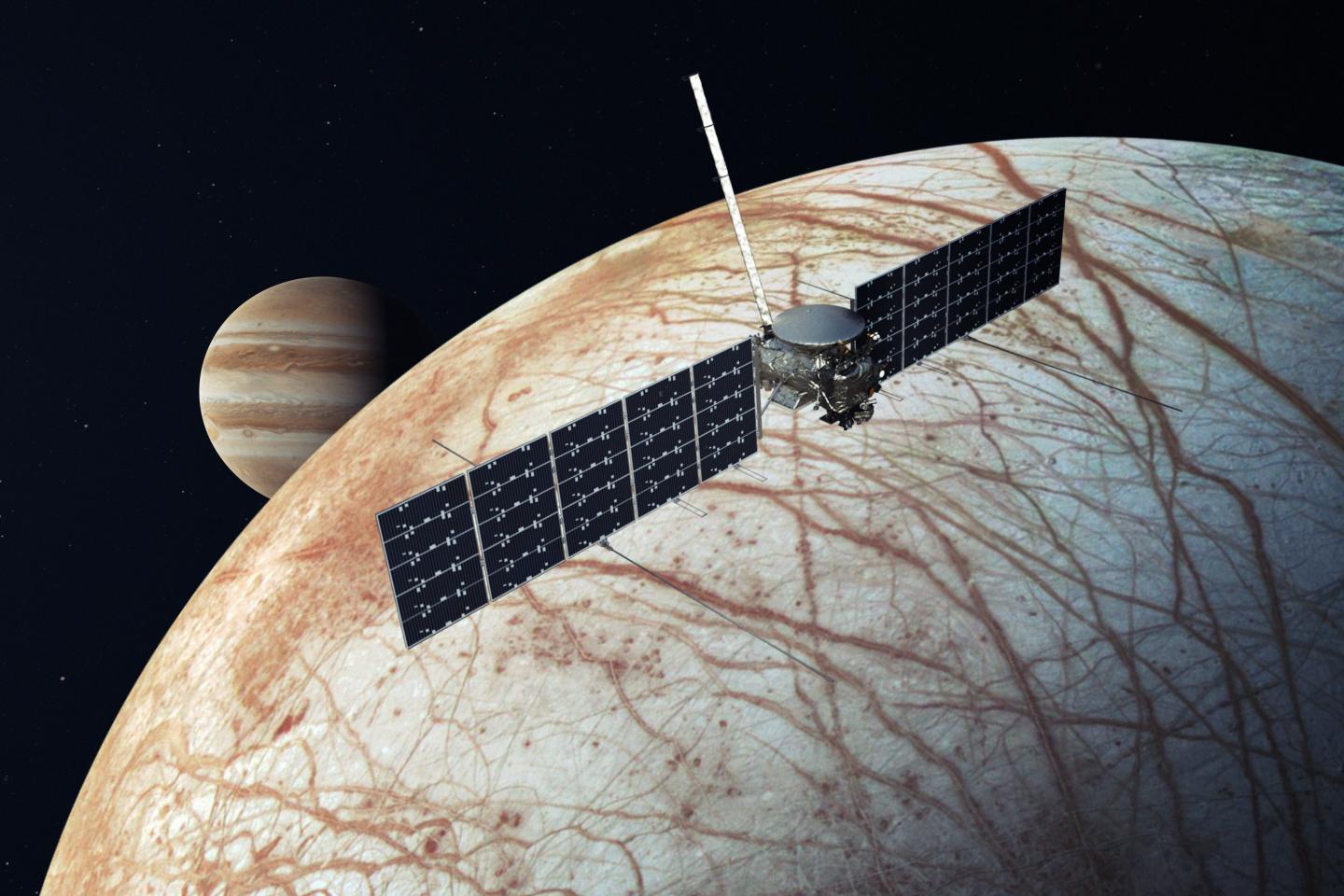
The findings could help interpret data from future NASA missions such as Europa Clipper, which will assess the habitability of Jupiter’s moon, Europa.
Using the Spallation Neutron Source’s SNAP instrument, the scientists replicated the cold vacuum of space and added a few molecules at a time of heavy water to a plate cooled to 25 Kelvin to produce amorphous ice. They then used neutron scattering to observe the ice’s structural changes at varying temperatures before it transitioned to crystalline ice.
“Amorphous water ice is ubiquitous in the universe, yet isn’t well understood. Our data could help understand exotic ice forms in our solar system and beyond,” said ORNL’s Chris Tulk.
Media contact: Paul Boisvert, 502.229.4466, [email protected]
Image: https:/
Buildings – In the loop
Researchers at Oak Ridge National Laboratory have developed a novel envelope system that diverts heat or coolness away from a building and stores it for future use.
Traditional building envelopes, such as roofs and walls, use insulation to reduce heat flow. ORNL’s thermally anisotropic building envelope, or TABE, adds thin conductive layers between the insulation. The conductive layers connect to a thermal loop that redirects the heat or coolness to an energy storage system.
Stored energy is then used to heat or cool the indoor space. Sensors and controls determine when to transfer energy between the envelope and the loop to maximize energy savings or peak load reductions.
“Our simulations predicted more than 50% energy savings in a residential building,” ORNL’s Som Shrestha said. “Results from a one-year field demonstration also showed promising results for TABE when used in walls and roofs.”
Media contact: Jennifer Burke, 865.414.6835, [email protected]
Image/Video: https:/
Recycling – Batteries unbound
Scientists at Oak Ridge National Laboratory have developed a solvent that results in a more environmentally friendly process to recover valuable materials from used lithium-ion batteries, supports a stable domestic supply chain for new batteries and keeps old ones out of landfills.
Spent batteries are typically broken down using smelting, an expensive, energy-intensive process that releases toxic gas. The ORNL-developed alternative is a wet chemical process using triethyl phosphate to dissolve the binder material that adheres cathodes to metal foil current collectors in Li-ion batteries. The result is efficient recovery of cobalt-based cathodes, graphite and other valuable materials like copper foils that can be repurposed in new batteries.
“With this solvent, we’re able to create a process that reduces toxic exposure for workers and recovers valuable, undamaged, active NMC [nickel-manganese-cobalt] cathodes, clean metal foils and other materials that can be easily reused in new batteries,” said ORNL’s Ilias Belharouak.
Media contact: Stephanie Seay, 865.576.9894, [email protected]
Image: https:/
Geothermal – Design and 3D print
Additive manufacturing can make the design and production of specialized tools for geothermal energy cheaper and more efficient, according to a study by Oak Ridge National Laboratory.
Geothermal is a renewable energy resource that requires specialized tools for drilling in harsh subsurface environments. The tools are typically produced in low quantities at high cost using conventional fabrication.
By using 3D-printing techniques, geothermal companies can take advantage of computer-aided technologies to design tools with enhanced performance characteristics. Those custom parts can then be printed using ORNL’s high-strength alloys at a lower cost, especially when printing multiple parts in a single build. The lab’s techno-economic analysis found ample opportunity to lower the cost of geothermal projects while improving system performance using additive manufacturing.
“The study points to the significant benefits of additive manufacturing and provides a roadmap for future work, including the development of new AM feedstocks based on advanced, high-temperature alloys,” said ORNL’s Yarom Polsky.
Media contact: Stephanie Seay, 865.576.9894, [email protected]
Image: https:/
###
Media Contact
Sara Shoemaker
[email protected]
Original Source
https:/
Related Journal Article
http://dx.