• HOME
  • NEWS
  • EXPLORE
    • CAREER
      • Companies
      • Jobs
    • EVENTS
    • iGEM
      • News
      • Team
    • PHOTOS
    • VIDEO
    • WIKI
  • BLOG
  • COMMUNITY
    • FACEBOOK
    • INSTAGRAM
    • TWITTER
Monday, August 24, 2026
BIOENGINEER.ORG
No Result
View All Result
  • Login
  • HOME
  • NEWS
  • EXPLORE
    • CAREER
      • Companies
      • Jobs
        • Lecturer
        • PhD Studentship
        • Postdoc
        • Research Assistant
    • EVENTS
    • iGEM
      • News
      • Team
    • PHOTOS
    • VIDEO
    • WIKI
  • BLOG
  • COMMUNITY
    • FACEBOOK
    • INSTAGRAM
    • TWITTER
  • HOME
  • NEWS
  • EXPLORE
    • CAREER
      • Companies
      • Jobs
        • Lecturer
        • PhD Studentship
        • Postdoc
        • Research Assistant
    • EVENTS
    • iGEM
      • News
      • Team
    • PHOTOS
    • VIDEO
    • WIKI
  • BLOG
  • COMMUNITY
    • FACEBOOK
    • INSTAGRAM
    • TWITTER
No Result
View All Result
Bioengineer.org
No Result
View All Result
Home NEWS Science News Chemistry

Story tips: Molding matter atom by atom and seeing inside uranium particles

Bioengineer by Bioengineer
April 2, 2020
in Chemistry
Reading Time: 3 mins read
0
IMAGE
Share on FacebookShare on TwitterShare on LinkedinShare on RedditShare on Telegram

IMAGE

Credit: Kristian Myhre/Oak Ridge National Laboratory, U.S. Dept. of Energy


Materials — Molding molecular matter

Scientists at Oak Ridge National Laboratory used a focused beam of electrons to stitch platinum-silicon molecules into graphene, marking the first deliberate insertion of artificial molecules into a graphene host matrix.

While scientists have already used the beam of a high-resolution electron microscope to intentionally rearrange graphene’s carbon-based molecular structure, this new development greatly enhances scientists’ ability to control matter at the atomic scale.

“This technique allows us to insert foreign molecules into the graphene lattice to change its physical properties,” said ORNL’s Ondrej Dyck.

He explained that this process is generally applicable and could be especially useful for prototyping quantum-based devices — including solid state qubits for quantum computers — from graphene and other ultra-thin materials.

The research was published in Carbon. ¬- Gage Taylor

Media Contact: Sara Shoemaker, 865.576.9219; [email protected]

Image: https://www.ornl.gov/sites/default/files/2020-04/Ebeam_IMAGE_Final.jpg

Caption: Researchers insert a platinum-silicon molecule into a graphene lattice with a focused electron beam. Credit: Ondrej Dyck/Oak Ridge National Laboratory, U.S. Dept. of Energy

Nuclear — Seeing inside particles

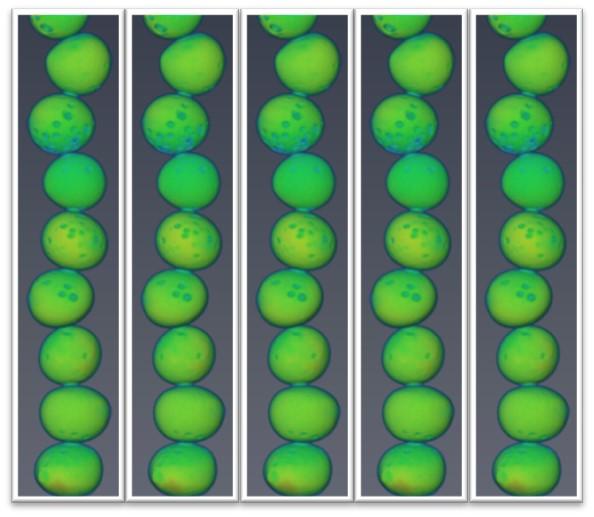
Oak Ridge National Laboratory researchers working on neutron imaging capabilities for nuclear materials have developed a process for seeing the inside of uranium particles – without cutting them open.

Nuclear materials experts and neutron scientists collaborated on the process, which creates image-based 3D reconstructions of the particles. Researchers can even view “slices” of different layers of particles to learn the effects of various conditions on elemental distribution, density and other properties.

Other methods to characterize these particles require they be cut in half, put in epoxy and mounted for viewing with an electron microscope. The new technique allows for characterization of the entire particle, not just a single cross section. ORNL’s Kristian Myhre said the process is broadly applicable and already is being used to study other materials.

“Unlike electron microscopy, the neutron imaging allows you to take a unique picture without destroying your sample,” Myhre said. “It’s such a versatile technique.”

Media Contact: Kristi Nelson Bumpus, 865.253.1381; [email protected]

Image: https://www.ornl.gov/sites/default/files/2020-04/Kernels-nuclear%20materials-2.jpg

Caption: Neutron imaging can non-destructively view important characteristics to develop advanced nuclear materials, such as the overall shape and defects shown in this example 3D image of uranium TRISO kernels. Credit: Kristian Myhre/Oak Ridge National Laboratory, U.S. Dept. of Energy

###

Media Contact
Sara Shoemaker
[email protected]

Original Source

https://www.ornl.gov/news/story-tips

Related Journal Article

http://dx.doi.org/10.1016/j.carbon.2020.01.042

Tags: Atomic/Molecular/Particle PhysicsChemistry/Physics/Materials SciencesMaterialsMolecular PhysicsNuclear PhysicsParticle Physics
Share12Tweet8Share2ShareShareShare2

Related Posts

Scientists Transform Plastic Bottles Into Cookies

Scientists Transform Plastic Bottles Into Cookies

August 24, 2026
KAIST discovers pathway to faster-charging, longer-lasting electric vehicle batteries

KAIST discovers pathway to faster-charging, longer-lasting electric vehicle batteries

August 24, 2026

Scientists uncover design rules for high-performance thermoelectric materials

August 22, 2026

Bringing Optical Fibre Materials to Photonic Chips

August 22, 2026
Please login to join discussion

POPULAR NEWS

  • Motor neurons coordinate fruit fly feeding sequences through disinhibitory signaling

    29 shares
    Share 12 Tweet 7
  • Experts establish criteria for enhanced recovery pathways in newborns and infants

    29 shares
    Share 12 Tweet 7
  • How Autophagy Maintains Brain Health and Contributes to Disease

    29 shares
    Share 12 Tweet 7
  • Can Scientists’ Self-Rankings Predict Scientific Impact Beyond Peer Review?

    29 shares
    Share 12 Tweet 7

About

BIOENGINEER.ORG

We bring you the latest biotechnology news from best research centers and universities around the world. Check our website.

Follow us

Recent News

Motor neurons coordinate fruit fly feeding sequences through disinhibitory signaling

Experts establish criteria for enhanced recovery pathways in newborns and infants

How Autophagy Maintains Brain Health and Contributes to Disease

Subscribe to Blog via Email

Enter your email address to subscribe to this blog and receive notifications of new posts by email.

Join 85 other subscribers
  • Contact Us

Bioengineer.org © Copyright 2023 All Rights Reserved.

Welcome Back!

Login to your account below

Forgotten Password?

Retrieve your password

Please enter your username or email address to reset your password.

Log In
No Result
View All Result
  • Homepages
    • Home Page 1
    • Home Page 2
  • News
  • National
  • Business
  • Health
  • Lifestyle
  • Science

Bioengineer.org © Copyright 2023 All Rights Reserved.