• HOME
  • NEWS
  • EXPLORE
    • CAREER
      • Companies
      • Jobs
    • EVENTS
    • iGEM
      • News
      • Team
    • PHOTOS
    • VIDEO
    • WIKI
  • BLOG
  • COMMUNITY
    • FACEBOOK
    • INSTAGRAM
    • TWITTER
Friday, June 26, 2026
BIOENGINEER.ORG
No Result
View All Result
  • Login
  • HOME
  • NEWS
  • EXPLORE
    • CAREER
      • Companies
      • Jobs
        • Lecturer
        • PhD Studentship
        • Postdoc
        • Research Assistant
    • EVENTS
    • iGEM
      • News
      • Team
    • PHOTOS
    • VIDEO
    • WIKI
  • BLOG
  • COMMUNITY
    • FACEBOOK
    • INSTAGRAM
    • TWITTER
  • HOME
  • NEWS
  • EXPLORE
    • CAREER
      • Companies
      • Jobs
        • Lecturer
        • PhD Studentship
        • Postdoc
        • Research Assistant
    • EVENTS
    • iGEM
      • News
      • Team
    • PHOTOS
    • VIDEO
    • WIKI
  • BLOG
  • COMMUNITY
    • FACEBOOK
    • INSTAGRAM
    • TWITTER
No Result
View All Result
Bioengineer.org
No Result
View All Result
Home NEWS Science News Health

Stick insect study shows the significance of passive muscle force for fast movements

Bioengineer by Bioengineer
January 9, 2019
in Health
Reading Time: 3 mins read
0
IMAGE
Share on FacebookShare on TwitterShare on LinkedinShare on RedditShare on Telegram

IMAGE

Credit: Arndt von Twickel et al.


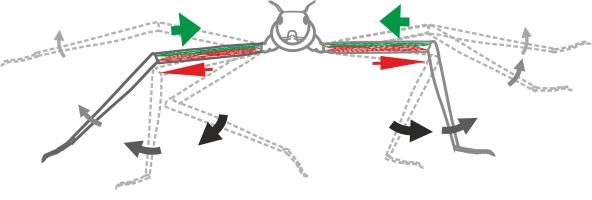
Long, heavy limbs such as arms or legs differ fundamentally from short, light limbs such as fingers in their ability to execute fast movements. While the central nervous system has to actively control fast movements of large limbs, passive muscle force can suffice for the movement velocity and movement amplitude of small and light limbs. That is the result of a study conducted on the stick insect by the zoologists Ansgar Bueschges, Arndt von Twickel and Christoph Guschlbauer at the University of Cologne in cooperation with the visiting scientist Scott Hooper from Ohio University. The paper has now been published under the title ‘Swing Velocity Profiles of Small Limbs Can Arise from Transient Passive Torques of the Antagonist Muscle Alone’ in Current Biology.

There are different basic speed levels in the course of a movement until the entire motor action has been optimally executed, says Bueschges: ‘If we look at the swinging of our legs when we walk, for example, the swinging phase brings the leg back into the starting position for the next step. With this feedback, the swing speed of the leg decreases towards the end, so that the foot does not touch down as quickly. Without the deceleration, the force generated when touching down would be so strong that it would counteract the next step.’ Our nervous system produces this deceleration in large limbs such as the human leg.

For smaller limbs such as insect bones, however, the authors have shown that the slowing of the leg during rapid movements such as the swinging phase is independent of the central nervous system. Von Twickel explains that this is due to the intrinsic muscle characteristics of the limb: ‘If the extensor muscle of a leg joint is actively shortened to produce rapid movements, the inactive flexor muscle is necessarily lengthened. During this stretching, the flexor muscle develops a previously unknown dynamic passive force, which is so large that it can continuously slow down movements to the functionally necessary level.’

In the study, the authors exposed the flexor muscle of the stick insect leg to various stretching scenarios and measured the dynamic forces exerted by the passive muscle against the different stretches. Then, they used the results to dynamically simulate the functioning of a leg joint. The passive dynamic forces of the flexor generated by extensor activation were able to generate a movement that corresponded to the speed profile of an animal.

These results are quite surprising and contradict widespread notions of how small limbs execute fast movements. Bueschges concludes: ‘We have known for a long time that passive muscle forces are important for the movements of small limbs, but we did not expect that their effect is so great that they can determine the speed profile of a movement. This means that the active muscle and its opponent must be perfectly tuned to each other. We are in the process of better understanding this interaction.’

###

Media Contact
Ansgar Bueschges
[email protected]
49-221-470-2607

Related Journal Article

http://dx.doi.org/10.1016/j.cub.2018.11.016

Tags: BiologyPhysiologyZoology/Veterinary Science
Share12Tweet8Share2ShareShareShare2

Related Posts

Tracking Lanthanide-Labeled Microplastics in Plants

June 25, 2026

Neural Design Enables Zero-Shot Drug-Binding Proteins

June 25, 2026

Genomic Insights into Human Skin Fungi Diversity

June 25, 2026

Chiral Laser Gyroscopes Surpass Lock-In Limit

June 25, 2026
Please login to join discussion

POPULAR NEWS

  • Saying Goodbye to PGY-6: Pediatric Fellowship Realities

    103 shares
    Share 41 Tweet 26
  • Multi-Hospital Study Reveals Long Covid Burden Is Twice as High as Current Estimates

    92 shares
    Share 36 Tweet 23
  • Detection of EDCs in Breast Milk and Infant Urine Up to Six Months Highlights Early Exposure Risks

    77 shares
    Share 31 Tweet 19
  • New Drug Candidate Developed at McMaster Shows Potential for Treating Brain Cancer

    58 shares
    Share 23 Tweet 15

About

We bring you the latest biotechnology news from best research centers and universities around the world. Check our website.

Follow us

Recent News

Tracking Lanthanide-Labeled Microplastics in Plants

POSTECH Researchers Slash Cost of Reconstituted Cell-Free Systems by 95%

AI and Physics Collaborate to Design Advanced Hydrogen Storage Materials

Subscribe to Blog via Email

Success! An email was just sent to confirm your subscription. Please find the email now and click 'Confirm' to start subscribing.

Join 82 other subscribers
  • Contact Us

Bioengineer.org © Copyright 2023 All Rights Reserved.

Welcome Back!

Login to your account below

Forgotten Password?

Retrieve your password

Please enter your username or email address to reset your password.

Log In
No Result
View All Result
  • Homepages
    • Home Page 1
    • Home Page 2
  • News
  • National
  • Business
  • Health
  • Lifestyle
  • Science

Bioengineer.org © Copyright 2023 All Rights Reserved.