Ebola virus causes serious infections in humans and in fatal cases, damage and dysfunction of the liver is often present, suggesting that the liver plays a decisive role in disease outcome. Although the liver can become directly infected, it is not well understood how liver cells respond to the Ebola virus, and if liver injury is directly caused by the infection or secondary to other disease processes. Research on liver cell response to Ebola virus infection has been limited by the lack of suitable cell-based models, however in a recent paper in Stem Cell Reports, Gustavo Mostoslavsky, Elke Mühlberger and colleagues from Boston University School of Medicine have now harnessed stem cell biology to obtain and inexhaustible source of human liver cells, so-called hepatocyte-like cells (HCLs), derived from induced pluripotent stem cells. The stem cell-derived HLCs closely resembled primary liver cells and could be readily infected by Ebola virus in the lab. Interestingly, the infected cultures were unable to mount a strong anti-inflammatory response to control viral spread, so that the majority of cells became infected over time. Although infected cells did not die, they did shut down genes required for proper HLC function, suggesting that viral infection directly disrupts liver function. Further, Ebola virus-infected immune cells could transfer the virus to HLCs in co-cultures, i.e. when cultured in the same dish, suggesting that infected immune cells may act as virus shuttles in patients. This stem cell-derived liver cell model will be a valuable tool for future studies on Ebola virus liver pathology and potential therapeutic interventions.
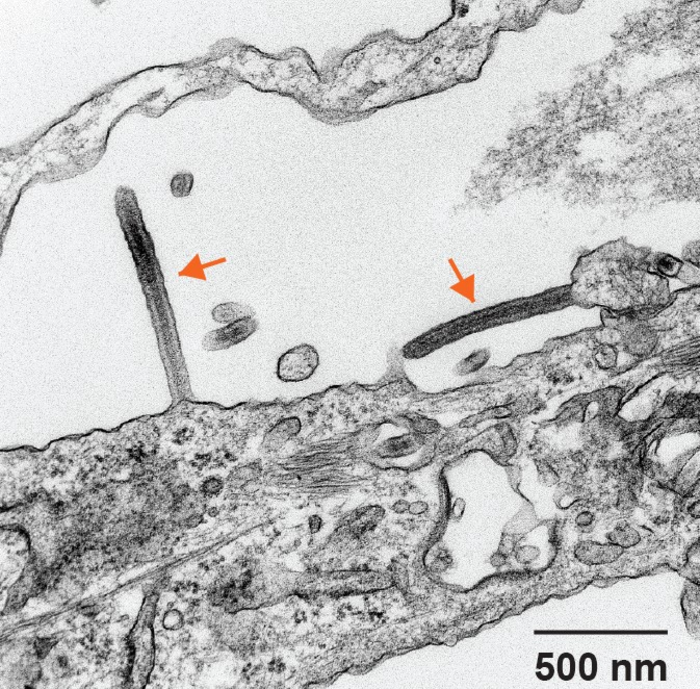
Credit: John G. Bernbaum, Integrated Research Facility, Division of Clinical Research, National Institute for Allergy and Infectious Disease, National Institutes of Health
Ebola virus causes serious infections in humans and in fatal cases, damage and dysfunction of the liver is often present, suggesting that the liver plays a decisive role in disease outcome. Although the liver can become directly infected, it is not well understood how liver cells respond to the Ebola virus, and if liver injury is directly caused by the infection or secondary to other disease processes. Research on liver cell response to Ebola virus infection has been limited by the lack of suitable cell-based models, however in a recent paper in Stem Cell Reports, Gustavo Mostoslavsky, Elke Mühlberger and colleagues from Boston University School of Medicine have now harnessed stem cell biology to obtain and inexhaustible source of human liver cells, so-called hepatocyte-like cells (HCLs), derived from induced pluripotent stem cells. The stem cell-derived HLCs closely resembled primary liver cells and could be readily infected by Ebola virus in the lab. Interestingly, the infected cultures were unable to mount a strong anti-inflammatory response to control viral spread, so that the majority of cells became infected over time. Although infected cells did not die, they did shut down genes required for proper HLC function, suggesting that viral infection directly disrupts liver function. Further, Ebola virus-infected immune cells could transfer the virus to HLCs in co-cultures, i.e. when cultured in the same dish, suggesting that infected immune cells may act as virus shuttles in patients. This stem cell-derived liver cell model will be a valuable tool for future studies on Ebola virus liver pathology and potential therapeutic interventions.
Journal
Stem Cell Reports
DOI
10.1016/j.stemcr.2022.08.003
Article Title
Ebola virus infection induces a delayed type I IFN response in bystander cells and the shutdown of key liver genes in human iPSC-derived hepatocytes
Article Publication Date
8-Sep-2022