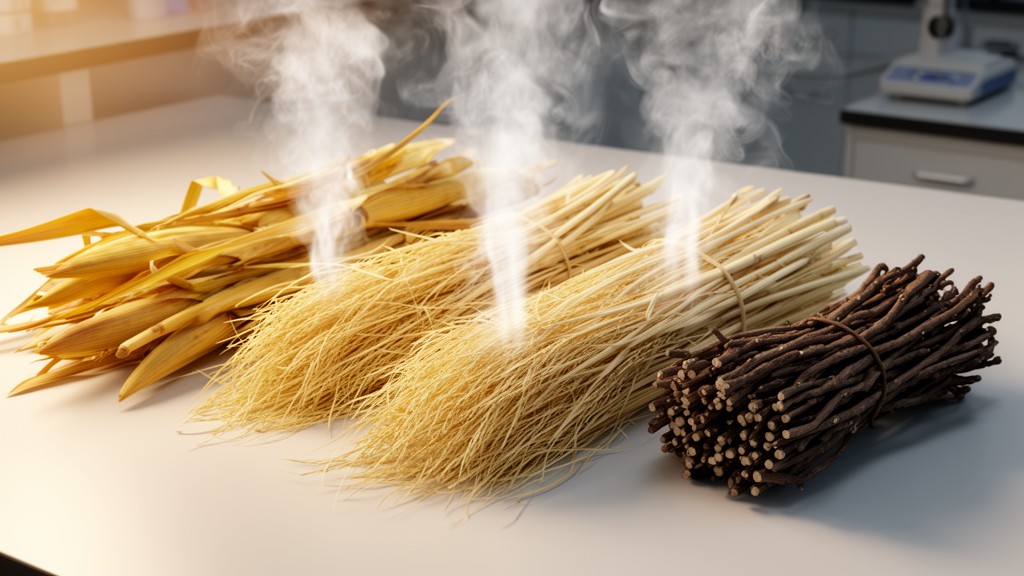
Steam explosion is often praised for tearing apart the tough lignocellulosic architecture of crop residues, but a new comparative study shows that the nutritional payoff depends heavily on which residue goes into the reactor. When corn stover, rice straw, and cotton stalk were subjected to identical nominal pretreatment conditions of 180 °C, 1.5 MPa, and 5 minutes, only corn stover and rice straw emerged with improved in vitro dry matter digestibility, while cotton stalk actually became less digestible despite clear physical disruption.
The study, published open access in Chemical and Biological Technologies in Agriculture on 28 October 2026, was led by Christiana Angel and colleagues including Shaoxun Tang and Zhiliang Tan. The researchers set out to compare the structural, physicochemical, and nutritional responses of the three feedstocks under the same steam explosion conditions, noting that efficient use of crop residues as ruminant feed is constrained by the recalcitrant structure of lignocellulosic biomass and that responses can vary among feedstocks.
The pretreatment left a clear chemical signature in all three materials. Steam explosion lowered pH from a range of 6.56 to 7.40 down to 4.64 to 5.97, and acetic acid, which was undetectable before treatment, rose to between 3.23 and 9.27 g per kg of dry matter. Scanning electron microscopy revealed extensive fragmentation, peeling, and surface fractures in every feedstock, confirming that the physical destructive action of steam explosion operated across the board.
Yet the deeper chemical story diverged sharply. Fourier-transform infrared spectroscopy and X-ray diffraction demonstrated feedstock-specific changes in lignocellulosic structure and crystalline organization, meaning that identical processing conditions did not produce identical molecular outcomes. This distinction between visible damage and compositional change became the central finding of the work.
Corn stover responded most favorably. It showed substantial decreases in neutral detergent fiber and hemicellulose concentrations, accompanied by increases in water-soluble carbohydrates from 22.95 to 88.48 g per kg dry matter, in xylose from 0.662 to 8.253 g per kg dry matter, and in in vitro dry matter digestibility from 37.44 to 46.52 percent. Rice straw followed a similar pattern, with decreased structural carbohydrate concentrations together with increased water-soluble carbohydrates from 43.14 to 61.91 g per kg dry matter and digestibility rising from 41.96 to 45.99 percent.
Cotton stalk moved in the opposite direction. Under the same nominal conditions it exhibited increased neutral detergent fiber, acid detergent fiber, and acid detergent lignin concentrations, reduced water-soluble carbohydrates from 58.26 to 16.74 g per kg dry matter, and lower digestibility, falling from 40.05 to 37.50 percent. In other words, the residue that had been physically shattered just as thoroughly as the others ended up nutritionally worse than before treatment.
Principal component analysis further differentiated the steam-exploded feedstocks according to their contrasting physicochemical and nutritional profiles, reinforcing that the three residues occupied distinct compositional spaces after pretreatment rather than converging toward a common product.
The authors conclude that although steam explosion modified the structure of all three crop residues, compositional and digestibility responses differed among feedstocks. Increased digestibility in corn stover and rice straw coincided with decreased structural carbohydrate fractions and increased water-soluble carbohydrates, whereas this combined response was absent in cotton stalk under the same conditions. The findings indicate that structural disruption alone is insufficient to characterize the nutritional response to steam explosion, and that the physicochemical and carbohydrate characteristics of the recovered biomass should also be considered when evaluating the technology for ruminant-feed applications.
For livestock producers and researchers, the practical implication is that pretreatment protocols may need to be tailored to the specific residue at hand rather than assumed to be universally beneficial. The digestibility measurements reported here are in vitro values, so they represent laboratory estimates of rumen degradability rather than feeding trials in animals, and the results apply to the single nominal condition set tested. The article was shared early as a peer-reviewed, accepted version of record, subject to further edits, and carries a permanent DOI. Even so, the comparative design offers a clear caution: the same steam explosion that unlocks sugars in corn stover and rice straw can leave cotton stalk with more lignin-rich fiber and less readily available carbohydrate, a reminder that in biomass pretreatment, what matters is not just how thoroughly the structure is broken, but what the broken material is made of afterward.
Subject of Research: Feedstock-specific effects of steam explosion pretreatment on the physicochemical composition and in vitro digestibility of three crop residues as ruminant feed
Article Title: Beyond structural disruption: feedstock-specific physicochemical transformation and digestibility responses to steam explosion
Article References: Angel, C., Qazi, I. H., Liu, Y., Tang, S., & Tan, Z. (2026). Beyond structural disruption: feedstock-specific physicochemical transformation and digestibility responses to steam explosion. Chemical and Biological Technologies in Agriculture. https://doi.org/10.1186/s40538-026-01121-9
Image Credits: AI Generated
DOI: 10.1186/s40538-026-01121-9
Keywords: steam explosion, corn stover, rice straw, cotton stalk, lignocellulose, in vitro dry matter digestibility, water-soluble carbohydrates, hemicellulose, ruminant feed, crop residues, pretreatment, biomass
News Source: Alan Morgan. (October 29, 2026). Steam explosion boosts digestibility of corn stover and rice straw but not cotton stalk. Scienmag.