


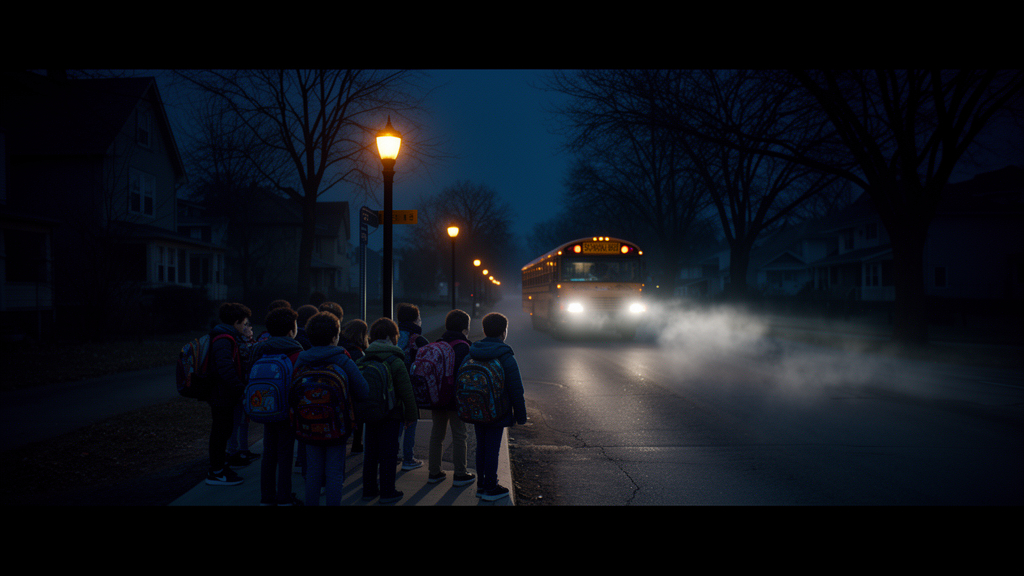
Making daylight saving time permanent in the United States would force millions of schoolchildren to leave for school before sunrise, and a new analysis published in the Cell Press journal Current Biology on October 29 quantifies just how large that shift would be. According to the study, the legislation known as the Sunshine Protection Act, which the US House passed in July 2026, would produce more than 2 billion pre-sunrise commutes for K–12 students across the country, exposing children who walk or take the bus to school to an increased risk of early morning crashes.
Public debate over permanent daylight saving time has centered largely on the extra evening light it would provide. But the researchers argue that mornings deserve at least as much attention, because schoolchildren would generally return home during daylight hours under any clock policy. The de la Iglesia lab has long studied how school start times affect adolescent sleep, including the later secondary school start times adopted in Seattle and many other districts. When the House passed the Sunshine Protection Act, the team realized that no one had investigated how many children would be sent to school in the dark under the new policy, so they set out to fill that gap.
The United States has, in fact, tried year-round daylight saving time before. It took effect in January 1974 and was abandoned that October, in part because of public concern over dark winter mornings and children traveling to school. “All of today’s students, and most of today’s parents, have never lived through a winter on DST, so experience with the current seasonal system does not tell us what permanent DST would be like,” says Guadalupe Rodríguez Ferrante, also of the University of Washington, Seattle.
To build their estimates, the researchers gathered school start times in 14 states that would operate under permanent daylight saving time, along with local sunrise times. Counting pre-sunrise commutes in each location, they found about 356 million more dark morning school trips under the policy in those states alone. When they extended the approach nationwide, the total climbed to more than 2 billion pre-sunrise commutes for children. The analysis also showed that students in both northern and southern states would be affected, with Georgia recording the highest number of pre-sunrise school commutes of all states examined.
The team then turned to safety data, analyzing a decade of fatal-crash records in the United States. They found greater odds of crashes involving pedestrians on dark mornings, and among fatal morning crashes, those involving pedestrians aged 5 to 18 were more likely when it was dark. The data suggest that permanent daylight saving time would place more children at an increased risk of early morning crashes, the researchers say, though the analysis is observational and reflects associations between darkness and crash likelihood rather than a direct test of the legislation itself.
The burden would not fall evenly. “The burden of permanent DST is likely greatest for children who walk, wait for buses, or arrive early for school breakfast programs, which disproportionately serve lower-income families,” says Ferrante.
Notably, the researchers point out that the current system of shifting clocks forward and back is not the safest option either. The twice-yearly changes double the number of dark school mornings compared with permanent standard time. Permanent standard time, they say, is not only safer for children traveling to school but also keeps students’ solar, biological, and social clocks best aligned, according to the team’s past research on sleep and school schedules.
“The name ‘Sunshine Protection Act’ is misleading,” says de la Iglesia. “No clock policy adds a single minute of daylight. It only changes when that daylight is available, and permanent DST moves an hour of light out of the morning, when children travel to school, and into the evening.”
As the legislation moves forward, the findings offer a quantitative picture of a consequence that has received far less attention than evening light: the daily journey of millions of American children to school, much of it before the sun comes up. The study, titled “Over a billion more dark-morning school commutes for K–12 children under the Sunshine Protection Act,” is published in Current Biology.
Subject of Research: Modeling the effects of permanent daylight saving time on dark morning school commutes and pedestrian crash risk for K–12 children in the United States.
Article Title: The Sunshine Protection Act puts K–12 children at greater risk for fatal car crashes
Article References: The Sunshine Protection Act puts K–12 children at greater risk for fatal car crashes. Original publication (Bibliographic details unavailable.)
Image Credits: AI Generated
DOI: Not provided
Keywords: daylight saving time, Sunshine Protection Act, school start times, pedestrian safety, fatal crashes, K-12 children, commutes, sunrise, Current Biology, sleep, standard time, traffic safety
News Source: Denise Maddox. (October 29, 2026). Permanent daylight saving time would send millions of US schoolchildren to school in the dark. Scienmag.



